
Recovering after a hospital stay often requires more than rest at home. For many Medicare beneficiaries, a Skilled Nursing Facility (SNF) provides the specialized medical care and rehabilitation needed to regain strength, improve mobility, and return to daily life safely. However, Medicare does not automatically cover SNF care. Specific eligibility requirements must be met before benefits apply.
Exploring these requirements can help you avoid unexpected costs, coverage denials, and delays in receiving care. In this article, you’ll learn who qualifies for Medicare-covered skilled nursing facility services, what conditions must be met, and how to maximize your benefits when transitioning from a hospital to an SNF.
What Is a Skilled Nursing Facility?
A Skilled Nursing Facility (SNF) is a healthcare facility that provides short-term medical treatment and rehabilitation services under the supervision of licensed healthcare professionals. These facilities are designed for patients who no longer need hospital-level care but still require ongoing medical attention to recover safely.
Common services provided in a skilled nursing facility include:
- Physical therapy
- Occupational therapy
- Speech therapy
- Wound care
- Intravenous (IV) medications
- Pain management
- Post-surgical recovery care
- Skilled nursing monitoring
The primary goal of an SNF is to help patients recover, regain independence, and transition back home whenever possible.
Skilled Nursing Facility vs. Nursing Home
Although the terms are often used interchangeably, a skilled nursing facility and a nursing home serve different purposes.
| Skilled Nursing Facility | Nursing Home |
| Provides short-term medical care | Provides long-term custodial care |
| Focuses on recovery and rehabilitation | Focuses on daily living assistance |
| Staffed with licensed medical professionals | Primarily assists with personal care |
| Medicare may provide coverage | Medicare generally does not cover long-term stays |
What Are Medicare Requirements for Skilled Nursing Facility Coverage?
To qualify for Medicare-covered skilled nursing facility care, beneficiaries must meet several specific eligibility requirements established by Medicare Part A.
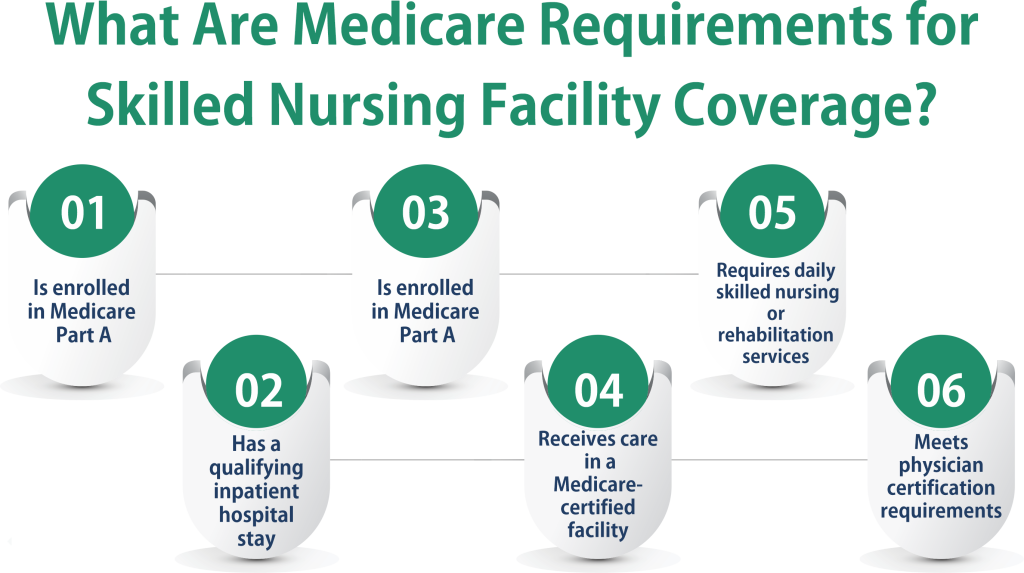
In most cases, Medicare will cover skilled nursing facility services when a patient:
- Is enrolled in Medicare Part A
- Has a qualifying inpatient hospital stay
- Requires daily skilled nursing or rehabilitation services
- Receives care in a Medicare-certified facility
- Needs treatment related to their hospital condition
- Meets physician certification requirements
Failing to meet even one of these requirements may result in denied coverage or unexpected out-of-pocket expenses.
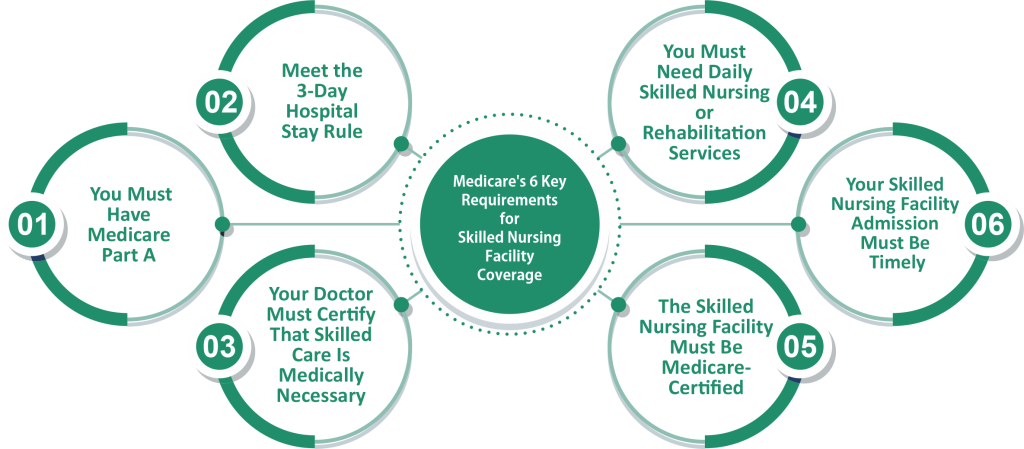
Medicare’s 6 Key Requirements for Skilled Nursing Facility Coverage
Medicare coverage for skilled nursing facilities is based on medical necessity rather than personal preference. The following requirements determine whether Medicare Part A will pay for your stay.
Requirement #1: You Must Have Medicare Part A
Medicare Part A is the portion of Medicare that covers inpatient hospital care, hospice care, and eligible skilled nursing facility services.
Most individuals qualify for premium-free Part A if they or their spouse have worked and paid Medicare taxes for at least 10 years. Without active Part A coverage, Medicare benefits for skilled nursing facility care generally will not apply.
Before planning an SNF stay, verify that your Medicare Part A coverage is active and in good standing.
Requirement #2: Meet the 3-Day Hospital Stay Rule
One of the most important Medicare requirements is the qualifying inpatient hospital stay rule.
Typically, Medicare requires you to spend at least three consecutive days as an admitted inpatient in a hospital before being transferred to a skilled nursing facility. The day of discharge does not count toward the three-day requirement.
A common mistake occurs when patients are placed under observation status rather than formally admitted as inpatients. Even if you stay overnight for several days, observation status generally does not satisfy Medicare’s hospital stay requirement.
Because of this rule, it’s important to confirm your hospital admission status before discharge to avoid coverage issues later.
Requirement #3: Your Doctor Must Certify That Skilled Care Is Medically Necessary
Medicare does not cover a skilled nursing facility stay simply because additional assistance is needed after leaving the hospital. A physician must determine that skilled nursing care or rehabilitation services are medically necessary for your recovery.
This certification confirms that your condition requires professional medical treatment that can only be provided by licensed healthcare personnel.
Examples of medically necessary skilled care include:
- Physical therapy after joint replacement surgery
- Speech therapy following a stroke
- Complex wound treatment
- Intravenous medication administration
- Monitoring serious medical conditions
If your care primarily involves help with daily activities rather than medical treatment, Medicare may not provide coverage.
Requirement #4: You Must Need Daily Skilled Nursing or Rehabilitation Services
To qualify for Medicare coverage, the services you receive must be considered skilled and typically required on a daily basis.
Skilled services involve specialized medical knowledge, training, or judgment that cannot be safely provided by non-medical caregivers.
Examples of covered skilled services include:
- Physical therapy to restore mobility
- Occupational therapy to regain daily living skills
- Speech-language therapy
- Wound care management
- Tube feeding management
- Post-surgical rehabilitation
- Skilled nursing assessments
Medicare evaluates whether these services are reasonable and necessary for treating your condition and supporting recovery.
Requirement #5: The Skilled Nursing Facility Must Be Medicare-Certified
Not every nursing facility qualifies for Medicare reimbursement. To receive coverage, you must be admitted to a skilled nursing facility that participates in Medicare and meets federal certification standards.
Medicare-certified facilities are regularly evaluated to ensure they provide quality healthcare services and comply with Medicare regulations.
Before selecting a facility, ask:
- Is the facility Medicare-certified?
- Does it accept Medicare Part A coverage?
- Are there any additional costs not covered by Medicare?
Verifying certification before admission can help prevent unexpected financial responsibilities.
Requirement #6: Your Skilled Nursing Facility Admission Must Be Timely
In most situations, admission to the skilled nursing facility must occur shortly after discharge from the qualifying hospital stay.
Medicare generally expects patients to enter the SNF within a reasonable period after leaving the hospital, usually within 30 days. The skilled care provided must also be related to the condition treated during the hospital stay.
For example, if you were hospitalized for a hip fracture and require rehabilitation afterward, Medicare may cover the SNF stay because the care directly relates to your hospitalization and recovery.
Delaying admission or seeking treatment unrelated to the hospital condition could affect eligibility for coverage.
What Services Does Medicare Cover in a Skilled Nursing Facility?
Once Medicare eligibility requirements are met, beneficiaries may receive coverage for a wide range of medically necessary services designed to support recovery and rehabilitation.
Coverage extends beyond nursing care and includes various treatments, therapies, and facility-related services needed during your stay.
Skilled Nursing Services
Medicare may cover skilled nursing services provided by licensed healthcare professionals, including:
- Medication management
- Intravenous injections and medications
- Wound care treatment
- Monitoring of serious health conditions
- Catheter care
- Post-operative nursing care
These services require professional medical expertise and are often essential during the recovery process.
Rehabilitation Services
Rehabilitation is one of the most common reasons patients qualify for skilled nursing facility coverage.
Covered rehabilitation services may include:
- Physical therapy
- Occupational therapy
- Speech-language pathology services
These therapies help patients restore mobility, regain independence, improve communication skills, and safely return to daily activities.
Additional Covered Services
Medicare coverage may also include several facility-related services while receiving skilled care, such as:
- A semi-private room
- Meals and dietary services
- Medical supplies used during treatment
- Ambulance transportation when medically necessary
- Social and discharge planning services
The exact services covered depend on your individual treatment plan and medical needs.
What Does Medicare Not Cover in a Skilled Nursing Facility?
While Medicare provides valuable coverage for short-term skilled nursing care, it does not pay for every service offered in a facility. Understanding these limitations can help you plan for potential out-of-pocket expenses and avoid unexpected bills.
Long-Term Custodial Care
One of the biggest misconceptions about Medicare is that it covers long-term nursing home care. In reality, Medicare generally does not pay for custodial care when it is the only type of care you need.
Custodial care typically includes assistance with:
- Bathing
- Dressing
- Eating
- Toileting
- Walking
- Personal hygiene
Although these services are important, they do not require skilled medical training and therefore, are not usually covered by Medicare on their own.
Private Rooms and Personal Convenience Items
Medicare may cover a semi-private room during an approved SNF stay, but it generally does not pay for a private room unless it is medically necessary.
Other non-covered expenses may include:
- Telephone charges
- Television services
- Personal comfort items
- Beauty and barber services
- Laundry services for personal clothing
Extended Nursing Home Stays
Medicare coverage is intended for short-term recovery and rehabilitation. Once a patient no longer requires skilled care, Medicare benefits typically end, even if the individual remains in the facility.
For long-term care needs, beneficiaries often rely on:
- Personal savings
- Long-term care insurance
- Medicaid (if eligible)
- Other financial assistance programs
How Long Will Medicare Pay for Skilled Nursing Facility Care?
Medicare Part A provides limited coverage for skilled nursing facility stays during each benefit period. The amount Medicare pays depends on the length of your stay.
Medicare Skilled Nursing Facility Coverage Timeline
| Days in SNF | Medicare Coverage |
| Days 1-20 | Medicare pays 100% of covered costs |
| Days 21-100 | Medicare pays a portion; patient owes a daily coinsurance |
| After Day 100 | Medicare coverage ends |
This coverage applies only if you continue to meet Medicare’s skilled care requirements throughout your stay.
Understanding Medicare Benefit Periods
A benefit period begins the day you are admitted to a hospital or skilled nursing facility and ends when you have not received inpatient hospital or skilled nursing care for 60 consecutive days.
Once a benefit period ends, a new benefit period can begin if you later require qualified care again.
Many beneficiaries mistakenly believe Medicare only provides 100 SNF days during their lifetime. In reality, coverage can renew with each new benefit period if eligibility requirements are met.
Common Reasons Medicare Denies Skilled Nursing Facility Coverage
Even when patients believe they qualify, Medicare claims are sometimes denied. Understanding the most common reasons for denial can help you protect your benefits and avoid costly surprises.
Observation Status Instead of Inpatient Admission:
One of the leading causes of denial occurs when a patient remains under hospital observation rather than being formally admitted as an inpatient.
Because observation days generally do not count toward the three-day hospital requirement, Medicare may refuse SNF coverage after discharge.
Medicare Determines Skilled Care Is No Longer Needed:
Coverage may end if Medicare determines that your condition has improved and no longer requires daily skilled nursing or rehabilitation services.
This does not necessarily mean you are fully recovered. It simply means Medicare believes skilled care is no longer medically necessary.
Incomplete Medical Documentation:
Missing physician certifications, therapy records, or medical necessity documentation can result in denied claims.
Accurate documentation is critical because Medicare relies on these records when reviewing eligibility.
Admission to a Non-Medicare-Certified Facility:
If the facility does not participate in Medicare, your stay may not qualify for reimbursement even if all other requirements are met.
Custodial Care Rather Than Skilled Care:
Medicare coverage is based on medical necessity. If the services provided primarily involve assistance with daily living activities rather than skilled treatment, coverage may be denied.
Exhausted Skilled Nursing Facility Benefits:
Patients who have reached Medicare’s coverage limits within a benefit period may be responsible for all remaining costs once benefits end.
How to Qualify for Medicare Skilled Nursing Facility Coverage Without Problems?
Meeting Medicare’s eligibility requirements is only part of the process. Taking a few proactive steps can help reduce the risk of coverage denials and unexpected expenses.
Step 1: Confirm Your Hospital Admission Status
Before leaving the hospital, verify that you were formally admitted as an inpatient and not placed under observation status.
Ask your healthcare provider:
- Was I admitted as an inpatient?
- Does my stay satisfy Medicare’s requirements for skilled nursing facility coverage?
Clarifying this information early can prevent costly surprises later.
Step 2: Ensure Skilled Care Is Documented
Your medical records should clearly show why skilled nursing or rehabilitation services are necessary.
Work with your healthcare team to ensure documentation includes:
- Physician certifications
- Therapy recommendations
- Treatment plans
- Medical necessity records
Proper documentation plays a major role in Medicare’s coverage decisions.
Step 3: Choose a Medicare-Certified Skilled Nursing Facility
Before admission, confirm that the facility participates in Medicare and is certified to provide covered SNF services.
You should also ask about:
- Coverage limitations
- Daily coinsurance costs
- Services included in your stay
- Additional fees that may not be covered
Step 4: Review Medicare Notices Carefully
During your stay, you may receive notices explaining changes to your Medicare coverage.
Read these documents carefully because they can inform you if:
- Coverage is ending
- Medicare no longer considers skilled care necessary
- You may become responsible for certain costs
Responding promptly can help you understand your options and avoid unexpected charges.
Step 5: Know Your Appeal Rights
If Medicare denies coverage or ends benefits sooner than expected, you have the right to appeal.
An appeal allows you to request a review of Medicare’s decision and provide additional evidence supporting your need for skilled care.
Many beneficiaries successfully challenge denials when proper medical documentation supports continued treatment.
Medicare Advantage vs. Original Medicare for Skilled Nursing Facilities
If you receive Medicare benefits through a Medicare Advantage plan, your coverage rules may differ from those under Original Medicare.
Understanding these differences can help you avoid confusion when planning post-hospital care.
Original Medicare Coverage Rules
Original Medicare generally follows standard federal eligibility requirements for skilled nursing facility coverage, including:
- Medicare Part A enrollment
- Qualifying hospital stay requirements
- Medical necessity standards
- Medicare-certified facility requirements
Coverage periods and cost-sharing rules are largely standardized across beneficiaries.
Medicare Advantage Coverage Differences
Medicare Advantage plans must provide at least the same level of coverage as Original Medicare, but they may have additional rules and procedures.
Depending on the plan, you may encounter:
- Prior authorization requirements
- Network restrictions
- Referral requirements
- Different cost-sharing structures
These requirements can affect how quickly you access skilled nursing facility services.
Network Restrictions
Many Medicare Advantage plans require members to use in-network providers and facilities.
Choosing an out-of-network skilled nursing facility could result in:
- Higher costs
- Reduced coverage
- Coverage denials in some situations
Always verify network participation before selecting a facility.
Prior Authorization Requirements
Some Medicare Advantage plans require approval before skilled nursing facility services begin.
Failing to obtain prior authorization when required could delay care or impact coverage.
Contact your plan provider before admission to understand any approval requirements and avoid unnecessary complications.
Closing Note
Medicare can help cover the cost of skilled nursing facility care, but only when specific eligibility requirements are met. Beneficiaries typically need Medicare Part A coverage, a qualifying inpatient hospital stay, medically necessary skilled care, and treatment in a Medicare-certified facility.
Understanding these rules before discharge can help you avoid denied claims, unexpected expenses, and interruptions in care. By verifying your eligibility, reviewing hospital records, and choosing the right facility, you can make the most of your Medicare benefits while focusing on recovery and rehabilitation.