
Keeping your CAQH profile accurate is one of the most important responsibilities for healthcare providers participating in insurance networks. Whether you’re a physician, nurse practitioner, physician assistant, therapist, or practice administrator, failing to maintain an active CAQH profile can delay credentialing, postpone provider enrollment, and impact reimbursements.
So, how often do you need to re-attest your CAQH profile?
The short answer is every 120 days. Even if none of your professional information has changed, CAQH requires providers to review their profile and confirm that all information is accurate. This process, known as re-attestation, ensures insurance payers have access to current provider information during credentialing and network participation.
While re-attestation usually takes only a few minutes, overlooking the deadline can create unnecessary administrative delays and slow the credentialing process.
In this guide, we’ll explain:
- How often CAQH re-attestation is required
- Why it matters for provider credentialing
- What happens if you miss the deadline
- How to complete re-attestation correctly
- Best practices to keep your CAQH profile up to date
Whether you manage your own credentialing or work with a professional credentialing partner like Dr Credentialing, understanding the re-attestation process can help keep your practice running smoothly and minimize interruptions in payer enrollment.
What Is CAQH Re-Attestation?
Before discussing the timeline, it’s helpful to understand what CAQH re-attestation actually means.
The Council for Affordable Quality Healthcare (CAQH) created the CAQH Provider Data Portal (formerly CAQH ProView) as a centralized database where healthcare providers maintain their professional information. Rather than completing separate credentialing forms for every insurance company, providers enter their information once and authorize participating payers to access it.
Your CAQH profile typically includes:
- Personal information
- National Provider Identifier (NPI)
- Medical licenses
- DEA registration
- Board certifications
- Education and training
- Employment history
- Hospital privileges
- Professional liability insurance
- Practice locations
- Specialty information
Because provider information changes over time, CAQH requires providers to periodically verify that everything remains accurate.
This verification process is called re-attestation.
Unlike updating your profile, re-attestation is simply your confirmation that the information currently stored in your account is complete and accurate. If something has changed, you’ll need to update the relevant section before submitting your attestation.
Think of re-attestation as a routine “health check” for your credentialing profile. Even when nothing has changed, CAQH still requires you to confirm the accuracy of your information so participating payers can rely on it during credentialing and provider enrollment.
How Often Do You Need to Re-Attest Your CAQH Profile?
Healthcare providers must re-attest their CAQH profile every 120 days.
This requirement applies regardless of whether you’ve updated any information since your last attestation. The purpose is to ensure your professional data remains current and trustworthy for insurance companies, hospitals, and healthcare organizations that rely on CAQH during credentialing.
Quick Answer
| Requirement | Details |
| Re-attestation frequency | Every 120 days |
| Required if nothing changed? | Yes |
| Average completion time | 5–20 minutes |
| Reminder emails | Yes, CAQH generally sends reminders before the deadline |
| Can you re-attest early? | Yes |
Many providers mistakenly believe they only need to log in when renewing a license or changing practice information. In reality, every provider with an active CAQH profile should review and re-attest every 120 days, even if all information remains unchanged.
Completing this simple task helps ensure your profile remains available to participating payers reviewing your credentialing or enrollment applications.
Can You Re-Attest Before the Deadline?
Yes.
You don’t have to wait until the 120th day. If you recently updated your profile—for example, after renewing your medical license or changing malpractice insurance—you can complete your re-attestation immediately.
Many credentialing specialists recommend completing the process as soon as you receive a reminder rather than waiting until the last minute. This reduces the risk of missing the deadline due to vacations, staffing changes, or unexpected administrative workload.
Why Does CAQH Require Re-Attestation?
Many providers wonder why CAQH asks them to confirm the same information every four months.
The answer is simple: healthcare credentialing depends on accurate provider data.
Insurance companies use your CAQH profile when evaluating provider enrollment applications, credentialing requests, and network participation. Outdated information can create delays or require additional verification before an application can move forward.
Regular re-attestation helps achieve several important goals.
Maintains Accurate Provider Information
Licenses expire.
Malpractice policies renew.
Practice addresses change.
Hospital privileges are updated.
By requiring providers to review their profiles every 120 days, CAQH helps ensure participating organizations access the most current information available.
Supports Faster Credentialing
Incomplete or outdated provider data often leads to additional document requests and manual verification.
An actively maintained CAQH profile can streamline credentialing because many participating payers rely on the information you’ve already verified.
Reduces Administrative Burden
Instead of submitting updated documents separately to multiple insurance companies, providers can maintain one centralized profile that authorized organizations can access.
This saves time for both healthcare providers and credentialing departments.
Improves Compliance
Healthcare organizations are expected to verify provider qualifications before granting network participation or clinical privileges.
Routine re-attestation supports compliance by confirming that your professional credentials remain accurate and current.
Builds Trust with Insurance Payers
Insurance companies rely on CAQH as a trusted source of provider information.
A consistently maintained profile demonstrates professionalism and helps reduce unnecessary follow-up requests during credentialing reviews.
Ultimately, re-attestation isn’t simply another administrative task—it’s an important part of maintaining an accurate professional record that supports efficient credentialing, provider enrollment, and uninterrupted participation in payer networks.
What Happens If You Miss Your CAQH Re-Attestation Deadline?
Missing your CAQH re-attestation deadline doesn’t permanently delete your profile, but it can create unnecessary roadblocks during the credentialing and provider enrollment process.
Once your profile becomes inactive, participating insurance payers may be unable to verify your most current information. Depending on where you are in the credentialing lifecycle, this can delay application reviews, slow payer approvals, and postpone reimbursements.
Although each payer follows its own credentialing policies, maintaining an active CAQH profile helps avoid preventable administrative delays.
Potential Consequences of Missing Your Re-Attestation
| Issue | Potential Impact on Your Practice |
| Inactive CAQH profile | Payers may be unable to access verified provider information. |
| Credentialing delays | Insurance applications may require additional follow-up or documentation. |
| Provider enrollment delays | Joining new insurance networks may take longer than expected. |
| Claims reimbursement delays | Billing may be affected if enrollment is incomplete. |
| Additional administrative work | Staff may need to update documents, respond to payer requests, or resubmit information. |
| Slower onboarding | Newly hired providers may experience delays before seeing insured patients. |
For independent providers and growing medical practices, even a short credentialing delay can affect scheduling, patient access, and cash flow. Staying ahead of your re-attestation schedule helps reduce these avoidable disruptions.
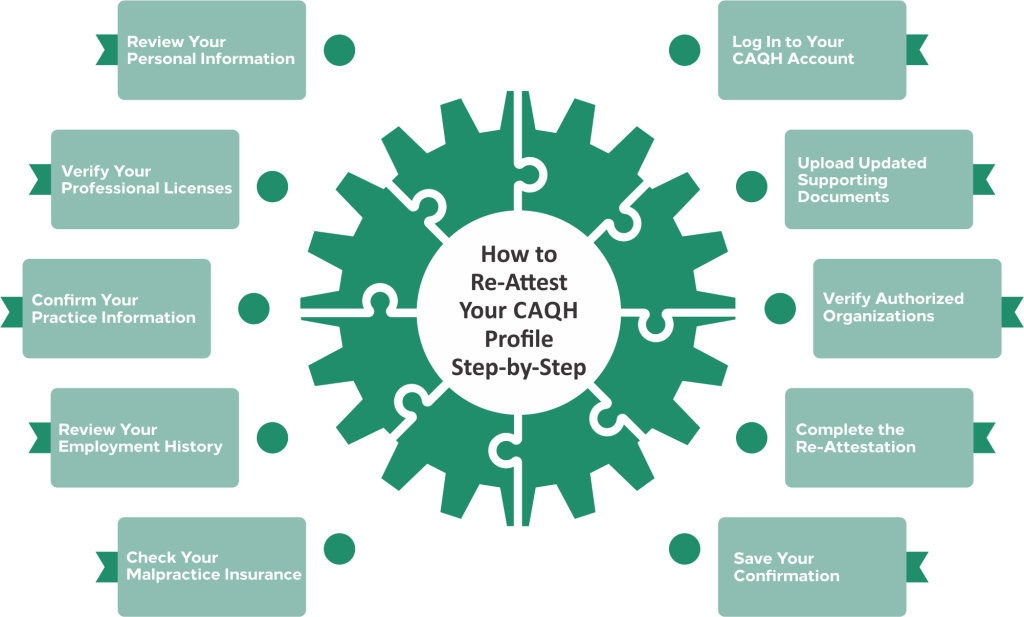
How to Re-Attest Your CAQH Profile: Step-by-Step
The good news is that re-attesting your CAQH profile is typically a quick process. If your information is already current, most providers can complete it in 5 to 20 minutes.
Follow these steps to ensure your profile remains accurate and accessible to participating payers.
Step 1: Log In to Your CAQH Account
Access your CAQH Provider Data Portal using your existing credentials.
If you’ve forgotten your username or password, recover your account before your re-attestation deadline to avoid last-minute delays.
Step 2: Review Your Personal Information
Verify that your:
- Legal name
- Contact information
- Email address
- Phone number
- National Provider Identifier (NPI)
are all accurate and up to date.
Even a simple typo can create communication issues during credentialing.
Step 3: Verify Your Professional Licenses
Carefully review:
- State medical licenses
- License expiration dates
- DEA registration
- Controlled substance registrations (where applicable)
Renew any expired credentials before submitting your attestation.
Step 4: Confirm Your Practice Information
Review details such as:
- Practice name
- Office locations
- Mailing address
- Phone numbers
- Fax numbers
- Group affiliations
Insurance companies frequently rely on this information when processing provider enrollment applications.
Step 5: Review Your Employment History
Make sure your professional work history is complete and accurate.
Pay special attention to:
- Employment dates
- Practice names
- Gaps in employment
- Current affiliations
Incomplete employment history is one of the most common causes of credentialing follow-up requests.
Step 6: Check Your Malpractice Insurance
Confirm that your professional liability insurance information includes:
- Current carrier
- Policy number
- Effective dates
- Expiration date
- Coverage limits
If your malpractice policy has renewed, upload the updated certificate before completing your attestation.
Step 7: Upload Updated Supporting Documents
Review all uploaded documents and replace any that have expired.
Common documents include:
- Medical licenses
- DEA certificate
- Board certifications
- Malpractice insurance certificate
- Government-issued identification
- Specialty certifications
Keeping these documents current can help reduce delays when payers review your profile.
Step 8: Verify Authorized Organizations
CAQH allows you to authorize participating insurance companies and healthcare organizations to access your profile.
Review this list periodically to ensure the appropriate payers can view your credentialing information.
Step 9: Complete the Re-Attestation
After reviewing every section, confirm that your information is complete and accurate.
Submit your electronic attestation.
If any information changed during your review, ensure those updates are saved before completing the process.
Step 10: Save Your Confirmation
After submitting your attestation, save or print the confirmation for your records.
Keeping documentation of completed re-attestations can be helpful if questions arise during future credentialing reviews.
What Should You Review Before Re-Attesting?
Rather than simply clicking “Submit,” take a few extra minutes to verify that every section of your CAQH profile reflects your current professional status.
Use this checklist before each re-attestation.
CAQH Re-Attestation Checklist
✔ Medical license is active
✔ DEA registration is current
✔ Board certifications are up to date
✔ Malpractice insurance has not expired
✔ Practice address is accurate
✔ Contact information is current
✔ Hospital privileges are updated
✔ Employment history is complete
✔ Education information is accurate
✔ Practice affiliations are correct
✔ Specialty information reflects your current services
✔ Recently renewed documents have been uploaded
Completing this review can reduce credentialing delays and minimize requests for additional documentation from insurance payers.
Common CAQH Re-Attestation Mistakes to Avoid
Even experienced providers occasionally make simple mistakes that slow the credentialing process.
Here are some of the most common issues—and how to avoid them.
| Common Mistake | Why It Matters | Best Practice |
| Missing the 120-day deadline | Your profile may become inactive for participating payers. | Set calendar reminders well before the due date. |
| Forgetting to upload renewed documents | Expired licenses or insurance certificates may delay credentialing reviews. | Update documents immediately after renewal. |
| Incorrect employment history | Verification requests may take longer. | Review employment dates and practice affiliations carefully. |
| Outdated practice information | Payers may receive inaccurate provider information. | Update address, phone numbers, and office locations as soon as changes occur. |
| Ignoring reminder emails | Missing notifications increases the chance of late re-attestation. | Whitelist CAQH emails and create backup reminders. |
| Assuming “nothing changed” means no action is required | Re-attestation is still required every 120 days. | Log in and complete the attestation even if your information remains the same. |
Most of these issues are easy to prevent with a consistent credentialing workflow and routine profile maintenance.
Best Practices for Keeping Your CAQH Profile Current
Rather than treating CAQH as a task every four months, successful practices maintain their provider profiles throughout the year.
Here are several best practices that can help streamline future re-attestations.
Review Your Profile Monthly
A quick monthly review makes it easier to identify changes before your next attestation deadline.
Update Information Immediately
Whenever you renew a license, change practice locations, update malpractice coverage, or join a new organization, update your CAQH profile as soon as possible instead of waiting until your next re-attestation.
Monitor Document Expiration Dates
Keep a spreadsheet or credentialing calendar that tracks expiration dates for:
- Medical licenses
- DEA registration
- Board certifications
- Professional liability insurance
- State-controlled substance registrations
This proactive approach helps prevent expired documents from delaying credentialing.
Keep Digital Copies of Important Documents
Maintain organized electronic copies of all credentialing documents so they can be uploaded quickly whenever updates are required.
Use Multiple Reminder Systems
Don’t rely solely on CAQH reminder emails.
Many practices use:
- Outlook reminders
- Google Calendar notifications
- Credentialing software
- Task management platforms
Multiple reminders reduce the likelihood of missing the 120-day deadline.
Consider Professional Credentialing Support
As your practice grows, managing provider enrollment, payer credentialing, and CAQH maintenance becomes increasingly complex.
Working with an experienced credentialing partner can help ensure deadlines are met, profiles remain compliant, and providers stay focused on delivering patient care rather than managing administrative paperwork.
CAQH Re-Attestation vs. Provider Credentialing vs. Recredentialing
Although these terms are often used interchangeably, they serve different purposes in the provider enrollment process.
| Process | Purpose | Frequency |
| CAQH Re-Attestation | Confirms your CAQH profile is accurate and up to date. | Every 120 days |
| Provider Credentialing | Verifies your qualifications before joining an insurance network. | Initial enrollment (and when required) |
| Recredentialing | Reassesses your credentials to maintain participation with insurance payers. | Typically every 2–3 years, depending on the payer |
Understanding these differences helps providers stay compliant and avoid unnecessary delays throughout the credentialing lifecycle.
How Dr Credentialing Can Help
Managing CAQH profiles alongside provider enrollment, payer applications, and credentialing deadlines can quickly become overwhelming—especially for growing practices.
At Dr Credentialing, we help healthcare providers simplify the process by:
- Monitoring CAQH re-attestation deadlines
- Updating provider profiles accurately
- Managing payer enrollment applications
- Tracking credential expiration dates
- Resolving credentialing issues proactively
- Supporting ongoing compliance with insurance payer requirements
Whether you’re an independent provider or a multi-specialty practice, our team works to keep your credentialing process organized so you can focus on delivering quality patient care.
Conclusion
Re-attesting your CAQH profile every 120 days is a simple but essential step in maintaining an active provider profile. Regular re-attestation helps ensure your information remains accurate, supports smoother credentialing and payer enrollment, and reduces the risk of avoidable administrative delays.
By reviewing your profile regularly, updating documents promptly, and staying ahead of deadlines, you can keep the credentialing process moving efficiently. If managing CAQH alongside other administrative responsibilities becomes challenging, partnering with an experienced credentialing team like Dr Credentialing can help you stay compliant while allowing you to focus on what matters most—providing exceptional patient care.
Frequently Asked Questions
Can I re-attest my CAQH profile before the 120-day deadline?
Yes. You can re-attest at any time after reviewing and updating your information. Many providers complete the process as soon as they receive a reminder.
What happens if nothing has changed?
You must still log in and complete the re-attestation. This confirms that your existing information remains accurate.
How long does CAQH re-attestation take?
If your profile is already up to date, re-attestation usually takes 5 to 20 minutes.
Does CAQH send reminder emails?
Yes. CAQH typically sends reminder emails before your attestation is due. However, it’s wise to set your own reminders as a backup.
Can someone else manage my CAQH profile?
Yes. Many healthcare organizations authorize credentialing specialists or third-party credentialing companies to assist with CAQH profile management while maintaining appropriate permissions.