
Every denied claim tells the same frustrating story for healthcare providers: services were delivered, patients were treated, but reimbursement never arrived because of a credentialing issue. Whether it’s a provider not enrolled rejection, a CO-16 denial code, or delays caused by pending enrollment, credentialing-related claim denials can quietly drain thousands of dollars from your practice’s revenue cycle.
The good news is that many of these denials are not permanent losses. With the right appeal strategy, retroactive effective date requests, claims reprocessing workflows, and timely filing management, providers can often recover a significant portion of unpaid revenue.
In this guide, you’ll learn exactly how to identify credentialing claim denials, write effective credentialing appeal letters, navigate backdated enrollment issues, and maximize reimbursement before filing deadlines expire.
What Are Credentialing Claim Denials?
Credentialing claim denials occur when insurance payers refuse reimbursement because a provider’s enrollment or credentialing information is incomplete, inactive, mismatched, or missing from the payer’s system. These denials are administrative, but their financial impact can be just as damaging as clinical claim denials.
In many cases, providers deliver services assuming enrollment is complete, only to discover later that the payer never finalized the credentialing process. As a result, claims are denied, rejected, or placed into pending status until the enrollment issue is resolved. Unfortunately, many practices fail to appeal these denials correctly, leading to unnecessary revenue loss.
It’s also important to understand the difference between a claim rejection and a claim denial:
- Claim Rejection: The claim never enters adjudication because of missing or invalid information.
- Claim Denial: The claim is processed but payment is refused due to enrollment, credentialing, or policy-related issues.
Some of the most common credentialing claim denials include:
- Provider not enrolled rejection
- Pending payer enrollment
- Group linkage errors
- Invalid or mismatched NPI
- Taxonomy inconsistencies
- Credentialing effective date conflicts
- Missing provider contracts
Most insurance payers use automated systems that verify provider enrollment before processing claims. If the provider’s information does not match the payer’s credentialing database exactly, reimbursement can be delayed or denied immediately.
Most Common Causes of Credentialing-Related Claim Denials
Understanding why credentialing denials happen is the first step toward preventing them. While every payer has different enrollment requirements, several credentialing issues consistently trigger denials across Medicare, Medicaid, and commercial insurance plans.
Provider Not Enrolled Rejection
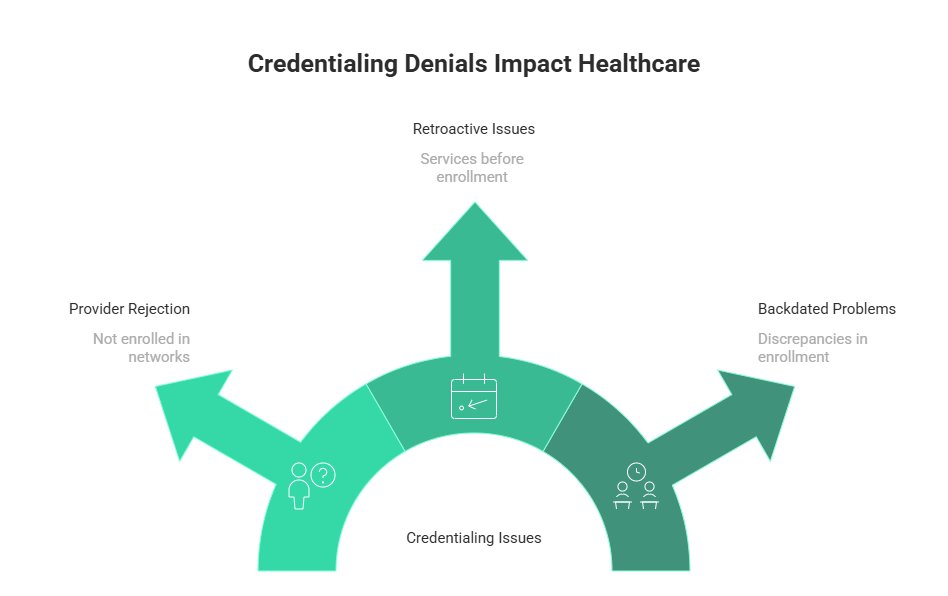
A provider not enrolled rejection happens when the insurance payer cannot locate an active enrollment record for the billing or rendering provider. This is one of the most common and costly credentialing-related claim denials in medical billing.
These rejections usually occur because:
- Enrollment applications are still pending
- Group affiliation was never linked correctly
- The payer has outdated provider records
- CAQH information was incomplete
- Medicare PECOS enrollment was not finalized
- The provider’s effective date has not started yet
Many practices assume that credentialing approval automatically activates billing privileges, but that is not always true. In some cases, providers may be credentialed but not fully enrolled for claims payment.
It’s also critical to distinguish between:
- Individual Enrollment: The provider is enrolled independently
- Group Enrollment: The provider is linked to a group practice
- Facility Enrollment: Billing occurs under a facility or organization
A mismatch between any of these enrollment structures can easily trigger denials or rejections.
Retroactive Effective Date Issues
A retroactive effective date allows insurance payers to activate a provider’s enrollment starting from a prior date rather than the official approval date. This can be extremely valuable when providers deliver services during enrollment delays.
For example, if a payer approves enrollment on June 1 but grants a retroactive effective date of April 1, claims submitted for services after April 1 may still become payable through claims reprocessing.
Retroactive approvals are often granted when:
- Credentialing applications were submitted on time
- Delays occurred on the payer side
- Supporting documentation proves eligibility
- The provider met all participation requirements earlier
However, payer rules vary significantly. Medicare may allow certain retroactive enrollment periods, while commercial payers often have stricter policies.
Many providers miss revenue recovery opportunities simply because they never request retroactive consideration during the appeal process.
Backdated Enrollment Problems
Although often confused with retroactive effective dates, backdated enrollment typically refers to requests made after credentialing delays have already caused claim denials.
Backdated enrollment requests are usually necessary when:
- Enrollment applications were delayed internally
- Providers began seeing patients before approval
- Administrative errors postponed payer processing
- Group affiliations were added late
Some payers may approve limited backdating under special circumstances, especially if documentation proves that credentialing was initiated before services were rendered.
Still, practices should understand that backdated enrollment approvals are never guaranteed. The longer enrollment delays continue, the greater the risk of hitting the payer’s timely filing limit and losing reimbursement permanently.
CO-16 Denial Code and Credentialing Errors
The CO-16 denial code is one of the most frequently misunderstood denial codes in medical billing. It generally indicates that a claim is missing information, contains incorrect details, or requires additional documentation before payment can be processed.
In credentialing-related cases, CO-16 denials commonly appear when:
- The provider is not enrolled with the payer
- Enrollment records are incomplete
- NPI or taxonomy information does not match
- Group affiliations are missing
- Credentialing effective dates are invalid
- Provider records are still pending activation
Because CO-16 is considered a broad administrative denial code, many billing teams mistakenly focus only on correcting the claim itself rather than investigating the underlying credentialing issue.
To resolve a credentialing-related CO-16 denial effectively:
- Review the ERA or EOB carefully
- Identify any accompanying RARC codes
- Verify provider enrollment status with the payer
- Confirm NPI, taxonomy, and group linkage accuracy
- Gather credentialing approval documentation
- Submit a corrected claim or formal appeal
- Request claims reprocessing after enrollment confirmation
One of the biggest mistakes practices make is resubmitting denied claims repeatedly without fixing the enrollment problem first. This only increases delays and may eventually push claims beyond the timely filing limit.
How Credentialing Denials Impact Revenue Cycle Management
Credentialing-related claim denials do far more than delay a single payment. They create a ripple effect across the entire revenue cycle, increasing administrative costs, slowing cash flow, and placing unnecessary pressure on billing teams. For many healthcare organizations, unresolved credentialing issues become one of the largest sources of preventable revenue leakage.
When claims are denied because a provider is not enrolled or credentialing records are incomplete, accounts receivable begin to pile up quickly. Billing staff must spend additional time investigating denials, contacting payers, resubmitting claims, and preparing appeals instead of focusing on clean claim submission and payment posting.
Some of the biggest financial consequences of credentialing claim denials include:
- Increased accounts receivable (AR) days
- Delayed reimbursements
- Higher administrative workload
- Increased claim rework costs
- Lost revenue due to the timely filing expiration
- Reduced provider productivity
- Patient billing confusion and dissatisfaction
Even a small enrollment delay can result in thousands of dollars in unpaid claims. For growing practices onboarding new providers, the impact can become even more severe if credentialing timelines are not managed proactively.
How to Appeal Credentialing Claim Denials Successfully?
Many providers assume that credentialing denials are final, but in reality, a large percentage of these claims can be recovered through a structured appeal and claims reprocessing strategy. The key is acting quickly, gathering the right documentation, and understanding whether the issue requires a corrected claim, reconsideration, or formal appeal.
When Should You Appeal vs Resubmit?
Not every denial requires a formal appeal. In some cases, correcting provider information and resubmitting the claim may be enough. In other situations, payers require detailed documentation and a formal credentialing appeal letter before reconsidering payment.
You should generally:
Resubmit or Correct the Claim When:
- Minor provider information is incorrect
- Taxonomy or NPI errors exist
- Group linkage needs updating
- Enrollment approval has already been finalized
Submit a Formal Appeal When:
- Claims were denied due to delayed credentialing
- Retroactive effective date approval is needed
- The payer incorrectly denied an enrolled provider
- Timely filing exceptions must be requested
- Multiple claims require reconsideration
Understanding the difference between a corrected claim and a formal appeal can significantly improve reimbursement timelines and reduce unnecessary denials.
Step-by-Step Credentialing Denial Appeal Process
A successful credentialing denial appeal starts with identifying the exact root cause behind the denial. Simply resubmitting claims without correcting the underlying enrollment issue often leads to repeated rejections.
Follow this step-by-step process to maximize claim recovery:
1. Identify the Exact Denial Reason
Review the ERA, EOB, and denial codes carefully. Determine whether the issue involves enrollment status, provider linkage, credentialing effective dates, or missing documentation.
2. Verify Enrollment Status
Contact the payer directly and confirm:
- Enrollment approval date
- Effective date
- Group affiliation status
- Rendering provider activation
- Contract participation details
3. Gather Supporting Documentation
Collect all relevant records, including:
- Enrollment approval letters
- Credentialing confirmation emails
- CAQH records
- PECOS screenshots
- Provider contracts
- Claim details and EOBs
4. Draft a Credentialing Appeal Letter
Clearly explain:
- Why the denial occurred
- When enrollment was submitted
- Why retroactive consideration is justified
- Which claims should be reprocessed
Include supporting documents with the appeal package.
5. Request Claims Reprocessing
Once enrollment issues are corrected, ask the payer to reopen and reprocess all affected claims tied to the denied dates of service.
6. Track Appeal Status Regularly
Credentialing appeals often require multiple follow-ups. Maintain records of:
- Call reference numbers
- Representative names
- Submission dates
- Reprocessing timelines
7. Escalate If Necessary
If the payer delays resolution or incorrectly refuses reconsideration, escalate the appeal to:
- Provider relations
- Enrollment departments
- Contracting representatives
- Supervisors or grievance teams
The faster they act after identifying a denial, the better their chances of recovering reimbursement before the timely filing limits expire.
How to Write a Credentialing Appeal Letter?
A strong credentialing appeal letter can make the difference between recovered revenue and permanent claim loss. Insurance payers want clear documentation, accurate timelines, and evidence that the provider met enrollment requirements before the denied services were rendered.
An effective appeal letter should remain professional, concise, and fully supported by documentation.
Essential Elements of a Credentialing Appeal Letter
Your appeal should include:
- Provider full name
- NPI and Tax ID number
- Payer name
- Claim numbers
- Dates of service
- Denial reason
- Enrollment submission timeline
- Credentialing approval date
- Retroactive effective date request
- Supporting documentation list
- Request for claims reprocessing
Claims Reprocessing After Credentialing Approval
Once a payer approves enrollment or grants a retroactive effective date, the next critical step is initiating claims reprocessing. Many providers mistakenly believe denied claims will automatically be reopened after credentialing approval, but that rarely happens. In most cases, practices must actively request reconsideration and follow the payer’s reprocessing procedures to recover unpaid revenue.
Claims reprocessing refers to the payer reviewing previously denied claims again after correcting the underlying issue that caused the denial. In credentialing-related cases, this usually happens after:
- Enrollment approval is finalized
- Provider records are updated
- Group affiliations are corrected
- Retroactive effective dates are granted
- Missing documentation is submitted
Without a formal reprocessing request, claims may remain denied indefinitely—even if the credentialing issue has already been resolved.
Claims Reprocessing vs Corrected Claims
Although the terms are often used interchangeably, they are not the same.
Corrected Claims
A corrected claim is typically submitted when:
- Billing information is incorrect
- Modifiers are missing
- NPI or taxonomy details need correction
- Claim data contains errors
Claims Reprocessing
Claims reprocessing occurs when:
- The original denial reason has been resolved
- Enrollment status changes after denial
- Retroactive credentialing approval is granted
- The payer agrees to reopen adjudication
How to Request Claims Reprocessing Successfully?
To improve approval chances, providers should follow a structured reprocessing workflow.
1. Confirm Enrollment Activation
Before requesting reprocessing, verify:
- Effective date
- Participation status
- Group linkage
- Rendering provider setup
Even small enrollment mismatches can trigger repeated denials.
2. Prepare a Reprocessing Request
Your request should include:
- Provider information
- Claim numbers
- Dates of service
- Enrollment approval evidence
- Retroactive effective date details
- Appeal reference numbers if applicable
3. Submit Requests in Batches
If multiple claims were denied due to the same credentialing issue, submit a bulk reprocessing request whenever possible. This can significantly speed up revenue recovery.
4. Monitor Payer Timelines
Claims reprocessing timelines vary by payer. Some may resolve claims within 15–30 days, while others require several review cycles.
5. Escalate Delayed Cases
If claims remain unpaid after reprocessing approval, escalate the issue to provider relations or payer management teams.
Understanding Timely Filing Limits for Credentialing Denials
One of the biggest risks associated with credentialing claim denials is missing the payer’s timely filing limit. Even when providers eventually receive enrollment approval, reimbursement may still be denied permanently if filing deadlines have expired.
Why Timely Filing Limits Matter?
Credentialing delays can consume weeks or even months. During that time:
- Claims may sit in denial status
- Enrollment applications remain pending
- Appeals are delayed
- Revenue recovery windows shrink

If practices wait too long to respond, they risk losing reimbursement even when the provider was ultimately approved.
This is why proactive denial management and early escalation are critical.
Common Timely Filing Deadlines
Although payer rules vary, many filing limits fall within these ranges:
- Medicare: Typically 12 months from date of service
- Medicaid: Varies by state
- Commercial Payers: Often 90–180 days
- Corrected Claims: Usually shorter than the original claim deadlines
- Appeals/Reconsiderations: May range from 30–180 days
Because every payer operates differently, providers should always verify payer-specific filing requirements directly.
Can Timely Filing Limits Be Waived?
In certain situations, payers may grant exceptions when:
- Credentialing delays occurred on the payer side
- Retroactive effective dates were approved
- Enrollment applications were submitted timely
- Supporting documentation proves provider eligibility
However, exceptions are never guaranteed. That’s why practices should maintain detailed credentialing records and track all enrollment communication carefully.
Supporting documents that strengthen filing exception requests include:
- Enrollment submission confirmations
- Credentialing emails
- Approval notices
- Call reference numbers
- Provider contracts
The stronger the documentation trail, the greater the likelihood of obtaining reconsideration beyond normal filing deadlines.
Best Practices to Prevent Credentialing Claim Denials
Preventing credentialing denials is far more effective than appealing them after revenue has already been delayed. While some payer issues are unavoidable, most credentialing-related denials stem from preventable administrative gaps, delayed follow-up, or inaccurate provider data.
By implementing proactive credentialing systems, healthcare organizations can improve clean claim rates, reduce rework, and protect long-term revenue cycle performance.
1. Start Credentialing Early
One of the biggest mistakes practices make is waiting too long to begin payer enrollment. Credentialing should start as early as possible—ideally 90 to 120 days before a provider’s intended start date.
Early enrollment reduces the risk of:
- Provider not enrolled rejections
- Delayed effective dates
- Revenue interruptions
- Claims backlog accumulation
This is especially important for:
- New provider onboarding
- Multi-state enrollments
- Medicare and Medicaid participation
- High-volume commercial payer contracts
The earlier the process begins, the more time practices have to resolve payer delays before claims submission starts.
2. Maintain Accurate CAQH Profiles
Many credentialing denials begin with incomplete or outdated CAQH information. Insurance payers rely heavily on CAQH data to verify provider credentials, education, licenses, and practice information.
Practices should regularly:
- Re-attest CAQH profiles
- Update malpractice insurance
- Verify work history
- Confirm practice locations
- Review taxonomy codes
- Ensure NPI consistency
Even small discrepancies between CAQH records and payer enrollment applications can trigger delays or denials.
3. Monitor Enrollment Status Regularly
Submitting an enrollment application is only the beginning. Practices should actively monitor payer portals and follow up consistently throughout the credentialing process.
Key areas to monitor include:
- Missing documentation requests
- Enrollment pending status
- Effective dates
- Group affiliations
- Contract activation
- Provider roster updates
Frequent follow-up helps identify problems early before claims begin to be denied.
4. Verify Effective Dates Before Billing
Many providers unintentionally submit claims before enrollment becomes active. This often leads to avoidable denials and payment delays.
Before billing services:
- Confirm payer approval
- Verify participation status
- Validate rendering provider activation
- Confirm retroactive effective dates if applicable
A simple, effective date verification process can prevent large batches of denied claims.
5. Conduct Pre-Bill Enrollment Audits
A pre-bill enrollment audit helps identify credentialing risks before claims are submitted.
These audits should verify:
- NPI linkage accuracy
- Taxonomy consistency
- Group enrollment status
- Credentialing approval dates
- Payer participation setup
Practices that perform routine enrollment audits typically experience fewer credentialing denials and faster reimbursement cycles.
Credentialing Denial Prevention Checklist
Even experienced healthcare organizations can overlook small enrollment details that eventually lead to denied claims and delayed reimbursements. A standardized credentialing workflow helps reduce errors, improve claim acceptance rates, and protect revenue before filing deadlines become a problem.
Use the checklist below to proactively prevent credentialing-related claim denials and strengthen your revenue cycle management process.
Credentialing & Enrollment Checklist
Before submitting claims, confirm that all of the following steps have been completed:
- Verify payer enrollment approval for each provider
- Confirm individual and group enrollment activation
- Review credentialing effective dates carefully
- Validate NPI and taxonomy code accuracy
- Ensure CAQH profiles are updated and attested
- Confirm provider contracts are active
- Check payer portal enrollment status regularly
- Verify rendering and billing provider linkage
- Monitor Medicare PECOS enrollment status
- Maintain copies of approval letters and confirmations
- Submit claims only after the effective dates begin
- Track all payer communication and reference numbers
- Monitor denied claims immediately after submission
- Review ERA and EOB denial codes promptly
- Follow up on pending credentialing applications consistently
- Track payer-specific timely filing limits
- Submit appeals before reconsideration deadlines expire
- Request claims reprocessing after enrollment approval
- Conduct routine pre-bill enrollment audits
A structured checklist like this helps practices reduce preventable denials while improving operational efficiency and reimbursement turnaround times.
Final Thoughts
From resolving provider not enrolled rejections to requesting retroactive effective dates and handling CO-16 denial codes, successful revenue recovery depends on understanding payer enrollment workflows and staying proactive throughout the credentialing process. Practices that monitor enrollment status closely, track filing deadlines carefully, and escalate denials early are far more likely to recover lost reimbursement successfully.
For healthcare organizations looking to reduce credentialing denials, improve payer enrollment efficiency, and strengthen revenue cycle performance, working with experienced credentialing specialists can make a significant difference.
For expert support with provider enrollment, denial management, and claims recovery services, visit DR Credentialing