
In today’s healthcare environment, providers often assume their insurance participation status is secure once credentialing is completed. Unfortunately, that is not always the case. Many physicians, clinics, and healthcare organizations suddenly discover they are listed as out-of-network (OON) by insurance payers — often after claims begin getting denied or patients start receiving unexpected bills.
Unexpected out-of-network status can create serious financial and operational problems for medical practices. It can lead to delayed reimbursements, increased claim denials, patient dissatisfaction, compliance concerns, and revenue loss.
At Dr Credentialing, we help healthcare providers stay ahead of credentialing, payer enrollment, and recredentialing issues that commonly trigger unexpected out-of-network status.
This guide explains:
- Why providers suddenly become out-of-network
- The most common credentialing and payer enrollment mistakes
- How out-of-network claim denials happen
- Steps providers can take to prevent revenue disruption
What Does Out-of-Network Status Mean?
A provider is considered out-of-network when they do not have an active participation agreement with a payer for a specific health plan or product.
This may happen because:
- The provider was never fully credentialed
- The payer contract expired
- Recredentialing deadlines were missed
- Provider information was not updated correctly
- The insurance company terminated participation
When providers unexpectedly become out-of-network, insurance claims may process at reduced reimbursement rates or get denied entirely.
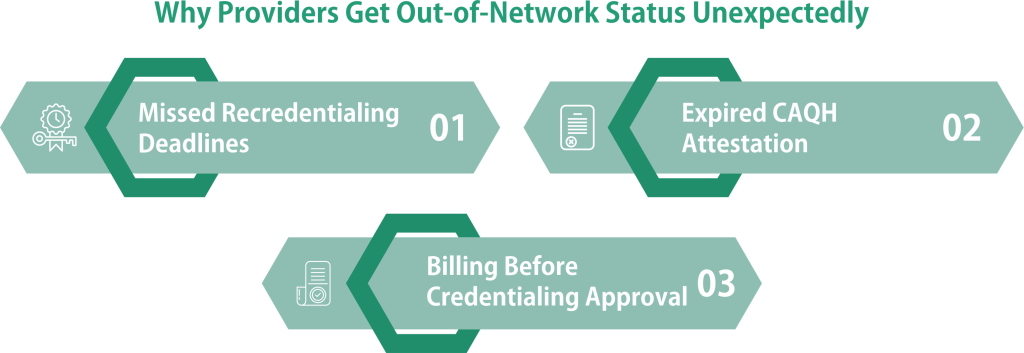
Why Providers Get Out-of-Network Status Unexpectedly
1. Missed Recredentialing Deadlines
One of the most common reasons providers lose in-network participation is failure to complete recredentialing on time.
Most insurance payers require providers to:
- Recredential every 2–3 years
- Submit updated documentation
- Verify licenses and certifications
- Maintain active malpractice coverage
If recredentialing documents are delayed or incomplete, payers may terminate network participation automatically.
Common Recredentialing Issues
- Expired malpractice insurance
- Missing board certifications
- Delayed payer responses
- Incomplete applications
- Missed payer notifications
Many providers do not realize they are out-of-network until denied claims begin appearing weeks later.
2. Expired CAQH Attestation
The CAQH profile is essential for provider enrollment and credentialing.
Providers must regularly:
- Update practice information
- Upload required documents
- Re-attest their profile every 120 days
If CAQH attestation expires, payers may:
- Suspend credentialing reviews
- Delay enrollment updates
- Mark providers inactive
- Remove providers from network directories
An outdated CAQH profile is one of the leading causes of provider enrollment gaps.
3. Billing Before Credentialing Approval
Many practices begin seeing patients before receiving the official payer effective date.
This creates major problems because:
- Claims may process as non-participating
- Reimbursement rates may be reduced
- Retroactive approvals are not always guaranteed
- Patients may receive out-of-network bills
Even if the provider submitted enrollment paperwork months earlier, claims can still deny if credentialing approval is incomplete.
Important Tip
Always verify:
- Effective participation date
- Network status
- Linked tax ID
- Group association before billing services.
Provider Enrollment Errors That Cause Out-of-Network Status
1. Incorrect NPI, Tax ID, or Practice Information
Small provider data errors can trigger large reimbursement issues.
Common mistakes include:
- Wrong billing address
- Incorrect taxonomy code
- Invalid group association
- Mismatched TIN/NPI combinations
- Outdated location information
If payer records do not match the claim exactly, providers may appear out-of-network even when contracts exist.
2. Insurance Network Product Confusion
Many providers participate with:
- PPO plans
- HMO networks
- Marketplace products
- Medicare Advantage plans
- Medicaid managed care plans
However, being in-network for one product does not guarantee participation across all plans.
A provider may unknowingly be:
- In-network for PPO
- Out-of-network for HMO
- Excluded from narrow network products
This is a growing issue as insurers continue expanding limited and tiered provider networks.
3. Contract Termination or Network Narrowing
Insurance companies periodically:
- Reduce provider panels
- Modify network participation
- Terminate inactive providers
- Restructure geographic coverage
Sometimes providers miss these notices because:
- Emails go to old addresses
- Staff turnover interrupts communication
- Portal notifications are ignored
As a result, practices discover network termination only after claims are rejected.
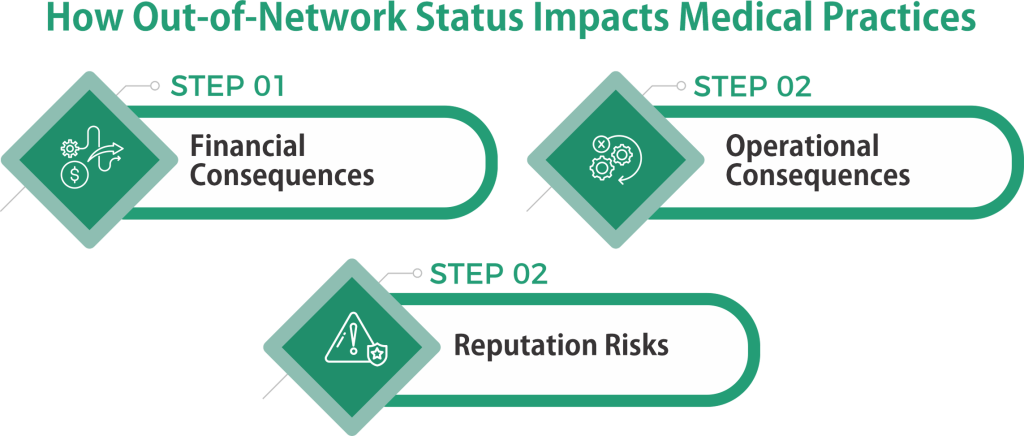
How Out-of-Network Status Impacts Medical Practices
Unexpected out-of-network status affects more than reimbursement alone.
Financial Consequences
- Increased claim denials
- Lower reimbursement rates
- Delayed payments
- Patient balance disputes
- Revenue cycle disruption
Operational Consequences
- Increased administrative workload
- Appeals and resubmissions
- Credentialing delays
- Patient scheduling confusion
Reputation Risks
Patients often blame providers when insurance issues occur, even if the payer caused the problem.
This can damage:
- Patient satisfaction
- Online reviews
- Referral relationships
- Provider trust
Warning Signs a Provider May Become Out-of-Network
Healthcare organizations should monitor for early indicators such as:
- Sudden increase in claim denials
- Payer requests for updated documents
- Expired malpractice insurance
- CAQH reminder emails
- Missing EFT payments
- Provider directory inaccuracies
- Rejected eligibility checks
- Delayed payer responses
Ignoring these signs can result in significant revenue loss.
How to Prevent Unexpected Out-of-Network Status
Maintain Continuous Credentialing Monitoring
Credentialing is not a one-time process.
Practices should:
- Track recredentialing deadlines
- Monitor payer communications
- Verify participation annually
- Audit provider directories regularly
Keep CAQH Profiles Updated
Providers should:
- Re-attest every 120 days
- Upload current licenses
- Update malpractice coverage
- Verify practice locations
Consistent CAQH maintenance reduces payer enrollment delays.
Verify Payer Effective Dates Before Billing
Before submitting claims:
- Confirm network approval
- Validate payer effective dates
- Confirm plan participation
- Verify group enrollment
This helps prevent out-of-network claim denials.
Perform Regular Provider Enrollment Audits
Quarterly enrollment audits help identify:
- Inactive payer contracts
- Missing providers
- Incorrect NPIs
- Expired contracts
- Directory listing problems
These audits are essential for large provider groups and multi-location practices.
How Dr Credentialing Helps Providers Stay In-Network
At Dr Credentialing, we help healthcare providers prevent credentialing lapses and unexpected out-of-network status through comprehensive provider enrollment and medical credentialing solutions.
Our services include:
- Provider credentialing
- Insurance enrollment
- CAQH management
- Recredentialing tracking
- Provider roster management
- Payer follow-up
- Medicare and Medicaid enrollment
- Credentialing audits
We work proactively to reduce:
- Out-of-network claim denials
- Enrollment delays
- Revenue interruptions
- Administrative burden
Final Thoughts
Unexpected out-of-network status is one of the most costly problems healthcare providers face. In many cases, the issue is not caused by poor patient care — it is caused by credentialing lapses, enrollment mistakes, payer communication failures, or missed recredentialing deadlines.
Healthcare organizations that actively monitor credentialing, maintain updated CAQH profiles, and verify payer participation regularly are far less likely to experience reimbursement disruption.
Partnering with an experienced credentialing company like Dr Credentialing can help practices maintain continuous payer participation, avoid costly denials, and protect long-term revenue stability.
FAQ
Can a provider suddenly become out-of-network?
Yes. Providers may unexpectedly become out-of-network due to missed recredentialing deadlines, expired CAQH attestations, payer contract terminations, or provider enrollment errors.
What happens if claims are billed before credentialing approval?
Claims may process as out-of-network or deny entirely if the payer effective date has not started.
How often should providers update CAQH?
Providers should re-attest and review their CAQH profile every 120 days.
Why are claims denying as out-of-network when the provider has a contract?
This may occur because of incorrect provider data, inactive enrollment status, plan participation limitations, or payer directory mismatches.
How can providers prevent out-of-network issues?
Regular credentialing audits, CAQH maintenance, payer follow-up, and enrollment monitoring are the best ways to prevent unexpected network termination.