Behavioral health credentialing has become more complex in 2026 due to tighter payer rules, higher claim denial pressure, and increased documentation checks. A common question from providers is: “I’m leaving my group practice, why am I suddenly out-of-network?” Another related concern is: “Why don’t my insurance contracts follow me when I move from group to solo practice?” In most cases, this is not a billing error. It reflects how payer contracts are legally tied to the group Tax ID and credentialed entity, not the individual clinician.
For many behavioral health providers, the issue becomes visible during practice transitions. A therapist leaving a group practice may suddenly find themselves out-of-network because their insurance participation was never held in their individual name. Instead, it was attached to the group’s Tax ID, billing structure, and contracted NPI setup. When they move to solo practice, they must complete a new credentialing and enrollment process under their own practice identity. Even minor mismatches in CAQH data, NPI type, or payer records can delay approval or trigger claim rejections.
Understanding Behavioral Health Credentialing is important because it directly affects reimbursement eligibility and billing continuity. When CAQH profiles, NPI records, and payer enrollment files are not aligned after a practice transition, providers experience delayed payments, claim denials, and temporary loss of in-network status. In 2026, payer systems will apply stricter verification rules, making it essential for providers to complete full re-credentialing when moving from group to solo practice to maintain uninterrupted revenue flow.
Behavioral Health Credentialing Overview and System Flow
Behavioral Health Credentialing defines how providers are verified, enrolled, and approved by payers. It connects identity data, provider records, and billing eligibility within a single workflow.
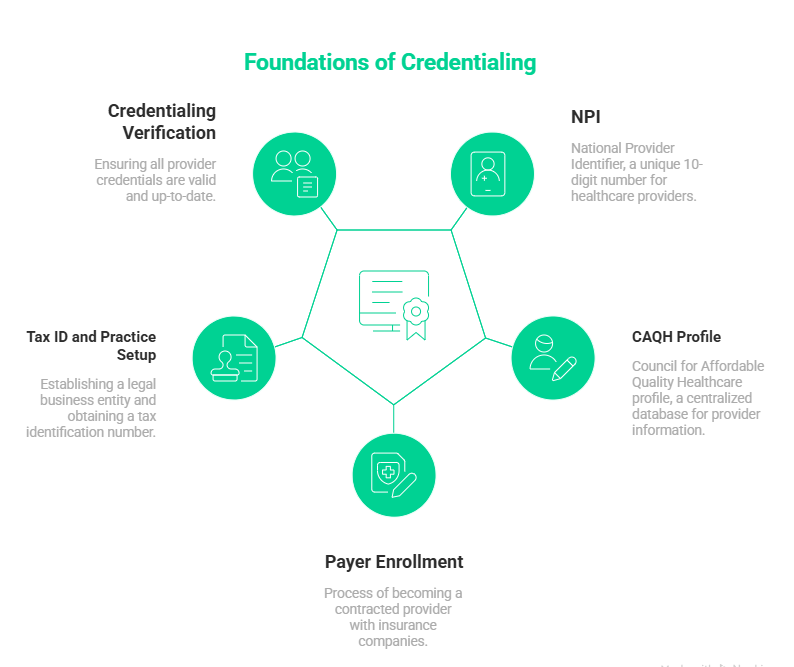
Core Components of Credentialing
Behavioral Health Credentialing depends on multiple systems working together. Each component must match across payer, billing, and provider records.
1. NPI (National Provider Identifier)
- Type 1 NPI identifies the individual provider
- Type 2 NPI for solo practice or group billing entity
- Used in all claim submissions and payer systems
2. CAQH Profile Update
- Centralized provider data used by payers
- Includes license, work history, and practice details
- Must be updated and re-attested regularly
3. Payer Enrollment
- Application submitted to insurance companies
- Determines participation in mental health insurance panels
- Links provider to payer contracts and fee schedules
4. Tax ID (EIN) and Practice Setup
- Required for private practice credentialing for therapists
- Defines the billing entity for reimbursement
- Must align with Type 2 NPI and CAQH data
5. Credentialing Verification
- Payers verify education, license, and background
- Confirms provider eligibility for network inclusion
- Errors or mismatches delay approval
Why Credentialing Impacts Reimbursement
Credentialing determines whether a provider is eligible to receive payment from insurance payers. If credentialing is incomplete or incorrect, claims are either denied or processed as out-of-network.
1. Controls In-Network Status
- Payers only reimburse providers who are approved and linked to a valid contract
- If enrollment is missing, claims are processed at out-of-network rates or rejected
2. Affects Claim Acceptance
Claims must match credentialed data:
- Type 1 NPI (rendering provider)
- Type 2 NPI for solo practice or billing entity
- Tax ID (EIN)
3. Impacts Payment Timelines
- Credentialing delays extend payment cycles
- Providers cannot bill payers until approval is active
- Backdated billing is limited or denied by many payers
4. Linked to CAQH Profile Accuracy
- Payers rely on the CAQH profile update data for verification
- Missing or outdated information delays approval
- Inconsistent records trigger rework and resubmissions
5. Drives Participation in Mental Health Insurance Panels
- Credentialing approval is required to join insurance panels
- Without panel participation, reimbursement options are limited
- Private practice credentialing for therapists depends on timely enrollment
Difference Between Group Practice and Private Credentialing in Behavioral Health Credentialing
This section explains how credentialing differs between group and solo practice setups. It focuses on Tax ID structure, payer contracts, and billing identity changes.
Group Tax ID Credentialing
In group settings, providers are credentialed under the organization’s Tax ID and payer contracts. The group controls enrollment, billing structure, and reimbursement terms. Individual providers are listed as rendering providers, but they do not hold direct contracts with insurance payers.
Claims are submitted using the group’s Type 2 NPI and Tax ID. Payments are issued to the group, not the individual clinician. This setup allows faster onboarding within the group but limits control. When a provider leaves, their credentialing status does not transfer because it belongs to the organization.
Private Practice Credentialing Changes
Private practice credentialing for therapists requires building a new billing identity. The provider must register a new Tax ID (EIN) and obtain a Type 2 NPI for solo practice. These elements define how claims are submitted and how payments are processed.
The provider must also complete a CAQH profile update and apply to mental health insurance panels independently. Each payer requires a separate enrollment application. Approval timelines vary, and billing cannot begin until credentialing is active under the new entity.
Why Providers Become Out-of-Network
Providers become out-of-network because payer contracts are linked to the group’s Tax ID, not the individual provider. When the provider leaves the group, that contract relationship ends. The payer no longer recognizes the provider as in-network under the new practice setup.
In many cases, CAQH and NPI records still reflect the previous group affiliation. This creates mismatches during claim submission. Until new credentialing is completed and approved, claims are denied or processed at out-of-network rates, which delays reimbursement and affects cash flow.
Role of CAQH Profile Update in Behavioral Health Credentialing
The CAQH profile update is a required step in Behavioral Health Credentialing. Payers use CAQH data to verify provider identity, practice setup, and eligibility.
Key CAQH Data Requirements
CAQH stores standardized provider data used during payer enrollment. Each field must match the NPI records, the Tax ID, and the practice details. Any mismatch creates delays in verification and slows approval timelines.
The CAQH profile update must include complete and current information across all sections. Missing or outdated data blocks payer review and prevents progress in credentialing.
a) Personal and professional details:
1. Provider name
2. Date of birth
3. State license information
b) Practice information:
1. Service location
2. Billing address
3. Type 2 NPI for solo practice
c) Work history and credentials:
1. Education and training
2. Employment timeline
d) Supporting documents:
1. Malpractice insurance
2. DEA (if applicable)
Common CAQH Errors
CAQH errors are a frequent cause of credentialing delays. Most issues arise from data mismatches between CAQH, the NPI registry, and payer systems. Even small inconsistencies can stop the review process.
These errors often appear during transitions from group to private practice. Old affiliations or outdated records remain active and conflict with new enrollment data.
- NPI mismatch between CAQH and payer records
- Old group affiliation not removed
- Missing CAQH profile update or expired attestation
- Incorrect Tax ID linked to the practice
- Incomplete work history or missing documentation
Impact on Credentialing Delays
CAQH issues directly affect Behavioral Health Credentialing timelines. Payers rely on CAQH for primary-source verification. If data is incomplete, applications are paused or rejected.
Delays in CAQH approval also affect billing readiness. Providers cannot submit claims until credentialing is active and linked to payer systems.
- Incomplete profiles lead to application rejection.
- Data mismatches trigger rework and resubmission
- Delayed verification extends enrollment timelines
Mental Health Insurance Panels and Enrollment Process
Mental health insurance panels define which providers can bill specific payers.
Enrollment depends on credentialing approval, CAQH profile update, and NPI alignment.
Common Panel Types
Mental health insurance panels vary by payer type and coverage structure. Each panel has different enrollment rules, reimbursement rates, and documentation requirements. Providers must apply separately for each panel.
Panel selection affects patient access, billing options, and revenue flow. Private practice credentialing for therapists often requires joining multiple panels to maintain a stable patient base.
Commercial insurance panels:
- Private payers such as employer-sponsored plans
- Require full credentialing and contract agreement
Medicare panels:
- Federal program for eligible patients
- Requires enrollment with provider identifiers and compliance checks
Medicaid panels:
- State-managed programs with varying rules
- Often include managed care organizations (MCOs)
Behavioral health networks:
- Specialized mental health insurance panels
- Focus on therapy and psychiatric services
Panel Enrollment Challenges
Panel enrollment is often delayed due to administrative and data-related issues. Each payer follows its own review process, which increases processing time and complexity.
Errors in credentialing data are a major cause of delays. Payers verify information across CAQH, NPI, and application records before approval.
- Incomplete CAQH profile update
- NPI mismatch between application and payer records
- Missing or incorrect documentation
- Closed panels with limited provider intake
- Long processing timelines (often 90–180 days)
Conclusion
Behavioral Health Credentialing directly affects payer approval, billing eligibility, and reimbursement timelines. Errors in NPI, CAQH profile update, or Tax ID alignment lead to denials, delays, and out-of-network status during practice transitions.
Providers moving from group to solo practice must complete full re-credentialing to establish a valid billing identity. Accurate data, timely enrollment, and panel approval ensure consistent cash flow and reduce claim rework.
FAQs
What is Behavioral Health Credentialing?
Behavioral Health Credentialing is the process of verifying providers with payers for network participation. It ensures eligibility for claim submission and reimbursement.
Why do providers become out-of-network after leaving a group practice?
Payer contracts are linked to the group Tax ID, not the individual provider. A new credentialing process is required under the solo practice.
How does a CAQH profile update affect credentialing?
CAQH provides verified provider data to payers during enrollment. Missing or outdated data delays approval and claim processing.
What is the role of Type 2 NPI for solo practice?
Type 2 NPI identifies the billing entity for private practice claims. It must align with Tax ID and payer enrollment records.
How long does Behavioral Health Credentialing take in 2026?
Credentialing typically takes 90 to 180 days, depending on the payer and data accuracy. Delays occur if documentation or CAQH data is incomplete.