For healthcare providers, delivering exceptional patient care is only one part of running a successful practice. Behind every physician, nurse practitioner, therapist, telehealth provider, and healthcare organization lies a complex web of credentialing requirements, insurance enrollments, compliance regulations, and administrative processes that directly impact revenue.
Unfortunately, even a small error in credentialing or payer enrollment can lead to costly delays, claim denials, interrupted reimbursements, and lost opportunities for practice growth. As healthcare regulations continue to evolve and insurance networks become increasingly stringent, providers across the United States are turning to specialized credentialing partners to navigate these challenges efficiently.
This is where Dr. Credentialing has emerged as a trusted resource. By offering comprehensive provider credentialing, payer enrollment, hospital privileging, compliance management, and healthcare accreditation services, Dr. Credentialing helps healthcare professionals eliminate administrative bottlenecks, accelerate approvals, and focus on what matters most: caring for patients.
Why Medical Credentialing Matters for Healthcare Providers
Medical credentialing is the foundation of a provider’s ability to deliver care and receive reimbursement from insurance companies. It is a comprehensive verification process that confirms a healthcare professional’s qualifications, including education, training, licenses, certifications, work history, and professional standing.
Before providers can join insurance networks, obtain hospital privileges, or bill government and commercial payers, they must successfully complete credentialing requirements.
While credentialing is essential for maintaining quality standards in healthcare, it has become increasingly complex due to evolving regulations, payer-specific requirements, and ongoing compliance obligations.
Providers often find themselves managing extensive paperwork, tracking multiple applications, responding to payer requests, and ensuring their information remains accurate across various platforms.
Key Components of Medical Credentialing
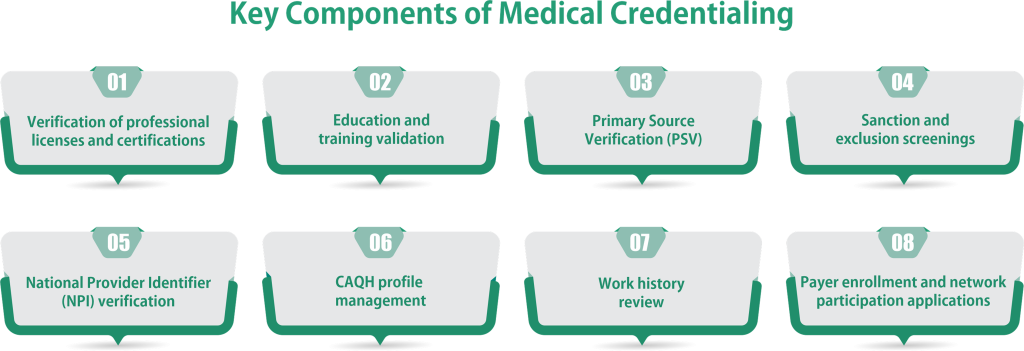
A successful credentialing process typically includes:
- Verification of professional licenses and certifications
- Education and training validation
- Primary Source Verification (PSV)
- National Provider Identifier (NPI) verification
- CAQH profile management
- Work history review
- Sanction and exclusion screenings
- Malpractice history verification
- Payer enrollment and network participation applications
Managing these requirements efficiently is critical for providers who want to avoid delays and focus on delivering exceptional patient care.
Why Credentialing Delays Cost Providers More Than They Realize
Many healthcare providers underestimate the financial and operational impact of credentialing delays until they begin experiencing reimbursement issues. Every day a provider remains uncredentialed is a day they may be unable to bill insurance companies, participate in preferred networks, or generate revenue from insured patients.
Credentialing delays can create a ripple effect throughout a practice. New providers may sit idle while waiting for approvals, billing teams may struggle with denied claims, and patients may seek care elsewhere if providers are not listed in their insurance networks.
Common Consequences of Credentialing Delays
Delayed Revenue Generation: Providers cannot bill most insurance companies until credentialing and payer enrollment are approved. This often results in months of lost revenue for new practices and recently hired providers.
Increased Claim Denials: Incomplete applications, missing documentation, and enrollment errors frequently lead to claim rejections and payment delays that require additional administrative work to resolve.
Network Participation Challenges: Without proper enrollment, providers may remain out-of-network, limiting patient access and reducing referral opportunities.
Administrative Burden: Credentialing paperwork consumes valuable staff time that could otherwise be dedicated to patient scheduling, care coordination, and practice growth initiatives.
Compliance Risks: Missed deadlines, expired credentials, and incomplete documentation can expose providers to regulatory issues and reimbursement interruptions.
How Dr. Credentialing Helps Providers Across the United States
Navigating today’s credentialing landscape requires expertise, persistence, and a deep understanding of payer requirements. Dr. Credentialing helps healthcare providers simplify this process through comprehensive credentialing and enrollment solutions designed to eliminate administrative bottlenecks and accelerate approvals.
Rather than requiring providers to manage countless forms, deadlines, and follow-ups on their own, Dr. Credentialing acts as a dedicated partner throughout the credentialing journey. Their team works directly with healthcare professionals, insurance carriers, hospitals, and regulatory organizations to ensure every application is completed accurately and submitted efficiently.
Comprehensive Provider Credentialing Services
Dr. Credentialing manages the full spectrum of provider credentialing activities, including:
- Primary Source Verification (PSV)
- Professional license verification
- Board certification verification
- Malpractice history reviews
- OIG and exclusion screenings
- CAQH profile creation and maintenance
- Credentialing application preparation
- Application submission and tracking
- Recredentialing support
- Compliance monitoring
By handling these critical tasks, Dr. Credentialing helps providers reduce administrative stress while improving approval timelines.
1. Streamlined Payer Enrollment Support
Insurance enrollment is often one of the most time-consuming aspects of credentialing. Dr. Credentialing assists providers with enrollment applications for major government and commercial payers, helping ensure all documentation is complete and submitted correctly the first time.
Their team actively monitors application status, follows up with payers, responds to requests for additional information, and works to resolve issues before they become costly delays.
2. Personalized Support for Every Provider Type
Whether serving physicians, nurse practitioners, behavioral health professionals, telehealth providers, specialists, or multi-provider organizations, Dr. Credentialing tailors its services to meet the unique requirements of each healthcare practice.
This personalized approach allows providers to focus on patient care while experienced credentialing professionals manage the administrative complexities that directly impact reimbursement and growth.
Faster Payer Enrollment and Insurance Network Participation
While credentialing verifies a provider’s qualifications, payer enrollment ensures they can actually bill insurance companies and receive reimbursements for the care they provide. Unfortunately, enrollment is often one of the most frustrating and time-consuming aspects of launching or expanding a healthcare practice.
Every insurance carrier has its own application requirements, documentation standards, approval timelines, and follow-up procedures. Missing a single detail can delay approval by weeks or even months, leaving providers unable to participate in valuable insurance networks.
Dr. Credentialing helps eliminate these obstacles by managing the enrollment process from start to finish. Their team prepares applications, verifies documentation, communicates with payers, and tracks progress to help providers gain network participation as efficiently as possible.
Government Payer Enrollment Support
Government insurance programs often involve extensive documentation and strict compliance requirements. Dr. Credentialing assists providers with:
- Medicare enrollment
- Medicaid enrollment
- TRICARE enrollment
- CHIP enrollment
- Medicare revalidation
- Provider updates and reassignment services
These programs represent significant patient populations, making timely enrollment critical for both practice growth and revenue generation.
Commercial Insurance Enrollment Services
In addition to government programs, providers must often enroll with multiple commercial insurance carriers to maximize patient access and reimbursement opportunities.
Dr. Credentialing supports enrollment with major insurance networks, helping providers expand their reach while minimizing administrative burdens.
How This Benefits Providers
When enrollment is handled correctly and proactively, providers can:
- Begin billing sooner
- Reduce claim denials
- Increase patient accessibility
- Join preferred insurance networks
- Accelerate cash flow
- Expand their practice more confidently
Instead of spending hours navigating payer portals and following up on applications, providers can focus on patient care while experienced professionals manage the enrollment process.
Supporting Every Type of Healthcare Provider
Credentialing requirements vary significantly depending on a provider’s specialty, practice setting, and state regulations. What works for a primary care physician may not apply to a behavioral health provider, telehealth organization, or multi-specialty clinic.
Dr. Credentialing understands these differences and provides customized solutions tailored to each provider’s unique needs.
Physician Credentialing Services
Physicians face extensive credentialing requirements when joining hospitals, healthcare groups, and insurance networks.
Dr. Credentialing supports:
- Primary care physicians
- Specialists
- Surgeons
- Hospital-employed physicians
- Independent practitioners
- Multi-physician groups
Their team ensures every qualification is properly verified while helping providers secure network participation and hospital privileges without unnecessary delays.
Nurse Practitioner Credentialing
As nurse practitioners continue expanding their role in healthcare delivery, credentialing requirements have become increasingly complex.
Dr. Credentialing helps nurse practitioners navigate:
- State-specific regulations
- Independent practice requirements
- Medicare and Medicaid enrollment
- Commercial insurance credentialing
- Collaborative agreement documentation
- Multi-state practice expansion
This support allows NPs to focus on patient care rather than administrative paperwork.
Telehealth Provider Credentialing
The rapid growth of virtual care has created complex administrative barriers for digital health networks expanding into multiple states simultaneously. To overcome cross-border licensing friction, deploying dedicated telehealth credentialing workflows is essential to synchronize multi-state payer enrollments and maintain cross-state compliance.
Dr. Credentialing assists telehealth organizations with:
- Multi-state credentialing
- Cross-state licensing considerations
- Virtual care compliance requirements
- Telehealth payer enrollment
- Network participation management
By simplifying these processes, providers can expand virtual care services while remaining compliant with state and payer requirements.
Behavioral Health Credentialing
Mental health practitioners and therapy practices face unique payer panel enrollment barriers due to specialized network capacity audits and fluctuating clinical documentation rules. Utilizing a specialized behavioral health credentialing strategy is the fastest way for independent therapists and psychiatric clinics to break through closed panels and expand local patient access.
Dr. Credentialing supports:
- Psychiatrists
- Psychologists
- Licensed therapists
- Counselors
- Behavioral health clinics
- Substance abuse treatment providers
Their expertise helps mental health professionals gain network access and improve patient accessibility while reducing administrative burdens.
Compliance and Regulatory Support Beyond Credentialing
Many providers assume credentialing ends once approval is granted. In reality, credentialing is an ongoing process that requires continuous monitoring, maintenance, and compliance management.
Healthcare organizations must regularly update provider information, renew licenses, complete recredentialing requirements, and remain compliant with evolving regulations. Failure to do so can result in network termination, reimbursement interruptions, and regulatory penalties.
Dr. Credentialing helps providers stay ahead of these challenges through proactive compliance support and ongoing credential management.
1. Recredentialing and Renewal Management
Insurance companies and healthcare organizations routinely require providers to undergo recredentialing to maintain active participation.
Dr. Credentialing helps manage:
- Recredentialing deadlines
- License renewals
- Board certification updates
- CAQH profile maintenance
- Provider data updates
- Compliance documentation
This proactive approach helps prevent disruptions that could impact patient care and revenue.
2. Ongoing Monitoring and Risk Reduction
Healthcare regulations continue to evolve, making compliance an ongoing responsibility rather than a one-time task.
Dr. Credentialing supports providers through:
- Exclusion and sanction monitoring
- Credential expiration tracking
- Regulatory compliance oversight
- Documentation management
- Audit readiness support
By identifying potential issues before they become major problems, providers can reduce risk and maintain uninterrupted operations.
3. Protecting Revenue Through Compliance
Compliance failures can lead to delayed reimbursements, denied claims, and costly administrative corrections. Maintaining accurate provider records and staying current with credentialing requirements helps protect both revenue and reputation.
With dedicated compliance support from Dr. Credentialing, healthcare providers gain peace of mind knowing their credentials, enrollments, and regulatory obligations are being actively managed by experienced professionals.
Hospital Privileging and Healthcare Accreditation Services
For many healthcare providers and organizations, credentialing alone is not enough. Hospitals, healthcare systems, ambulatory surgery centers, and specialty facilities often require additional approvals before providers can perform specific procedures or access certain clinical privileges. These processes, known as hospital privileging and accreditation, are essential for maintaining quality care standards and regulatory compliance.
Managing these requirements can be overwhelming, particularly for providers joining new facilities or organizations expanding their services. Dr. Credentialing helps simplify these complex processes by guiding providers and healthcare organizations through every stage of privileging and accreditation.
Hospital Privileging Support
Facility clinical authorization determines which specific procedures, medical staff tracks, and admitting services a provider can legally manage within an acute care or surgical center. Because these approvals directly dictate clinical operations and risk mitigation, balancing application accuracy via expert hospital privileging management prevents costly career downtime for newly hired physicians.
Dr. Credentialing assists providers with:
- Privileging application preparation
- Documentation collection and verification
- Work history validation
- Procedure competency documentation
- Committee review support
- Privilege renewal management
- Ongoing privileging maintenance
By ensuring applications are complete and accurate before submission, providers can avoid unnecessary delays and begin practicing sooner.
Healthcare Accreditation Services
Accreditation demonstrates that a healthcare organization meets established standards for quality, safety, and operational excellence. It also plays a critical role in reimbursement eligibility and patient trust.
Dr. Credentialing supports organizations pursuing various accreditation and certification programs, helping them navigate documentation requirements, compliance standards, and regulatory expectations.
Healthcare organizations often seek assistance with:
- CMS certification preparation
- Home health accreditation
- Hospice accreditation support
- DMEPOS certification
- CLIA certification
- Regulatory compliance readiness
With expert guidance throughout the process, organizations can improve their chances of successful accreditation while reducing administrative stress.
How Dr. Credentialing Creates a Faster Path to Revenue
One of the biggest misconceptions in healthcare administration is that credentialing is simply a regulatory requirement. In reality, credentialing has a direct impact on a provider’s revenue cycle. Every day spent waiting for approvals can translate into delayed reimbursements, reduced patient access, and lost income opportunities.
Dr. Credentialing understands that speed and accuracy are equally important. Their structured approach is designed to help providers move from application submission to reimbursement readiness as efficiently as possible.
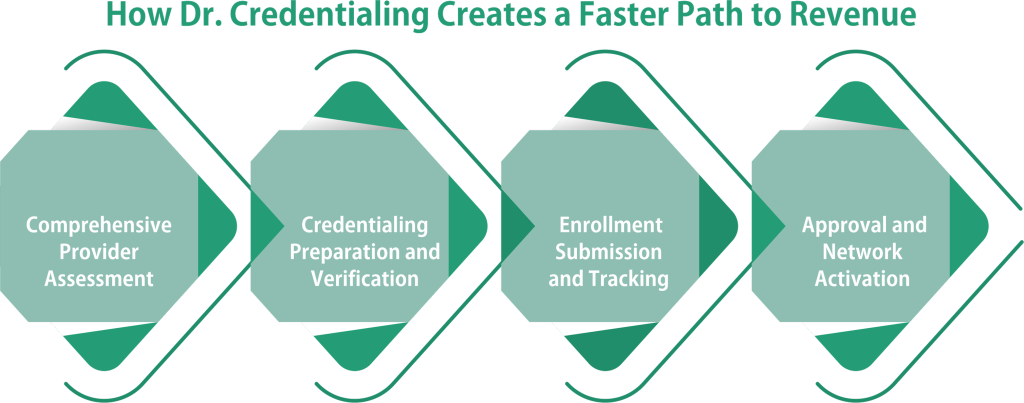
Step 1: Comprehensive Provider Assessment
The process begins with a detailed review of the provider’s credentials, licenses, certifications, and enrollment goals.
This initial assessment helps identify:
- Missing documentation
- Potential compliance issues
- Enrollment requirements
- State-specific obligations
- Payer participation opportunities
By addressing these factors early, providers can avoid delays later in the process.
Step 2: Credentialing Preparation and Verification
Once the required information is collected, Dr. Credentialing conducts thorough verification procedures and prepares applications according to payer and facility requirements.
This stage typically includes:
- Primary Source Verification
- License validation
- Board certification review
- CAQH management
- Background screenings
- Documentation organization
Accuracy at this stage is critical because incomplete applications are one of the leading causes of credentialing delays.
Step 3: Enrollment Submission and Tracking
After applications are prepared, Dr. Credentialing manages submissions and monitors progress with insurance carriers, hospitals, and regulatory organizations.
Their team proactively:
- Tracks application status
- Responds to payer requests
- Resolves missing information issues
- Communicates with enrollment representatives
- Escalates delayed applications when necessary
This hands-on approach helps prevent applications from becoming stalled in lengthy review queues.
Step 4: Approval and Network Activation
Once approvals are received, Dr. Credentialing helps ensure providers are properly activated within payer networks and prepared for billing operations.
This may include:
- Network participation confirmation
- EFT enrollment
- ERA setup
- Provider directory verification
- Billing readiness support
The result is a smoother transition from approval to revenue generation.
Why Healthcare Providers Nationwide Trust Dr. Credentialing
Choosing a credentialing partner is an important decision that can significantly impact a provider’s operational efficiency, compliance status, and financial performance. Healthcare providers across the United States trust Dr. Credentialing because of their commitment to accuracy, responsiveness, and long-term client success.
Rather than offering a one-size-fits-all solution, Dr. Credentialing provides personalized support tailored to each provider’s specialty, practice model, and growth objectives.
Reduced Administrative Burden: Credentialing requires substantial time and attention to detail. By outsourcing these responsibilities, providers and administrative teams can focus on patient care, business development, and operational improvement rather than paperwork and follow-up calls.
Greater Accuracy and Fewer Delays: Application errors are one of the most common reasons credentialing and enrollment timelines become extended. Dr. Credentialing’s experience helps minimize mistakes and improve submission quality from the beginning.
Support Across Multiple States: As healthcare organizations expand into new markets, credentialing requirements become increasingly complex. Dr. Credentialing helps providers navigate multi-state credentialing, payer enrollment, and compliance obligations with greater confidence.
Ongoing Compliance Management: Credentialing is not a one-time event. Continuous monitoring and maintenance are necessary to protect provider participation and revenue streams. Dr. Credentialing helps clients stay current with renewals, recredentialing requirements, and regulatory changes.
Improved Financial Performance: Ultimately, effective credentialing supports faster reimbursements, fewer claim denials, stronger payer relationships, and greater operational stability. By helping providers achieve these outcomes, Dr. Credentialing contributes directly to long-term practice growth and success.
The Future of Healthcare Credentialing and Why Expert Support Matters
Healthcare credentialing continues to evolve as regulatory requirements become more complex and payer expectations grow increasingly stringent. Providers are facing greater pressure to maintain accurate records, comply with changing regulations, manage multiple payer relationships, and ensure uninterrupted reimbursement.
At the same time, healthcare organizations are expanding services, entering new markets, adopting telehealth solutions, and navigating new compliance challenges. These changes make credentialing more important than ever before.
Organizations that invest in efficient credentialing processes position themselves for sustainable growth, stronger payer relationships, and improved financial performance. Those that fail to prioritize credentialing often encounter avoidable delays, compliance issues, and revenue disruptions.
This is why more providers across the United States are choosing experienced credentialing partners who can proactively manage these responsibilities while supporting long-term organizational goals.
The Bottom Line
Healthcare providers dedicate their careers to improving patient outcomes, not managing endless paperwork, payer applications, and compliance requirements. Yet credentialing, enrollment, and regulatory management remain essential components of a successful healthcare practice. Dr. Credentialing bridges this gap by providing comprehensive support that helps providers navigate every stage of the credentialing journey.
From initial provider credentialing and payer enrollment to hospital privileging, accreditation, recredentialing, and ongoing compliance management, their services are designed to simplify complex administrative processes and support long-term practice success.