Telehealth has transformed healthcare delivery, allowing providers to treat patients across state lines without requiring in-person visits. However, expanding virtual care into multiple states brings complex regulatory responsibilities, particularly when prescribing controlled substances. From obtaining the appropriate state medical licenses and DEA registrations to meeting federal telemedicine rules and prescription monitoring requirements, every step matters.
Overlooking even one requirement can lead to credentialing delays, prescribing restrictions, or potential compliance issues. Understanding out-of-state telehealth prescribing and DEA registration helps physicians, healthcare organizations, and virtual care providers establish compliant prescribing workflows while expanding their reach.
By aligning licensing, registration, credentialing, and ongoing compliance processes, providers can reduce administrative barriers, protect patient safety, and build a more reliable foundation for delivering virtual care across state lines.
Out-of-State Telehealth Prescribing Requirements
Out-of-state telehealth prescribing allows healthcare providers to evaluate and treat patients who are physically located in a different state. Although virtual consultations make healthcare more accessible, providers must comply with the laws governing their professional practice and the patient’s location.
Requirements may differ depending on the provider’s specialty, the medication being prescribed, and the state where the patient receives care. Before offering services across state lines, healthcare organizations should verify applicable licensing, prescribing authority, registration, and documentation requirements.
How State Laws Affect Virtual Care Across State Lines
In general, a provider must hold a license or another form of authorization recognized by the state where the patient is located. Some states offer telehealth-specific registration pathways, while others require a full professional license or recognize qualifying interstate compact arrangements.
Providers should verify the rules of both their own state and the patient’s state before delivering care. They should also establish procedures to confirm the patient’s physical location at each encounter and comply with applicable requirements for informed consent, medical records, and follow-up care.
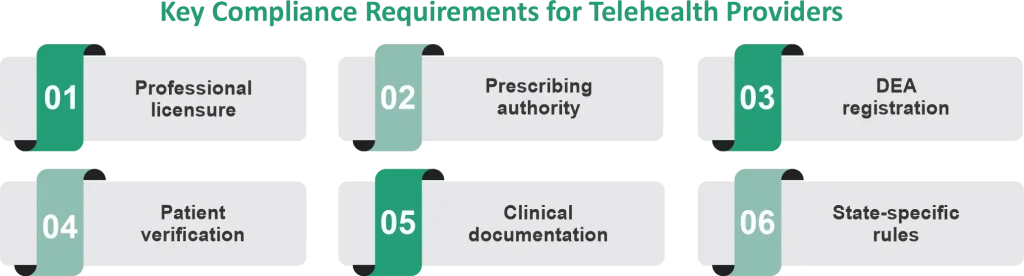
Key Compliance Requirements for Telehealth Providers
Before launching a multi-state telehealth service providers should assess:
- Professional licensure: Confirm that the provider is authorized to practice in the patient’s state.
- Prescribing authority: Verify permission to prescribe the relevant medication under applicable state law.
- DEA registration: Determine which federal controlled substance registration requirements apply.
- Patient verification: Establish procedures for confirming patient identity and location.
- Clinical documentation: Maintain accurate records of evaluations, treatment decisions, and prescriptions.
- State-specific rules: Review telehealth standards and additional prescribing restrictions.
Meeting these requirements at the beginning helps reduce administrative delays and supports a more consistent compliance process.
DEA Registration for Out-of-State Telehealth Providers
The Drug Enforcement Administration (DEA) regulates the handling and prescribing of controlled substances under federal law. For telehealth providers, DEA registration must be considered alongside state medical licensure and any applicable state controlled substance permits.
A DEA registration does not automatically authorize a physician to prescribe controlled substances nationwide. Registration requirements depend on the provider’s practice, location, applicable exceptions, and the location of the patient receiving the prescription.
When Do Telehealth Providers Need DEA Registration in Another State?
In general, practitioners prescribing controlled substances must have the required DEA registration in the state where the patient is located, unless a specific exception applies. Federal rules may also require registration in the state where the practitioner practices or dispenses controlled substances.
Providers should not assume that their existing registration covers every state in which they treat patients. Before prescribing, they should verify state authorization and applicable DEA requirements, including whether a specific exception or telemedicine pathway applies.
Multi-State DEA Registration Rules for Doctors
Doctors treating patients across multiple states should distinguish between two important issues: registration for a separate physical practice location and registration requirements associated with prescribing to patients in other states.
DEA regulations generally require separate registration for each principal place of business or professional practice at a general physical location where controlled substances are handled, subject to applicable exceptions. Separately, prescribing controlled substances to patients in other states may trigger additional state-specific registration requirements.
To manage these obligations effectively, physicians and healthcare organizations should:
- Identify every state in which they intend to prescribe controlled substances.
- Confirm professional licensure and prescribing authority in each relevant state.
- Determine whether a separate DEA registration or an applicable exception is required.
- Maintain accurate registration records and monitor expiration dates.
- Review changes in federal and state regulations before expanding services.
A state-by-state registration matrix can help credentialing and compliance teams identify missing requirements before a provider begins treating patients in a new location.
Ryan Haight Act Telehealth Prescribing Update
The Ryan Haight Online Pharmacy Consumer Protection Act of 2008 established federal restrictions on prescribing controlled substances through the internet. It generally requires an in-person medical evaluation before prescribing controlled substances online, unless the encounter qualifies for an exception under federal law.
For telehealth providers, the distinction between the general in-person evaluation requirement and legally authorized telemedicine exceptions is essential. A virtual encounter does not automatically qualify for every exception, and state law may impose additional requirements.
In-Person Evaluation Requirements and Telemedicine Exceptions
The applicable requirements depend on the type of telemedicine encounter, the provider’s authorization, the medication, and the relevant federal provisions.
Providers should determine whether the encounter qualifies under an applicable statutory exception or federal telemedicine rule. They must also satisfy other relevant conditions, including state licensure, registration, legitimate medical purpose, and appropriate clinical evaluation.
Healthcare organizations should avoid adopting a single prescribing policy for every controlled substance. Instead, policies should account for medication schedules, clinical circumstances, and the rules governing each prescribing pathway.
Current Federal Telehealth Prescribing Flexibilities
DEA and the U.S. Department of Health and Human Services have issued rules addressing controlled substance prescribing through telemedicine, including provisions for specific medications and qualifying encounters. DEA also announced rulemaking in January 2025 intended to preserve access to telehealth treatment while strengthening patient protections.
Federal flexibilities and permanent rules do not necessarily apply in the same way to every medication or clinical situation. Providers should verify the current status of applicable rules before relying on a particular prescribing pathway, particularly when treating patients who have never been evaluated in person.
For ongoing compliance, organizations should review official DEA guidance, applicable federal regulations, and state-specific requirements whenever they update prescribing policies.
Cross-State Prescription Monitoring Program (PDMP) Requirements
Prescription Drug Monitoring Programs (PDMPs) are state-run databases that track controlled substance prescriptions dispensed within their jurisdictions. They help authorized healthcare professionals identify potential medication interactions, duplicate prescriptions, and patterns that may require further clinical evaluation.
For telehealth providers working across state lines, PDMP compliance can become more complicated because access procedures and mandatory query requirements vary by jurisdiction. Providers should determine which state’s database they must consult and whether additional requirements apply to the medication or prescribing pathway.
Do Telehealth Providers Need to Check the Patient’s State PDMP?
Whether a PDMP check is mandatory depends on applicable state law, the prescribed medication, and any specific federal requirements. Some states require prescribers to review the database before prescribing certain controlled substances, while others establish different conditions or exceptions.
Providers should not assume that checking their home-state PDMP satisfies every obligation when treating an out-of-state patient. They should verify the patient’s state requirements and document the review whenever required.
For example, a specific federal rule governing certain telemedicine prescriptions for buprenorphine requires the practitioner to review the PDMP data for the state where the patient is located and document the review. This illustrates why organizations should assess medication-specific rules rather than relying on a universal policy.
How to Manage PDMP Access Across Multiple States
Healthcare organizations can improve compliance by establishing a standardized process for accessing and documenting prescription monitoring records.
Recommended practices include:
- Registering for access to relevant state PDMP systems when required.
- Checking whether interstate data-sharing arrangements are available.
- Verifying whether a PDMP query is mandatory for the medication being prescribed.
- Documenting the date, time, and outcome of required checks.
- Recording the reason when a required database is unavailable and following applicable procedures.
- Training prescribing staff to recognize state-specific requirements.
Integrating these procedures into clinical workflows can reduce missed checks and help providers make informed prescribing decisions.
Telehealth Controlled Substance Prescribing Credentialing
Credentialing plays an important role in preparing healthcare professionals to deliver virtual care across multiple states. While credentialing verifies a provider’s qualifications, organizations must also establish that the provider has the necessary legal authority to practice and prescribe in each relevant jurisdiction.
A complete compliance process should coordinate professional credential verification, state licensing, DEA registration, organizational approvals, and payer enrollment where applicable. These processes serve different purposes and should not be treated as interchangeable.
Essential Credentials and Documents to Verify
Before allowing a provider to prescribe controlled substances through a telehealth platform, the credentialing team should review the documents and authorizations relevant to the provider’s role.
These may include:
- Professional licenses: Current licenses or other legally recognized authorizations for each relevant state.
- DEA registration: Valid registration details and applicable state-specific requirements.
- State controlled substance permits: Additional permits required by the relevant jurisdiction.
- Education and qualifications: Medical education, training, specialty credentials, and board certification where applicable.
- Professional liability insurance: Coverage appropriate for the provider’s practice locations and telehealth activities.
- Background and exclusion checks: Applicable verification requirements for the organization and payer contracts.
- Organizational privileges: Required approvals to provide services through the healthcare organization.
- Payer enrollment records: Enrollment status for insurance networks when the provider will treat reimbursable patients.
Credentialing requirements vary by organization, payer, specialty, and state. Teams should maintain clear records showing which requirements have been verified and which remain outstanding.

Building a Multi-State Credentialing and Compliance Workflow
A well-defined workflow helps organizations expand telehealth services without overlooking important requirements.
Step 1: Identify target states. Establish a list of states where providers will deliver care and where patients are expected to be located.
Step 2: Verify professional authorization. Confirm the provider’s license or other legally recognized authorization in each relevant state.
Step 3: Assess controlled substance requirements. Determine which DEA registrations, state permits, and prescribing restrictions apply to the provider’s practice.
Step 4: Complete credential verification. Review qualifications, work history, insurance, and other required documents according to organizational policies.
Step 5: Coordinate payer enrollment. Complete relevant enrollment processes separately from licensing and prescribing authorization.
Step 6: Approve operational readiness. Confirm that required authorizations, documentation systems, and prescribing workflows are in place before services begin.
Step 7: Maintain ongoing compliance. Monitor expiration dates, recredentialing deadlines, regulatory changes, and changes to prescribing authority.
By assigning clear responsibilities to credentialing specialists, compliance officers, and clinical leadership, organizations can make this workflow easier to manage and audit.
Common Compliance Mistakes in Out-of-State Telehealth Prescribing
Even experienced healthcare organizations can encounter compliance gaps when expanding into new markets. Common mistakes include:
- Assuming a medical license from one state automatically authorizes practice in another.
- Treating a DEA registration as nationwide permission to prescribe controlled substances.
- Overlooking separate state controlled substance permits or applicable registration exceptions.
- Relying on outdated information about federal telemedicine prescribing rules.
- Failing to verify the patient’s location during a virtual encounter.
- Missing required PDMP checks or failing to maintain supporting documentation.
- Allowing professional licenses or registrations to expire.
- Confusing payer enrollment approval with legal authority to practice or prescribe.
These problems can cause operational delays, interrupt patient care, and create potential regulatory exposure. A documented review process and clear ownership of compliance tasks can help reduce these risks.
Best Practices for Maintaining Ongoing Telehealth Compliance
Compliance does not end when a provider receives a license or completes credentialing. Healthcare organizations need ongoing processes to keep records accurate and prescribing practices aligned with changing requirements.
Consider implementing the following measures:
- Maintain a state-by-state compliance matrix. Track licensing, registration, prescribing, and PDMP obligations for each relevant jurisdiction.
- Use renewal tracking systems. Set reminders for license expirations, registration renewals, and recredentialing deadlines.
- Standardize documentation. Establish consistent procedures for patient verification, clinical evaluations, prescribing decisions, and required PDMP checks.
- Train clinical and administrative teams. Ensure staff understand their responsibilities and know when to escalate regulatory questions.
- Conduct periodic audits. Review provider files and prescribing workflows to identify missing documentation or expired credentials.
- Monitor official regulatory updates. Review DEA, HHS, state medical board, pharmacy board, and PDMP guidance as appropriate.
- Review new-state expansion plans before launch. Complete the necessary licensing, registration, credentialing, and operational assessments before treating patients in a new jurisdiction.
These practices help create a repeatable process for maintaining compliance as telehealth programs grow.
Simplify Telehealth Credentialing and Enrollment
Expanding virtual care across state lines requires more than obtaining the appropriate licenses. Healthcare organizations must also coordinate provider credential verification, payer enrollment, documentation, and ongoing compliance responsibilities to support efficient operations.
A structured credentialing process helps organizations identify missing documents, track approval requirements, and prepare providers to deliver services in accordance with applicable rules.
If your organization is looking to streamline these administrative processes, explore our Telehealth Credentialing and Enrollment services to learn how credentialing and enrollment support can help simplify virtual care operations.
Summary
Out-of-state telehealth prescribing requires healthcare providers to coordinate state licensing, DEA registration, federal controlled substance regulations, PDMP requirements, and credentialing procedures. Each requirement serves a different purpose, and satisfying one does not automatically fulfill the others.
For physicians and healthcare organizations, the key is to establish a reliable, state-specific compliance process before expanding services. By verifying provider qualifications, maintaining accurate registration records, documenting prescribing decisions, and monitoring regulatory changes, organizations can reduce administrative obstacles and support safer virtual care.
A proactive approach to telehealth credentialing and compliance helps providers expand access to care while maintaining the regulatory standards essential to responsible prescribing.
Frequently Asked Questions
Q1. How long does telehealth provider credentialing usually take?
Ans: Timelines vary depending on document completeness, verification requirements, organizational processes, and payer enrollment. Submitting accurate documentation and tracking outstanding items can help reduce delays.
Q2. Can a telehealth organization credential providers before launching in a new state?
Ans: Yes. Organizations can begin credential verification and administrative preparation in advance, but they should confirm that all required authorizations and approvals are in place before the provider begins practicing or prescribing.
Q3. What happens if a telehealth provider changes employers?
Ans: The new organization may need to conduct its own credential verification, establish organizational privileges, and complete applicable payer enrollment processes. Existing professional licenses and DEA registrations should also be reviewed for continued validity and applicability.
Q4. Why is centralized credentialing documentation important?
Ans: Centralized records help authorized staff locate provider documents, monitor outstanding requirements, track renewals, and respond more efficiently to internal reviews or external requests.
Q5. How can healthcare organizations reduce credentialing delays?
Ans: Organizations can use standardized document checklists, assign clear responsibilities, follow up on pending verifications, and establish renewal reminders to keep provider records current.