Choosing the right credentialing structure is one of the most important decisions healthcare providers make when starting or expanding a medical practice. Whether you operate independently or manage a multi-provider organization, credentialing directly affects insurance enrollment, medical billing, compliance, and reimbursement timelines.
Yet many providers still struggle to understand the difference between single provider credentialing and group credentialing.
While both processes involve verifying provider qualifications with insurance payers, the administrative requirements, billing structure, and operational impact can vary significantly.
In this guide, the experts at Dr Credentialing break down the key differences between individual and group credentialing, explain how each model affects revenue cycle management, and help healthcare organizations determine which approach best fits their practice.
Understanding the Basics of Provider Credentialing
Provider credentialing is the process insurance companies use to verify that healthcare providers meet professional and legal standards before joining payer networks.
Credentialing typically includes verification of:
- Medical licenses
- Education and training
- Board certifications
- DEA registrations
- Work history
- Malpractice insurance
- CAQH profiles
- NPI information
Without completed credentialing, providers usually cannot bill insurance companies or receive reimbursements for covered services.
This process applies to:
- Solo physicians
- Group practices
- Hospitals
- Mental health providers
- Therapists
- Dental practices
- Specialty clinics
However, the way credentialing is managed changes depending on whether the provider operates individually or under a group structure.
What Is Single Provider Credentialing?
Single provider credentialing — also called individual credentialing — is the process where one healthcare provider enrolls independently with insurance payers.
This model is common among:
- Private practice physicians
- Independent therapists
- Solo specialists
- Freelance healthcare professionals
- Newly established providers
In this setup:
- The provider bills under their personal credentials
- Insurance contracts are tied directly to the individual provider via dedicated provider credentialing services to ensure distinct, individual payer recognition
- Claims are generally linked to a Type 1 NPI
The provider remains personally responsible for maintaining:
- Credentialing updates
- Recredentialing deadlines
- CAQH attestation
- Payer enrollment status
What Is Group Credentialing?
Group credentialing is used when multiple healthcare providers operate under a shared organizational structure.
This is common among:
- Multi-specialty practices
- Medical groups
- Clinics
- Healthcare organizations
- Behavioral health networks
In group credentialing:
- The organization enrolls with insurance payers as a group entity
- Providers are linked to the group contract
- Billing may occur under the organization’s Type 2 NPI
Individual providers still require personal credentialing verification, but they are also connected to the group’s payer enrollment structure.
This creates a more centralized billing and credentialing workflow.
The Role of Type 1 and Type 2 NPIs
One major area competitors often fail to explain properly is the relationship between NPIs and credentialing.
Understanding this distinction is essential.
Type 1 NPI
A Type 1 NPI is assigned to an individual healthcare provider.
Examples:
- Physicians
- Dentists
- Therapists
- Nurse practitioners
This number stays with the provider permanently.
Single provider credentialing usually revolves around the provider’s Type 1 NPI.
Type 2 NPI
A Type 2 NPI is assigned to healthcare organizations or business entities.
Examples:
- Group practices
- Clinics
- Hospitals
- Healthcare corporations
Group credentialing relies heavily on the Type 2 NPI because payers connect multiple providers under the organization’s enrollment structure.
Key Differences Between Single and Group Credentialing
Although the overall credentialing process may appear similar, several operational differences separate individual and group credentialing.
Ownership Structure
Single Provider Credentialing
- One provider controls the enrollment process
- Contracts belong directly to the provider
- Simpler administrative structure
Group Credentialing
- Multiple providers share enrollment relationships
- Contracts may be tied to the organization
- More complex payer coordination
Billing and Claims Processing
Individual Credentialing
Claims are typically submitted:
- under the provider’s personal credentials,
- using a Type 1 NPI.
This creates straightforward claim attribution but may limit scalability.
Group Credentialing
Claims are often billed:
- through the organization,
- under the group’s Type 2 NPI,
- while still identifying rendering providers individually.
This structure improves centralized billing but requires accurate provider linking to avoid reimbursement issues.
Administrative Complexity
One of the biggest differences involves operational management.
Single Provider Credentialing
Generally includes:
- fewer documents,
- simpler payer communication,
- easier renewal tracking.
Group Credentialing
Requires management of:
- provider rosters,
- onboarding workflows,
- terminated providers,
- payer updates,
- multi-provider CAQH profiles.
As practices grow, credentialing complexity increases significantly.
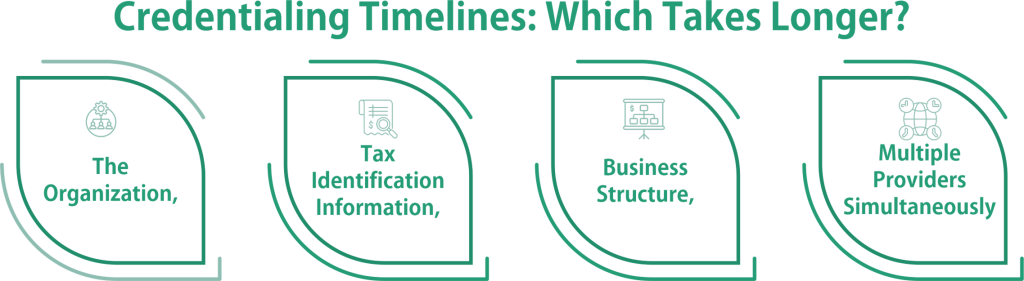
Credentialing Timelines: Which Takes Longer?
In many cases, group credentialing takes longer because insurance companies must verify:
- the organization,
- tax identification information,
- business structure,
- multiple providers simultaneously.
Additional delays may occur when:
- providers join or leave the practice,
- payer rosters require updates,
- provider information becomes inconsistent.
Single provider credentialing is often faster, though timelines still vary by payer.
Typical payer enrollment timelines range from:
- 60 to 180 days,
depending on the insurance company and specialty.
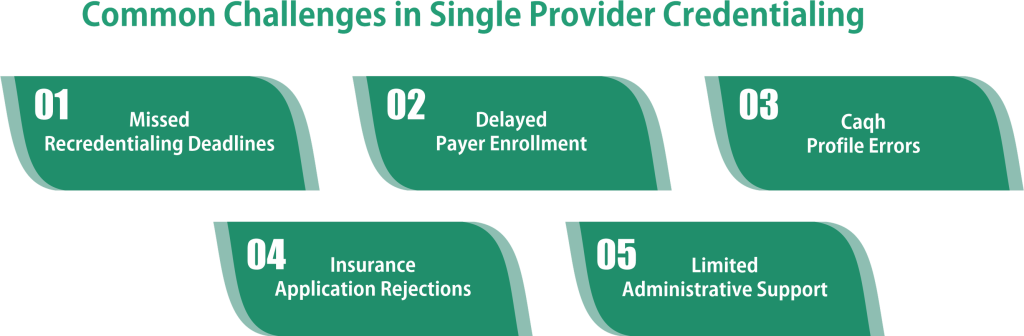
Common Challenges in Single Provider Credentialing
Solo providers often underestimate how time-consuming credentialing can become.
Common problems include:
- Missed recredentialing deadlines
- Delayed payer enrollment
- CAQH profile errors
- Insurance application rejections
- Limited administrative support
Since many independent providers manage credentialing themselves, errors can easily delay reimbursements.
Common Challenges in Group Credentialing
Group credentialing introduces additional layers of operational complexity.
Healthcare organizations frequently struggle with:
- Provider onboarding delays
- Incorrect payer roster management
- Provider termination updates
- Multi-state licensing coordination
- Inconsistent provider documentation
- Billing synchronization issues
Even small credentialing mistakes can affect multiple providers simultaneously.
This can create:
- claim denials,
- payment delays,
- compliance risks,
- and revenue cycle disruption.
How Credentialing Impacts Medical Billing
Credentialing and medical billing are closely connected, yet many competitor blogs barely discuss this relationship.
Without accurate credentialing:
- Claims may reject automatically
- Payers may deny reimbursement
- Revenue cycles slow down
- Providers experience cash flow interruptions
For group practices, billing complications can become even more expensive because multiple providers may be affected by a single enrollment issue.
Improper provider linking between:
- rendering providers,
- billing providers,
- and group NPIs
can trigger widespread claim denials.
This is why credentialing should never operate separately from revenue cycle management.
Which Credentialing Structure Is Better?
There is no universal answer.
The right credentialing model depends on:
- practice size,
- growth plans,
- operational structure,
- billing goals,
- and administrative resources.
Single Provider Credentialing May Be Better For:
- Independent physicians
- New private practices
- Freelance healthcare professionals
- Providers with low administrative volume
It offers:
- simplicity,
- direct payer relationships,
- and easier management.
Group Credentialing May Be Better For:
- Multi-provider practices
- Growing healthcare organizations
- Multi-specialty clinics
- Healthcare systems
It offers:
- centralized billing,
- operational scalability,
- streamlined payer relationships,
- and administrative efficiency.
However, it also requires stronger credentialing oversight.
Why Professional Credentialing Support Matters
Credentialing errors can cost healthcare organizations thousands of dollars in delayed or denied reimbursements.
Professional credentialing support helps providers:
- Maintain compliance
- Reduce payer enrollment delays
- Prevent claim denials
- Manage CAQH updates
- Improve billing accuracy
- Track provider renewals proactively
At Dr Credentialing, healthcare organizations receive support for:
- Individual provider credentialing
- Group credentialing
- Insurance enrollment
- CAQH management
- Recredentialing
- Medical billing coordination
- Revenue cycle optimization
This integrated approach helps providers avoid operational bottlenecks while improving reimbursement performance.
Final Thoughts
Understanding the difference between single provider and group credentialing is essential for building an efficient and financially stable healthcare practice.
While individual credentialing offers simplicity and direct payer relationships, group credentialing supports scalability and centralized operations for larger healthcare organizations.
Both models require:
- accurate documentation,
- ongoing compliance management,
- proactive payer communication,
- and careful revenue cycle coordination.
The key is choosing a credentialing structure that aligns with your practice’s size, workflow, and long-term growth strategy.
For providers looking to simplify credentialing while improving billing performance, Dr Credentialing delivers credentialing and enrollment solutions designed to support both solo providers and growing healthcare organizations.