
Your Alabama practice deserves more than another enrollment form-filler; it needs a team that knows the payer process. We coordinate credentialing and enrollment across Medicare, Alabama Medicaid, and 30+ participating payers. From initial applications to recredentialing and payer follow-ups, we manage the details that can hold up reimbursement.









In Alabama, credentialing problems often start with details that look minor, but can stop enrollment and delay reimbursement. A provider-name mismatch, missing attachment, incomplete contact information, or incorrect enrollment record can trigger a denial or correction request from Alabama Medicaid. And if revalidation slips, Alabama Medicaid can close the provider file, forcing you to start the enrollment process again.
If a provider is not properly enrolled, Alabama Medicaid says claims can be denied, and providers who prescribe, order, or refer Medicaid services must be enrolled. Multiple locations create another layer: Alabama Medicaid requires each location to be enrolled under the provider’s NPI. That means one overlooked location, enrollment update, or provider record can leave billable services exposed to avoidable payment problems
Dr. Credentialing takes the Alabama enrollment workload off your staff and puts it under one accountable team. We prepare and review provider information, coordinate NPI and enrollment details, manage Alabama Medicaid applications and revalidations, submit required documentation, monitor payer responses, and handle follow-ups when something needs correction. From a new Alabama provider joining your practice to adding locations or maintaining existing payer participation, we keep the details aligned so you can get enrolled, stay enrolled, and keep your billing moving.
Getting credentialed in Alabama means meeting different requirements across Medicare, Alabama Medicaid, and commercial payer networks, not simply completing one enrollment form. Dr. Credentialing coordinates the provider data, applications, documentation, payer communication, and follow-ups needed to move your enrollment from paperwork to active participation.
Applications are prepared around each Alabama-serving payer’s requirements, preventing generic submissions from creating avoidable corrections or delays.
NPI, taxonomy, TIN, license, specialty, practice address, and provider information are checked for consistency before reaching the payer.
CAQH information is reviewed and maintained so commercial payer applications have accurate provider data available when credentialing begins.
Medicare and Alabama Medicaid enrollment requirements are handled alongside commercial credentialing, keeping each provider’s participation requirements organized.
Credentialing support covers major Alabama-serving networks such as BCBS of Alabama, UnitedHealthcare, Aetna, Cigna, and other applicable plans.
Licenses, certifications, education, training, work history, malpractice coverage, and other credentials are organized and verified for payer review.
Submitted applications are monitored through the payer process, with follow-ups and correction responses handled when additional information is requested.
Expiring credentials, recredentialing cycles, address changes, new providers, specialties, and practice locations are managed to help maintain active payer participation.
Let Dr. Credentialing handle the applications, payer follow-ups, credentialing details, and enrollment hurdles, so your Alabama practice can focus on patients instead of paperwork.
Your patients use more than one insurance plan, and your payer strategy should be just as broad.
Dr. Credentialing helps Alabama providers pursue participation across Medicare, Alabama Medicaid, Blue Cross and Blue Shield of Alabama, and applicable commercial and managed-care networks, with enrollment requirements handled according to the payer rather than forcing every application through the same process. BCBS Alabama, for example, maintains its own enrollment and credentialing requirements, including required documentation and NPI information.
Common payer enrollment pathways include:
PECOS enrollment, updates, and revalidation.
State enrollment, updates, and revalidation.
Payer-specific credentialing and enrollment requirements.
Applications based on individual payer requirements.
Participation support where applicable to your provider type.
Your exact payer mix depends on your specialty, location, provider type, and network needs. The goal is simple: identify the plans that matter to your Alabama practice and build the enrollment process around them.
A new address isn't just an address change!
When an Alabama practice opens another office, changes ownership, adds a provider, changes its tax structure, or updates key provider information, the payer records may need corresponding updates.
Medicare requires certain changes, including practice-location changes, to be reported within specified timeframes, while Alabama Medicaid maintains formal processes for enrollment updates and changes.
Dr. Credentialing helps keep the provider-to-group-to-location relationship synchronized across applicable payer records.
Practice Changes We Can Help Manage
Add the provider and location relationships required for payer participation.
Connect newly hired providers with the appropriate group and payer enrollment records.
Update addresses, tax information, specialties, credentials, and other enrollment details.
Coordinate applicable enrollment updates when your organization's ownership or structure changes.
The objective isn’t simply updating a form. It’s keeping the information a payer uses to recognize your provider accurate across the entire enrollment relationship.
Different providers can face different documentation, enrollment, and credentialing requirements. Your application shouldn’t be treated like everyone else’s.
Whether you’re adding one physician or onboarding an entire provider roster, Dr. Credentialing builds the process around the actual provider, not a generic checklist.
One provider. Multiple offices. Multiple payers. That’s where enrollment details can become complicated quickly. Alabama Medicaid specifically requires providers practicing at multiple locations to enroll each location using the provider’s assigned NPI.
Provider: Who is rendering the service?
Group: Which organization is the provider associated with?
Location: Where is the service being delivered?
Payer: Which insurance network recognizes that provider-location relationship?
Billing: Where should claims and payment information connect?
Dr. Credentialing reviews these relationships as part of the enrollment process, so expanding from one Alabama office to several doesn’t leave disconnected provider or location records behind. Growing into Birmingham, Mobile, Huntsville, Montgomery, Tuscaloosa, or another Alabama market? The enrollment strategy grows with the practice.
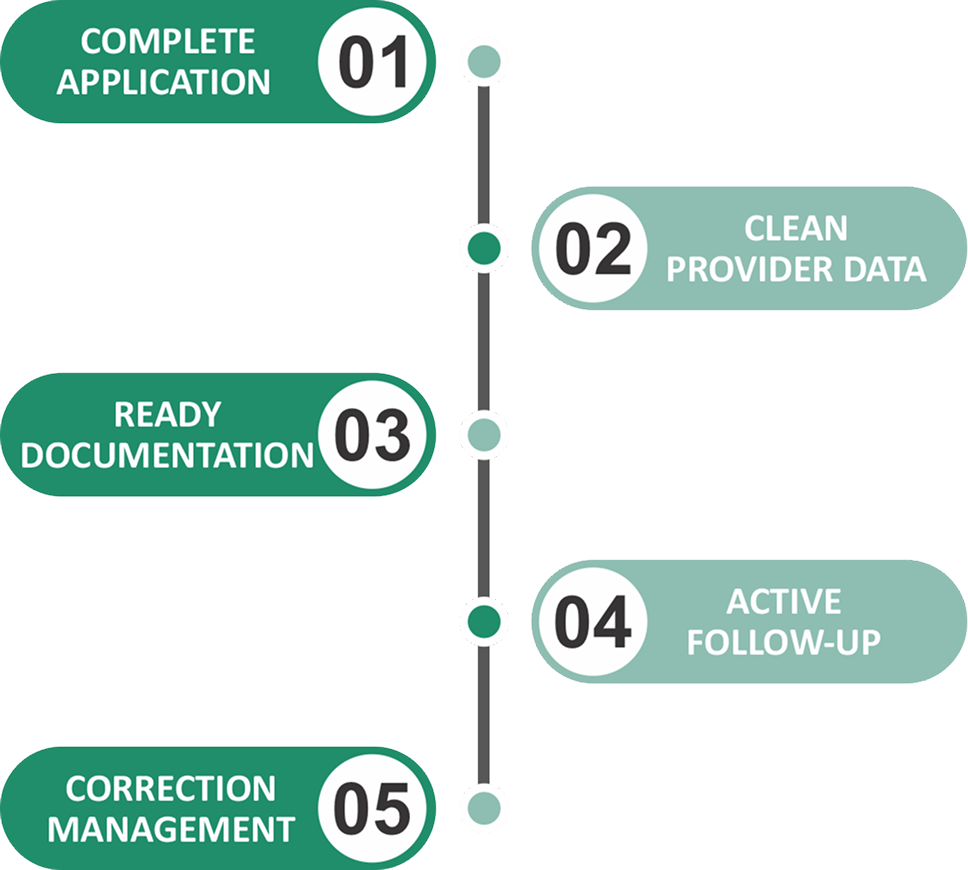
There isn’t one honest “Alabama credentialing takes X days” answer, because the payer, provider type, application completeness, verification requirements, and payer processing all influence the timeline. Medicare enrollment, for example, is handled through PECOS and may involve additional requests from the applicable Medicare Administrative Contractor.
What Can Move the Timeline Forward?
01: COMPLETE APPLICATION
Missing information creates opportunities for payer follow-up and correction.
02: CLEAN PROVIDER DATA
NPI, taxonomy, TIN, address, license, and other information should agree across the enrollment record.
03: READY DOCUMENTATION
Required supporting credentials need to be available when the payer requests them.
04: ACTIVE FOLLOW-UP
An application shouldn’t disappear into a payer queue after submission.
05: CORRECTION MANAGEMENT
When a payer asks for additional information, the response needs to be handled rather than left sitting in someone’s inbox.Dr. Credentialing focuses on controlling the parts of the process that can be controlled, while keeping payer-specific timelines realistic rather than promising an arbitrary approval date.
These three terms are often used interchangeably. They shouldn’t be.
Credentialing | Enrollment | Contracting |
Verifies your professional qualifications and credentials. | Establishes your participation/enrollment record with the payer. | Establishes the terms of network participation when a contract is required. |
Focuses on your qualifications. | Focuses on your payer/provider record. | Focuses on the payer-provider relationship and agreement. |
May involve primary-source verification. | May involve payer applications and supporting documents. | May involve network participation terms. |
A provider can have credentials verified without every enrollment detail being complete. Likewise, submitting an enrollment application doesn’t automatically mean the provider is ready to bill every payer. Medicare, for example, uses PECOS to manage enrollment, revalidation, and changes to enrollment information. Dr. Credentialing manages the pieces as a connected process, so “credentialed” doesn’t become the end of the conversation when your actual goal is payer participation and revenue.
The Approval Letter Isn’t the Finish Line!
A provider may have completed credentialing while another enrollment detail still needs attention. Think about what happens when:
The provider is credentialed → but the payer record isn’t correctly connected to the group.
The provider is enrolled → but the new service location hasn’t been updated.
The practice changed → but the payer still has outdated information.
The provider is active → but a required credential has expired.
The application was submitted → but a payer requested additional information that nobody answered.
Credential → Enroll → Track → Update → Maintain
That means looking beyond “Was the application submitted?” and asking the more important question:
Is this provider properly positioned with the payer to support the practice’s billing operation?”

Stop asking your staff, “Did the payer ever get back to us?”
Every enrollment should have a clear status, responsible action, and next step.Dr. Credentialing gives your practice a structured process instead of leaving enrollment status scattered across emails, spreadsheets, payer portals, and phone calls.
Getting credentialed is only half the job. Staying credentialed is what protects continuity. Medicare requires providers and suppliers to revalidate periodically to maintain billing privileges, generally every five years, with DMEPOS suppliers generally on a three-year cycle. Alabama Medicaid also requires periodic revalidation, and failure to complete it can result in an enrollment file being closed and a new application being required.
Monitor credentials that support continued participation.
One credentialing partner coordinates the moving parts instead of making your practice chase multiple payer processes.
A broader payer reach helps practices pursue participation across the networks relevant to their patient population and specialty.
State requirements, payer processes, provider types, locations, and enrollment updates are considered within the workflow, not treated as an afterthought.
From provider data and documentation through submission, payer follow-up, corrections, approval, and ongoing maintenance.
The process is built around a practical business outcome: helping your providers establish and maintain the payer relationships needed to support billing.
Your practice staff doesn't have to spend every week gathering documents, checking portals, calling payers, and wondering what's still outstanding.
Dr. Credentialing gives you a dedicated team to manage the work behind Alabama provider credentialing and enrollment, so your administrative team can spend more time running the practice.
Schedule a Free Consultation
Stop letting payer applications, credentialing paperwork, follow-ups, and revalidation deadlines compete with patient care and practice growth. Dr. Credentialing can take the enrollment workload off your team and manage the process across your applicable Alabama payer networks.