If you’re planning to join insurance networks, one of the first terms you’ll encounter is CAQH credentialing. Many healthcare providers assume that obtaining a CAQH number is just another administrative task, but it actually plays a crucial role in simplifying the entire credentialing process. A complete and accurate CAQH profile allows insurance companies to access your professional information from a single, secure source, eliminating the need to submit the same documents repeatedly.
Whether you’re a physician, nurse practitioner, therapist, dentist, or another licensed healthcare professional, understanding how CAQH works can save you valuable time, reduce paperwork, and help prevent costly delays in payer enrollment.
In this article, you’ll learn what CAQH credentialing is, how it differs from provider enrollment, how to obtain your CAQH number, the documents you’ll need, common mistakes to avoid, and best practices for keeping your profile up to date so you can move through the credentialing process with confidence.
What Is CAQH?
The Council for Affordable Quality Healthcare (CAQH) is a non-profit organization that develops solutions to simplify administrative processes across the healthcare industry. One of its most widely used platforms is CAQH ProView, a centralized provider database where healthcare professionals can securely store, manage, and share their professional and practice information with insurance companies, hospitals, and other participating organizations.
Before CAQH, providers had to complete separate credentialing applications for every insurance payer they wanted to join. This repetitive process consumed valuable time, increased administrative costs, and often delayed participation in insurance networks.
CAQH addressed this challenge by creating a standardized provider data repository that allows healthcare professionals to complete a single profile and authorize multiple participating organizations to access it.
Why Was CAQH Created?
CAQH was established to solve several long-standing challenges in provider credentialing, including:
- Eliminating duplicate paperwork for multiple insurance companies.
- Improving the accuracy and consistency of provider information.
- Reducing administrative costs for both providers and payers.
- Accelerating the credentialing and enrollment process.
- Creating a secure, centralized source for provider data.
By standardizing how professional information is collected and shared, CAQH has become an essential part of the healthcare credentialing process.
What Is CAQH Credentialing?
CAQH credentialing refers to the process of creating, completing, verifying, and maintaining a provider profile within CAQH ProView so participating insurance companies can review your credentials during their credentialing process.
It’s important to understand that CAQH itself does not credential healthcare providers. Instead, it serves as a centralized data repository that stores your professional information. Insurance companies, hospitals, and healthcare organizations access your authorized CAQH profile to verify your qualifications before deciding whether to approve your participation in their networks.
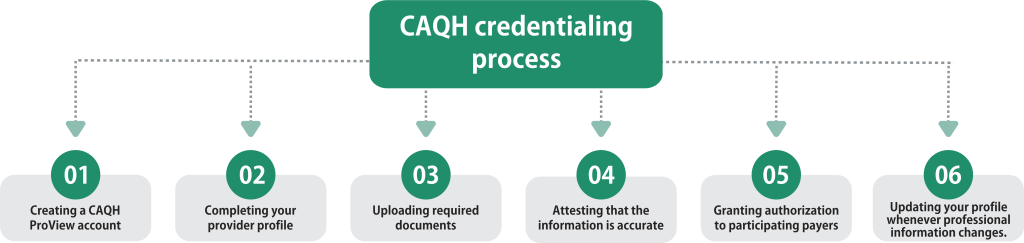
A typical CAQH credentialing process includes:
- Creating a CAQH ProView account.
- Completing your provider profile.
- Uploading required documents.
- Attesting that the information is accurate.
- Granting authorization to participating payers.
- Updating your profile whenever professional information changes.
Because all participating payers retrieve information from the same profile, providers no longer need to complete separate credentialing applications for each insurer, significantly reducing administrative work.
Is CAQH the Same as Credentialing?
No. This is one of the biggest misconceptions among healthcare providers.
CAQH is a provider information database, while credentialing is the verification process performed by insurance companies or healthcare organizations.
Think of it this way:
- CAQH stores your professional information.
- Insurance companies review that information to determine whether you meet their credentialing requirements.
- Credentialing is the decision-making and verification process carried out by the payer, not by CAQH.
In other words, completing your CAQH profile is an important step toward credentialing, but it does not automatically make you credentialed with any insurance company.
What Is a CAQH Number?
A CAQH Number, often referred to as a CAQH Provider ID, is a unique identification number assigned to a healthcare provider after they successfully register with CAQH ProView. This number identifies your profile within the CAQH system and allows participating organizations to access your information once you grant them permission.
Your CAQH Number serves as a reference point for insurers throughout the credentialing process. Instead of requesting your complete professional history each time, insurance companies can simply locate your CAQH profile using this unique identifier.
A CAQH Number is assigned only once and remains associated with your provider profile throughout your career, even if you update your practice information or work with different insurance companies.
Why Is a CAQH Number Important?
Having a CAQH Number offers several advantages:
- Simplifies provider credentialing.
- Reduces repetitive paperwork.
- Speeds up insurance enrollment.
- Allows multiple payers to access the same verified information.
- Makes profile updates easier through a single platform.
- Supports ongoing recredentialing requirements.
Many insurance companies request your CAQH Number before initiating the credentialing process, making it an essential part of joining payer networks.
Is a CAQH Number the Same as an NPI?
No.
Although both identify healthcare providers, they serve completely different purposes.
An NPI (National Provider Identifier) is a federally assigned identification number used for billing, claims processing, and healthcare transactions. A CAQH Number is assigned by CAQH solely to identify your provider profile within its database.
Most providers need both numbers during credentialing and payer enrollment.
CAQH Number vs. NPI vs. Tax ID vs. Provider Enrollment
Healthcare providers often confuse these terms because they are frequently used together during the credentialing process. However, each serves a distinct purpose.
| Feature | CAQH Number | NPI | Tax ID (TIN/EIN) | Provider Enrollment |
| Purpose | Identifies your CAQH profile | Identifies you as a healthcare provider | Identifies your practice or business for tax purposes | Registers you with an insurance company |
| Issued By | CAQH | CMS (National Plan and Provider Enumeration System) | IRS | Individual insurance payer |
| Required for Billing | No | Yes | Yes | Yes |
| Used During Credentialing | Yes | Yes | Yes | Yes |
| One-Time Assignment | Yes | Yes | Yes | No, each payer has its own enrollment process |
Understanding the differences between these terms can help prevent confusion during the credentialing process and ensure you submit the correct information to insurance companies.
Who Needs a CAQH Number?
A CAQH Number is beneficial for nearly every licensed healthcare professional seeking participation in commercial insurance networks. While not every payer requires CAQH, many of the nation’s largest insurance companies use CAQH ProView as part of their credentialing process.
Healthcare professionals who commonly need a CAQH Number include:
- Physicians (MDs and DOs)
- Nurse Practitioners (NPs)
- Physician Assistants (PAs)
- Clinical Psychologists
- Licensed Professional Counselors (LPCs)
- Licensed Clinical Social Workers (LCSWs)
- Marriage and Family Therapists (LMFTs)
- Physical Therapists
- Occupational Therapists
- Speech-Language Pathologists
- Chiropractors
- Dentists and Dental Specialists
- Behavioral Health Providers
- Optometrists
- Podiatrists
- Certified Nurse Midwives
- Registered Dietitians and other licensed allied healthcare professionals
Do All Healthcare Providers Need a CAQH Number?
Not necessarily. Whether you need a CAQH Number depends on the insurance companies you plan to work with and their credentialing requirements.
If you intend to join multiple commercial insurance networks, maintaining a CAQH profile is highly recommended because it streamlines the credentialing process, reduces administrative burden, and allows participating payers to access your professional information from a single, secure location.
Even if a specific payer does not currently require CAQH, having an up-to-date profile can make future credentialing requests significantly faster and more efficient.
Benefits of CAQH Credentialing
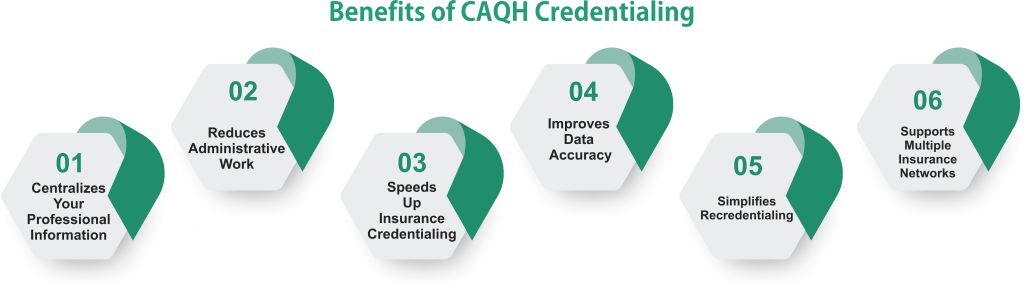
Completing your CAQH profile is more than just another administrative requirement; it can significantly improve how efficiently you manage provider credentialing. Since many insurance companies rely on CAQH ProView to access provider information, maintaining a complete and accurate profile helps reduce delays, minimize duplicate paperwork, and simplify interactions with multiple payers.
Centralizes Your Professional Information
Instead of filling out separate credentialing applications for every insurance company, CAQH allows you to maintain one secure provider profile. Your licenses, certifications, education, employment history, malpractice insurance, and practice details are stored in a centralized location, making updates much easier.
Reduces Administrative Work
One of the biggest challenges in provider credentialing is repeatedly submitting the same documents to different payers. CAQH eliminates much of this duplication by allowing authorized organizations to retrieve your information directly from your profile.
This saves valuable administrative time for both individual providers and medical practices.
Speeds Up Insurance Credentialing
Since participating insurance companies can access your information through CAQH, they spend less time requesting documents and verifying provider details. While credentialing timelines vary by payer, maintaining a complete CAQH profile can help prevent unnecessary delays caused by incomplete or outdated information.
Improves Data Accuracy
Keeping all professional information in one place reduces inconsistencies across credentialing applications. This minimizes the risk of errors such as mismatched employment dates, outdated licenses, incorrect practice addresses, or expired malpractice coverage.
Accurate information also helps insurers complete primary source verification more efficiently.
Simplifies Recredentialing
Most insurance companies periodically recredential providers to ensure their qualifications remain current. Instead of rebuilding your professional profile every few years, you simply update your existing CAQH account and complete the required re-attestation.
This makes ongoing credentialing much less time-consuming.
Supports Multiple Insurance Networks
After authorizing participating payers, multiple insurance companies can securely review the same provider profile. This makes it easier to apply to additional payer networks without starting the credentialing process from scratch every time.
Documents Required Before Registering
Before creating your CAQH profile, gather all required documents and professional information. Having everything prepared in advance makes the registration process faster and helps reduce interruptions while completing your profile.
Below is a comprehensive checklist of information you’ll typically need.
Personal Information
Prepare the following personal details:
- Full legal name
- Date of birth
- Social Security Number (if applicable)
- Contact information
- Personal email address
- Practice address
- Mailing address
Professional Identification
You’ll also need important provider identification details, including:
- National Provider Identifier (NPI)
- State license numbers
- License expiration dates
- DEA registration (if applicable)
- Controlled substance registration (where required)
Education and Training
Be ready to provide complete educational history, including:
- Medical, dental, nursing, or professional school
- Internship information
- Residency training
- Fellowship training
- Graduation dates
- Specialty training
Board Certifications
Include information about:
- Specialty board certifications
- Certification numbers
- Effective dates
- Expiration or recertification dates
Employment History
Prepare a detailed employment timeline covering:
- Previous employers
- Current employer
- Practice affiliations
- Employment dates
- Any gaps in employment, if applicable
Malpractice Insurance Information
Insurance companies typically require details such as:
- Current malpractice carrier
- Policy number
- Coverage limits
- Effective dates
- Claims history, if requested
Hospital Affiliations and Privileges
If applicable, provide:
- Hospital names
- Staff privileges
- Admitting privileges
- Affiliate organizations
Professional References
Some credentialing organizations may request professional references, including:
- Colleagues
- Supervising physicians
- Medical directors
- Professional contacts within your specialty
Supporting Documents Checklist
Keep digital copies of the following documents ready for upload:
- Active state licenses
- DEA certificate (if applicable)
- Board certification certificates
- Malpractice insurance certificate
- Curriculum Vitae (CV)
- Government-issued identification
- W-9 form (if applicable)
- Professional liability documents
Preparing these documents beforehand can significantly reduce the time required to complete your CAQH profile and minimize delays during insurance credentialing.
How to Get a CAQH Number
Obtaining a CAQH Number is a straightforward process, but it requires careful attention to detail. An incomplete profile or missing documentation can delay insurance credentialing and require additional follow-up from participating payers.
Follow these steps to obtain your CAQH Number successfully.
Step 1: Create Your CAQH ProView Account
Begin by registering for a CAQH ProView account using your personal and professional information. During registration, you’ll verify your identity and establish secure login credentials.
If an insurance company has already invited you to CAQH, use the registration information provided by that payer to activate your account.
Step 2: Complete Your Provider Profile
After registration, you’ll be asked to enter comprehensive information about your professional background.
This includes:
- Personal information
- Practice information
- Education
- Training
- Licensure
- Employment history
- Board certifications
- Hospital affiliations
- Professional liability insurance
Be sure every section is completed accurately, as missing information may delay the credentialing process.
Step 3: Upload Required Documents
Next, upload all the requested supporting documents.
Ensure that every document:
- Is current
- Is clearly legible
- Matches the information entered in your profile
- Has not expired
Keeping digital copies organized before starting this step can save considerable time.
Step 4: Review Your Information Carefully
Before submitting your profile, carefully review every section.
Pay special attention to:
- License numbers
- Dates
- Employment history
- Practice addresses
- Contact information
- Certification details
Even small errors can result in additional verification requests from insurance companies.
Step 5: Complete Your Attestation
Once your profile is complete, you’ll electronically attest that all information is accurate and up to date.
This attestation confirms that the information you’ve submitted is truthful and authorizes participating organizations to rely on your profile during credentialing.
You’ll also need to re-attest periodically to keep your profile active.
Step 6: Authorize Participating Payers
Creating your profile alone isn’t enough.
You’ll need to grant authorization for insurance companies and participating organizations to access your CAQH information. Without this authorization, payers won’t be able to review your credentials during their credentialing process.
Step 7: Receive Your CAQH Number
After successfully completing your registration and profile setup, you’ll receive your unique CAQH Number.
You can locate this number within your CAQH account dashboard. Since it serves as your permanent provider identifier within the CAQH system, keep it readily available for future insurance applications and credentialing requests.
How Long Does It Take to Get a CAQH Number?
Many providers want to know how quickly they can obtain a CAQH Number, especially when they’re eager to join insurance networks. The answer depends largely on how quickly you complete your profile and whether all the required information is accurate.
Here’s a typical timeline:
| Stage | Estimated Time |
| Account registration | 15–30 minutes |
| Completing the provider profile | 1–3 hours |
| Uploading supporting documents | 30–60 minutes |
| Reviewing and submitting information | 15–30 minutes |
| Receiving your CAQH Number | Usually available after successful registration and profile creation |
| Insurance credentialing using your CAQH profile | Typically 30–120 days, depending on the payer |
While obtaining a CAQH Number can happen relatively quickly, joining an insurance network usually takes much longer because each payer conducts its own credentialing review, primary source verification, and enrollment process.
To avoid unnecessary delays:
- Complete every section of your profile.
- Upload current documents only.
- Double-check all dates and license information.
- Respond promptly to requests from insurance companies.
- Keep your profile updated through regular re-attestation.
Taking these steps can help ensure that your CAQH profile supports a smoother and more efficient credentialing experience.
What Happens After You Receive Your CAQH Number?
Receiving your CAQH Number is an important milestone, but it doesn’t mean you’re automatically approved to accept insurance. Your CAQH profile simply becomes the centralized source of your professional information that participating insurance companies can review during their credentialing process.
Once your profile is complete and you’ve authorized the appropriate payers, the next phase begins.
Share Your CAQH Number with Insurance Companies
Most insurance companies will ask for your CAQH Number when you apply to join their provider network. Instead of submitting your credentials multiple times, you simply provide your CAQH Number and authorize the payer to access your profile.
This allows the insurance company to retrieve your information directly from CAQH ProView.
Insurance Credentialing Begins
After gaining access to your profile, the insurance company starts its own credentialing process. During this stage, the payer reviews your qualifications and verifies that you meet its participation requirements.
This review typically includes:
- Professional licenses
- Education and training
- Board certifications
- Employment history
- Malpractice insurance
- Work history
- Professional references (if required)
- Practice information
Although CAQH stores your information, the final credentialing decision always belongs to the insurance company.
Primary Source Verification
Insurance companies also conduct Primary Source Verification (PSV) to confirm the accuracy of the information in your profile. Rather than relying solely on uploaded documents, they verify details directly with the issuing organizations whenever possible.
Common items verified include:
- Active medical or professional licenses
- Board certification status
- DEA registration
- Educational credentials
- Hospital privileges
- Professional liability coverage
If discrepancies are found, the payer may request clarification or additional documentation before moving forward.
Provider Enrollment
Once credentialing is approved, the insurance company begins the provider enrollment process. During enrollment, your information is added to the payer’s network so you can provide covered services to their members.
Enrollment may include:
- Contract execution
- Fee schedule assignment
- Tax information verification
- Electronic claims setup
- Payment enrollment
Only after enrollment is complete can you typically begin billing that payer as an in-network provider.
Keep Your Profile Updated
Your responsibilities don’t end once you’re credentialed. Insurance companies expect providers to maintain an accurate CAQH profile throughout their participation in the network.
Whenever information changes, update your profile promptly. This includes:
- New licenses
- Practice address changes
- Phone or email updates
- New malpractice insurance policy
- Employment changes
- Additional certifications
Keeping your profile current helps prevent delays during future recredentialing cycles.
How Often Should You Update Your CAQH Profile?
Maintaining an accurate CAQH profile is just as important as creating one. Outdated information can delay credentialing, interrupt payer enrollment, or even affect your ability to remain in an insurance network.
Healthcare providers should review their profiles regularly and make updates whenever professional information changes.
Complete Re-Attestation Every 120 Days
CAQH requires providers to re-attest every 120 days. During re-attestation, you confirm that the information in your profile is still complete and accurate.
If you fail to re-attest on time, participating insurance companies may no longer be able to rely on your profile during credentialing or recredentialing.
Setting calendar reminders can help ensure you never miss this important deadline.
Update Information Immediately After Changes
Don’t wait until your next re-attestation if something changes. Update your CAQH profile as soon as possible whenever you experience changes, such as:
- New practice location
- Updated contact information
- New employment
- License renewal
- Board certification renewal
- New malpractice insurance policy
- Additional hospital privileges
- Changes to your specialty
Prompt updates help insurance companies access the most accurate information whenever they review your profile.
Monitor Expiration Dates
Several credentials stored in your CAQH profile have expiration dates. Providers should regularly monitor:
- Professional licenses
- DEA registration
- Board certifications
- Malpractice insurance
- Controlled substance registrations
Updating these documents before they expire helps avoid unnecessary credentialing delays.
Is CAQH Credentialing Free?
Yes. Creating and maintaining a CAQH ProView profile is free for healthcare providers. There is no registration fee, annual membership fee, or charge to receive a CAQH Number.
This allows providers to maintain one centralized profile without incurring additional costs.
However, it’s important to distinguish between CAQH registration and credentialing services.
What Is Free?
Healthcare providers can generally complete the following at no cost:
- Create a CAQH account
- Receive a CAQH Number
- Build and maintain a provider profile
- Upload professional documents
- Re-attest every 120 days
- Authorize participating payers
What May Involve Costs?
Although CAQH itself is free, you may still incur expenses related to the broader credentialing process, including:
- Credentialing service providers that manage applications on your behalf
- Medical practice consultants
- Legal or compliance assistance
- State licensing fees
- DEA registration fees
- Malpractice insurance premiums
- Board certification costs
These expenses are separate from CAQH and depend on your profession, specialty, and business needs.
Common Problems When Getting a CAQH Number (and How to Fix Them)
Although the CAQH registration process is relatively straightforward, providers occasionally encounter issues that can slow down profile completion or delay insurance credentialing. Most of these problems can be resolved quickly once you identify the cause.
The table below outlines some of the most common challenges and practical ways to address them.
| Problem | Possible Cause | Solution |
| Unable to create an account | Incorrect personal information or an existing profile | Verify your information and check whether you already have a CAQH account before registering again. |
| Identity verification failed | Mismatched personal details | Ensure your name, date of birth, and other identifying information match your official records. |
| Missing required documents | Incomplete profile | Gather all required documents before starting the registration process and upload clear, current copies. |
| Expired licenses or certifications | Outdated credentials | Renew expired credentials and update your CAQH profile immediately. |
| Duplicate CAQH profiles | Multiple registrations | Contact CAQH support to merge or recover your existing account rather than maintaining multiple profiles. |
| Insurance company cannot access your profile | Payer authorization not granted | Log in to your CAQH account and authorize the participating payer to view your profile. |
| Profile marked incomplete | Required fields missing | Review every section carefully and complete any outstanding information before submitting. |
| Delayed credentialing | Inaccurate or inconsistent information | Compare your profile with supporting documents to ensure all information is accurate and consistent. |
Most registration issues are caused by incomplete information rather than technical problems. Taking the time to review your profile before submission can help prevent unnecessary delays later in the credentialing process.
Tips for Avoiding Registration Delays
A few simple practices can help you complete your CAQH profile more efficiently:
- Gather all required documents before creating your account.
- Use consistent information across all forms and supporting documents.
- Review every section before submitting your profile.
- Upload only current and legible documents.
- Respond promptly if an insurance company requests additional information.
- Keep your profile updated after receiving your CAQH Number.
Being proactive during registration can save weeks of back-and-forth communication during credentialing.
Conclusion
CAQH credentialing plays a vital role in helping healthcare providers simplify the credentialing process and connect with insurance companies more efficiently. Instead of completing separate applications for every payer, you can maintain a single, centralized profile that securely stores your professional credentials, licenses, certifications, and practice information.
Obtaining a CAQH Number is a straightforward process, but accuracy and ongoing maintenance are essential. Completing your profile thoroughly, uploading current documents, authorizing participating payers, and re-attesting every 120 days can help reduce credentialing delays and improve your chances of joining insurance networks more quickly.