
An oral and maxillofacial surgeon (OMS) who bills both dental and medical plans needs a separate approval on every track that pays: each dental network, each medical plan, Medicare if the practice wants Medicare money, and the Medicaid dental plan where it treats those patients. Being in-network on the dental side of a carrier does nothing for its medical side.
A DDS or DMD is enough for most of it. Medicare counts a licensed dentist as a physician, and medical plans can credential DDS-only oral surgeons, though each plan sets its own criteria. What trips practices up is the setup underneath the applications: which taxonomy the NPI carries, whether CAQH is the route a given payer actually uses, and which claim form and code set the plan expects.
Those oral surgeon medical insurance credentialing rules differ by payer, so this guide separates what is fixed by federal rule from what each plan decides for itself, and points to the source for each.
Key Takeaways
- Every payer track is its own enrollment. Dental, commercial medical, Medicare and Medicaid dental plans each credential and contract separately, and hospital privileges are a fifth, unrelated approval.
- A DDS or DMD can enroll in Medicare. The Social Security Act lists licensed dentists in its definition of physician, and CMS recognizes oral and maxillofacial surgery as a dental specialty for enrollment on the CMS-855I.
- Medicare still excludes routine dental care. It pays for dental services only in narrow cases, such as work inextricably linked to a covered medical treatment, and since July 1, 2025 those claims need the KX modifier.
- Taxonomy is a real decision for OMS. The national code set lists the specialty twice, 1223S0112X under Dentist and 204E00000X under physicians, and the choice affects how payers classify the surgeon.
- CAQH is now DataSpring, powered by CAQH, and one profile serves dental and medical plans alike. Some payers still skip it, including Medicare and UnitedHealthcare’s dental credentialing.
- MCNA Dental currently enrolls dentists for programs in Texas, Louisiana, Idaho and Florida, and does not publish a standard turnaround. In Texas, the dentist must already be enrolled in Texas Medicaid before MCNA will review the file.
Last updated: October 29, 2026.
Which enrollments an oral surgeon actually needs
Start from the claims, not the applications. Every claim the practice sends goes to a payer that must already recognize the surgeon, at that location, under that tax ID. So the first job is listing which payers will receive claims and working backward to the enrollments.
Most OMS practices end up with four tracks running at once. They share documents, but not approvals, and each moves at its own pace.
The four payer tracks at a glance
| Track | Who credentials | How you apply | Claims go on |
|---|---|---|---|
| Dental plans (PPO, DHMO) | Each dental carrier or its credentialing vendor | CAQH profile where accepted, otherwise the carrier’s own application or portal | ADA dental claim form or 837D, CDT codes |
| Commercial medical plans | Each health plan, often through a delegated group or verification vendor | CAQH profile plus the plan’s application and contract | CMS-1500 or 837P, CPT/HCPCS with ICD-10-CM |
| Medicare (Original) | Your Medicare Administrative Contractor (MAC) | PECOS or the paper CMS-855I, plus CMS-855B for a group | Covered dental services: 837D/2024 ADA, 837P/CMS-1500 or 837I/CMS-1450; medical services: 837P/CMS-1500 |
| Medicaid dental plans (for example MCNA) | The dental plan, after state Medicaid enrollment where required | State-specific route: CAQH or a state credentialing application | Per the plan’s manual, CDT codes |
Hospital and surgery-center privileges sit outside this table. A medical staff office grants them for its own building, and they are not network participation. Some medical plans do ask for privileges as a credentialing condition, which is why the privileging file and the payer file have to tell the same story. Our hospital privileging services handle that side.
A dental contract with a carrier does not put the surgeon in that carrier’s medical network. Claims to the medical side process as out-of-network until the medical contract is signed and its effective date has passed.
Dental vs medical credentialing for oral surgery
The paperwork overlaps more than people expect. Both sides want the license, NPI, malpractice face sheet, DEA registration, education and residency, and work history. The difference is what the payer is deciding.
A dental plan decides whether a licensed dentist with OMS training can join its dental network. A medical plan decides whether to classify the surgeon as a participating provider for medical and surgical benefits, and that classification drives which CPT codes it will pay a dentist for.
An MD is not a universal requirement for medical networks. But each plan writes its own criteria, and some set the bar high. One example: Univera Healthcare’s published oral surgeon criteria call for completed advanced OMS training from an ADA-approved program, current board certification with the American Board of Oral and Maxillofacial Surgery, a valid DEA and hospital privileges if applicable, and liability coverage of $1,000,000 per occurrence and $3,000,000 aggregate. That is one plan’s standard, not an industry rule. Ask each medical plan for its OMS criteria before building the packet.
| Item | Dental plan credentialing | Medical plan credentialing |
|---|---|---|
| License verified | State dental license | State dental license, plus medical license for dual-degree surgeons who list one |
| Specialty proof | OMS residency certificate | OMS residency, often board status; criteria vary by plan |
| Provider classification | Dental specialist | Varies: some plans file OMS under a dental type, others under a physician-type specialty |
| Facility requirements | Rarely asked | Hospital or ASC privileges sometimes required |
| Data source | CAQH or the carrier’s own portal | CAQH at many commercial plans; PECOS for Medicare |
| Code sets on claims | CDT | CPT/HCPCS with ICD-10-CM |
Keep one master credentialing file per surgeon and build every application from it. Dual-track denials often start with two versions of the same fact, such as a different practice address or taxonomy on the dental and medical applications.
Medicare rules for DDS and DMD oral surgeons
Medicare is where practices go wrong in both directions. Some assume a dentist can’t enroll. Others enroll and then expect Medicare to pay for routine extractions. Both are mistakes.
Eligibility comes from the statute
Section 1861(r) of the Social Security Act defines “physician” to include a doctor of dental surgery or dental medicine who is licensed by the state and acting within the scope of that license. CMS’s Medicare dental coverage page (last modified March 10, 2026) lists who can enroll: a DDS or DMD, legally authorized to practice in the state, acting within scope. Oral and maxillofacial surgery is one of the dental specialties Medicare recognizes for enrollment.
What Medicare will and won’t pay a dentist for
Section 1862(a)(12) of the Act and 42 CFR 411.15(i) exclude services for the care, treatment, filling, removal or replacement of teeth or structures directly supporting the teeth. The exceptions are narrow. CMS’s own list of examples includes:
- Dental exams and treatment to eliminate an oral or dental infection before or alongside certain covered treatments, such as organ transplant, cardiac valve replacement, valvuloplasty, certain cancer therapies and ESRD dialysis.
- Dental services before, during and after Medicare-covered treatment of head and neck cancer.
- Ridge reconstruction done at the same time as, and because of, surgery to remove a tumor.
- Stabilizing or immobilizing teeth in connection with reducing a jaw fracture.
- Dental splints used as part of covered treatment of a covered condition, such as a dislocated jaw joint.
CMS clarified and expanded these “inextricably linked” examples through the CY 2023, CY 2024 and CY 2025 Physician Fee Schedule final rules; the CY 2026 rule made no changes to this policy. The same CMS page names extraction of an impacted tooth as a non-covered example, so routine removal of impacted teeth, including most third molars, isn’t payable by Original Medicare. It goes to the patient’s dental coverage (for example a Medicare Advantage supplemental dental benefit) or is self-pay, unless it is inextricably linked to a covered service.
Separately, Medicare may cover medical procedures a dentist is licensed to perform that fall outside the dental exclusion. The ADA’s example is a biopsy for suspected oral cancer. Coverage still depends on medical necessity and correct coding.
Enroll, order and refer only, or opt out
A dentist has three Medicare statuses to choose from, and the right one depends on whether the practice will bill Medicare at all.
| Status | Form | What it allows | Watch for |
|---|---|---|---|
| Full enrollment | CMS-855I (or PECOS); CMS-855B for the group | Billing Medicare for covered services; ordering and referring | Must submit claims for covered services; report ownership, adverse-action and practice-location changes within 30 days, other changes within 90 days |
| Ordering and referring only | CMS-855O | Medicare pays others for imaging, clinical lab, DMEPOS and home health the dentist orders | No Medicare payment to the dentist |
| Opt out | Opt-out affidavit to each MAC | Private contracts with Medicare patients for services Medicare would cover | Two-year periods that renew automatically; Medicare Advantage plans generally can’t pay an opted-out dentist except for emergency or urgent care |
The ordering rules come from CMS’s ordering and certifying page, which lists doctors of dental medicine and dental surgery as eligible and requires approved or opt-out status with an individual NPI. Two ADA notes matter for OMS: dentists are not required to enroll or opt out for Part D plans to cover their prescriptions, and since January 1, 2022, opt-out status no longer blocks Medicare Advantage payment for supplemental dental benefits. If you are weighing opt-out, our guide to opting out of Medicare walks through the affidavit and the private contract.
Timeline, effective date and claims
CMS says MACs take about 45 days to review an application, longer on paper. If approved, the billing effective date is the later of the date the MAC received the application or the date the surgeon began furnishing services. Billing starts after the approval letter arrives. The Medicare provider enrollment page covers how we handle the PECOS side.
Medicare accepts covered dental services on the 837D or 2024 ADA dental claim form, as well as the 837P/CMS-1500 and the institutional 837I/CMS-1450. The 837D has been accepted since July 2024. The rules tightened in 2025: since July 1, 2025, the KX modifier is required on dental services inextricably linked to covered medical services, and an ICD-10 code is required on the dental claim form. The medical record must also show the coordination between the treating physician and the dentist. Without that documented exchange, CMS says it won’t pay.
Medicare uses PECOS and the CMS-855 forms, not CAQH. A perfect CAQH profile does nothing for a Medicare application.
NPI and taxonomy setup for dental and medical billing
One surgeon, one individual NPI. CMS’s NPI guidance says an individual can hold only one Type 1 NPI, and it doesn’t change when the taxonomy, name or address changes. The group adds a Type 2 NPI for the practice entity. There is no separate “dental NPI” and “medical NPI.” Our NPI Type 1 vs Type 2 guide covers the group side.
Taxonomy is where OMS practices have a genuine choice. The NUCC taxonomy code set (version 26.1, July 2026) lists the specialty in two places:
| Taxonomy code | NUCC grouping | Medicare specialty it maps to | Typical use |
|---|---|---|---|
| 1223S0112X | Dentist, Oral and Maxillofacial Surgery | 19, Oral Surgery (dentist only) | The dental classification for any DDS or DMD oral surgeon |
| 204E00000X | Allopathic & Osteopathic Physicians, Oral & Maxillofacial Surgery | 85, Maxillofacial Surgery | Dual-degree surgeons, and OMS who meet one of the CMS criteria for specialty 85 that AAOMS describes |
The specialty mappings come from CMS’s Medicare specialty-to-taxonomy crosswalk. The NUCC notes on 204E00000X say OMS is generally considered a specialty of dentistry, while physicians can also be board certified in it through ABOMS.
AAOMS goes further. In a February 6, 2024 letter to CMS, it said OMS can enroll under either provider category 19 or 85, subject to CMS criteria. Its practice guidance encourages surgeons to list the physician-based code as primary if they meet any one of the CMS criteria for specialty 85 that AAOMS cites: ABOMS board certification, malpractice coverage through OMSNIC, or a current state OMS specialty license. It also warns that the dental code, while not incorrect, can lead to payment differences, and that surgeons who meet none of the criteria have only the dental code available.
So the code on the NPI is not a formality. Pick it deliberately, record it in NPPES, and make CAQH, PECOS and every payer application match it. For the mechanics of changing a code, see our explainer on taxonomy codes in medical billing.
Before the first medical application goes out, pull the surgeon’s NPI record from the NPPES registry and check the primary taxonomy against the specialty you plan to claim with each payer. A mismatch here is a frequent reason applications come back.
CAQH dental vs medical profile setup
There is no separate dental CAQH. One profile in the CAQH Provider Data Portal can be released to dental plans and medical plans alike.
Two name changes confuse dental offices. The portal many people still call ProView now goes by the Provider Data Portal, and in June 2026 CAQH itself rebranded as DataSpring, powered by CAQH. Logins, profiles and portal access stayed the same, and the portal remains free for providers. Dentists also reach the portal through the ADA Credentialing Service, which the ADA describes as powered by CAQH and available to every U.S.-licensed dentist, member or not. It is an entry point, not a second profile.
What a dual-track OMS profile needs
- Every state license the surgeon holds, dental and medical
- DEA registration and state controlled-substance registrations
- Sedation or anesthesia permits the state issues to OMS
- OMS residency, board certification status and any fellowship
- Hospital and surgery-center affiliations, with privilege dates
- A current malpractice face sheet with limits and policy dates
- Taxonomy entries that match NPPES, primary first
- Each practice location, tax ID and group affiliation
- Authorization for every plan you’re applying to, dental and medical
Re-attest every 120 days. The ADA notes the system is designed to require it for all providers, and an expired attestation stalls every plan pulling from the profile at once.
Payers that don’t rely on CAQH
CAQH is common, not universal. Know the exceptions before assuming a profile is enough:
- Medicare uses PECOS and the CMS-855 forms.
- UnitedHealthcare dental still requires in-network dentists to credential and recredential through its own portal (which can import CAQH data), according to an August 12, 2026 ADA News report. The ADA noted the same company appears to use CAQH for medical providers.
- MCNA in Louisiana asks for the Louisiana Standardized Credentialing Application rather than a CAQH release.
Whether CAQH is required at all is a payer decision. Our post on whether CAQH is mandatory explains how plans use it.
Cross-coding dental procedures to medical insurance
Cross-coding means reporting a service with the code set the paying plan uses: CDT on dental claims, CPT or HCPCS with ICD-10-CM diagnoses on medical claims. There is no official one-to-one crosswalk between CDT and CPT. The code must describe the procedure actually performed, and the diagnosis must support why the medical plan should pay.
Cross-coding only works when the enrollment is already in place. A correctly coded medical claim from a surgeon who isn’t contracted with that medical plan still processes out-of-network. That is the link between this section and everything above.
How common OMS scenarios usually route
These are general patterns, not coverage decisions. The patient’s plan documents and the payer’s policies decide each case.
| Scenario | Usually billed to | Diagnosis coding example | What decides it |
|---|---|---|---|
| Removal of impacted third molars | Dental plan | K01.1, impacted teeth | Medicare lists impacted-tooth extraction as non-covered; a commercial medical plan pays only if its policy covers it |
| Mandible fracture repair | Medical plan | S02.6- category, fracture of mandible, coded to full specificity | Medical benefits; Medicare also covers tooth stabilization done with the jaw-fracture reduction |
| Cyst or tumor of the jaw | Medical plan | K09.0, developmental odontogenic cysts, or the pathology-confirmed code | Pathology report and the medical plan’s policy |
| Clearing a dental infection before an organ transplant | Medicare (inextricably linked) | ICD-10 code required on the dental claim since July 1, 2025 | Documented physician-dentist coordination plus the KX modifier |
| Orthognathic surgery | Medical plan, usually after review | M26.0- category, major anomalies of jaw size, coded to full specificity | The plan’s orthognathic policy; cosmetic surgery is excluded |
ICD-10-CM codes shown are from the FY 2027 code set. Categories marked with a dash need additional characters before they are billable.
Documentation and prior authorization
Medical plans pay on documented necessity, and each plan writes its own criteria. UnitedHealthcare’s commercial orthognathic surgery policy (MP.013.25, effective May 1, 2026) is a good illustration: it requires both a measured skeletal deformity and a functional impairment, such as chewing or swallowing problems or a speech impairment caused by the deformity. It excludes cosmetic surgery and defers to the member’s plan document when the two conflict.
Dental plans set their own authorization rules too. MCNA’s Texas provider manual (version 1.32, September 14, 2026) requires prior authorization for surgical extraction codes D7210, D7220, D7230 and D7240 on primary and permanent teeth, plus extraction of teeth 1, 16, 17 and 32. The manual carves out a separate documentation exception for oral surgeons on D7210, so read the current version rather than relying on a summary.
Common cross-coding errors that end in denials:
- A CPT code that doesn’t describe what the operative report shows.
- A diagnosis code without the clinical findings to support it.
- Billing the medical plan for a service its policy excludes.
- Skipping a required prior authorization.
- Sending the claim before the surgeon’s effective date with that plan.

Cross-coding is not a way around a dental benefit limit. A medical claim has to describe a medically covered service, and the record has to prove it.
MCNA dental provider enrollment timeline
MCNA Dental administers Medicaid and CHIP dental benefits under state contracts. As of October 2026, MCNA’s site lists four state programs, and each has its own enrollment route:
| State and program | Credentialing route | Prerequisites and notes | Provider hotline |
|---|---|---|---|
| Texas Medicaid and CHIP | CAQH (MCNA’s preferred method) or the Texas Universal Credentialing Application | Active Texas Medicaid (TMHP) enrollment required before MCNA review | 1-855-776-6262 |
| Louisiana Medicaid and CHIP | Louisiana Standardized Credentialing Application | Check MCNA’s Louisiana manual for state prerequisites | 1-855-701-6262 |
| Idaho Smiles (Medicaid) | CAQH (preferred) or MCNA’s New Provider Form | One Office Location/Information Form per office not already in the network | 1-855-235-6262 |
| Florida Healthy Kids (CHIP) | CAQH (preferred) or MCNA’s New Provider Form | Florida Healthy Kids covers children 5 to 18 | 1-855-698-6262 |
The steps MCNA publishes
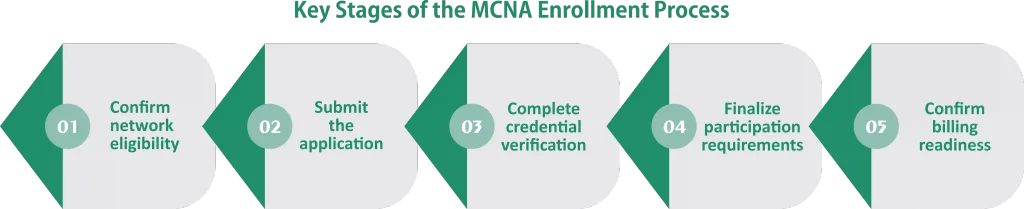
Each state page lays out the same three steps. First, credentialing materials: the CAQH release or the state application. Second, contracting materials: in Texas that means the Dental Provider Agreement, a group roster, an IRS W-9, an office location form for any new office and a payment method form if you want electronic payment. Third, submission: in Texas, through MCNA’s secure email form or by fax to its Network Development team.
MCNA’s Texas manual lists what it verifies at initial credentialing and every recredentialing: Texas dental license, Medicare or Medicaid provider number, DEA certificate, malpractice face sheet, CV, board certificate or evidence of adequate training, W-9, the signed agreement and application, a provider roster and reference letters. MCNA recredentials at least every three years, and its committee reviews a written appeal of a denial within 30 days of the decision notice.
How long it takes
MCNA doesn’t publish a standard turnaround, so any fixed number quoted online is an estimate. In Dr. Credentialing’s experience, a complete MCNA application usually takes about 60 to 120 days, and state Medicaid prerequisites, missing documents or contracting questions add time. Treat that as a planning estimate, not an MCNA commitment.
Three practical points shorten the wait or prevent a reset:
- A dentist already in MCNA’s network who joins an office already in the network uses the Add an Existing MCNA Provider to an Existing MCNA Office form instead of the full enrollment steps.
- Texas providers can ask MCNA for application status at any time through the hotline.
- The Texas manual asks for three to four weeks’ notice before adding a new treating dentist, and immediate notice of license, address, name or tax ID changes.
MCNA covers dental benefits only. When the same Medicaid patient needs a medically covered procedure, that claim goes through the state’s medical program or medical plan, which is a separate enrollment. Our MCNA Dental credentialing team tracks both sides for OMS groups.
A payer enrollment sequence for OMS practices
Run the tracks in parallel, but in this order, so nothing downstream gets built on bad data.
Step 1: Map payers to services
List the dental plans, medical plans, Medicare and Medicaid programs your patients carry, and the services each will actually pay for. Drop any track that will never receive a claim.
Step 2: Fix identity data first
Settle the taxonomy decision, update NPPES, then bring CAQH into line with it. Every later application copies these fields.
Step 3: File Medicare and the dental plans early
Medicare runs on its own review clock, and dental plans don’t wait on medical ones. Start the CMS-855I or CMS-855O and the dental applications in the same week.
Step 4: Ask each medical plan for its OMS criteria
Board certification, privileges and malpractice limits vary by plan. Ask before submitting, so the packet answers the questions the first time.
Step 5: Track effective dates, not approval letters
For each payer, record the contract effective date and the location and tax ID it covers. Schedule patients as in-network only after that date.
Step 6: Test claims before volume arrives
Send a first claim on each new track and confirm it pays at the in-network rate before the schedule fills.
Conclusion
Most oral surgeon medical insurance credentialing rules aren’t hard; the number of separate approvals is. A DDS or DMD surgeon can join Medicare, medical plans and dental networks, but each one needs its own application, its own contract and its own effective date. Get the NPI taxonomy right first, keep one CAQH profile attested, and know which payers skip CAQH entirely. Cross-coding only pays once those enrollments are live.
Practices that would rather not run four payer tracks plus privileging at once can hand them to our dental credentialing services team, which handles dental, medical and Medicare enrollment for oral and maxillofacial surgeons.
Frequently Asked Questions
Yes. The Social Security Act counts a licensed doctor of dental surgery or dental medicine as a physician, and CMS lists oral and maxillofacial surgery as a dental specialty for enrollment on the CMS-855I. Medicare still pays dentists only for covered services, not routine dental care.
There is no need for one. A single CAQH Provider Data Portal profile can be released to dental and medical plans, and dentists who log in through the ADA Credentialing Service reach that same CAQH system.
No. Original Medicare enrollment goes through PECOS or the paper CMS-855 forms filed with your Medicare Administrative Contractor. Medicare Advantage plans run their own credentialing, which may or may not use CAQH.
Sometimes, when the visit includes distinct services that each plan covers, such as a medically covered procedure and a separate dental service. Each service is billed once, with the code set that plan uses, and each plan’s coordination-of-benefits rules decide which pays first. Billing the same service to both plans for double payment is not allowed.
MCNA administers Medicaid and CHIP dental benefits under state contracts. It currently enrolls dentists for Texas Medicaid and CHIP, Louisiana Medicaid and CHIP, Idaho Smiles and Florida Healthy Kids.
NPPES, CAQH, PECOS and every payer record that lists the old address. Medicare requires a practice-location change to be reported within 30 days, and MCNA’s Texas manual asks for immediate notice of address changes.