
If you’re planning to join insurance networks, expand your healthcare practice, or begin the provider credentialing process, you’ve likely wondered, “Is CAQH mandatory?” The answer isn’t as straightforward as a simple yes or no.
While CAQH (Council for Affordable Quality Healthcare) ProView is not legally required by federal law, it has become an essential part of the credentialing process for many commercial insurance companies, healthcare organizations, and medical groups.
In fact, not having an up-to-date CAQH profile can delay payer enrollment, slow reimbursements, and even prevent you from contracting with certain insurers.
What Is CAQH?
CAQH (Council for Affordable Quality Healthcare) is a nonprofit alliance created by the healthcare industry to streamline administrative processes between healthcare providers and insurance companies. One of its most widely used solutions is CAQH ProView, a secure online database where providers store and manage their professional credentials.
Instead of completing nearly identical credentialing applications for every insurance company, providers enter their information once into CAQH ProView. Authorized insurance companies and healthcare organizations can then review the profile during credentialing and provider enrollment.
A typical CAQH profile includes:
- Professional licenses
- National Provider Identifier (NPI)
- DEA registration (if applicable)
- Education and training history
- Board certifications
- Work history
- Practice locations
- Malpractice insurance
- Hospital affiliations
- Disclosure questions
- Supporting credentialing documents
By centralizing this information, CAQH reduces duplicate paperwork and speeds up the credentialing process for both providers and payers.
Is CAQH Mandatory?
The short answer is no, CAQH is not legally mandatory. There is no federal law that requires healthcare providers to register with CAQH ProView before practicing medicine or treating patients. However, for many providers who want to participate in commercial insurance networks, maintaining an active CAQH profile is considered a practical necessity.
Most private health insurance companies use CAQH as their preferred platform to collect and verify provider information during credentialing. Instead of asking every provider to complete separate applications, insurers access a centralized profile that contains licensing, education, certifications, malpractice history, and other credentialing documents.
Is CAQH Mandatory in Different Situations?
| Situation | Is CAQH Mandatory? |
| Federal law | ❌ No |
| Medicare enrollment | ❌ No |
| Traditional Medicaid enrollment | Usually No |
| Commercial insurance credentialing | ✅ Often Required |
| Hospital or health system credentialing | Sometimes |
| Group practice employment | Frequently Requested |
| Cash-pay or concierge practice | ❌ Usually No |
Although CAQH isn’t a legal requirement, it has become an industry standard that simplifies credentialing and payer enrollment for thousands of healthcare providers.
Why Do Insurance Companies Require CAQH?
Insurance companies process thousands of credentialing applications every year. Reviewing separate applications from every provider would be time-consuming, inconsistent, and expensive. CAQH solves this challenge by providing a standardized platform where credentialing information is stored, updated, and securely shared.
When providers maintain an accurate CAQH profile, insurers can verify qualifications much faster without repeatedly requesting the same documents.
Benefits for Insurance Companies
- Standardized provider information
- Faster credential verification
- Reduced administrative costs
- Fewer incomplete applications
- Improved compliance with credentialing standards
- Easier recredentialing every few years
Benefits for Healthcare Providers
- Complete one profile instead of multiple applications
- Save hours of administrative work
- Faster participation in insurance networks
- Easier updates when licenses or practice information change
- Less paperwork for future payer enrollments
Benefits for Patients
Although patients never interact with CAQH directly, they benefit when providers complete credentialing more efficiently. Faster credentialing means providers can join insurance networks sooner, improving patient access to in-network healthcare services.
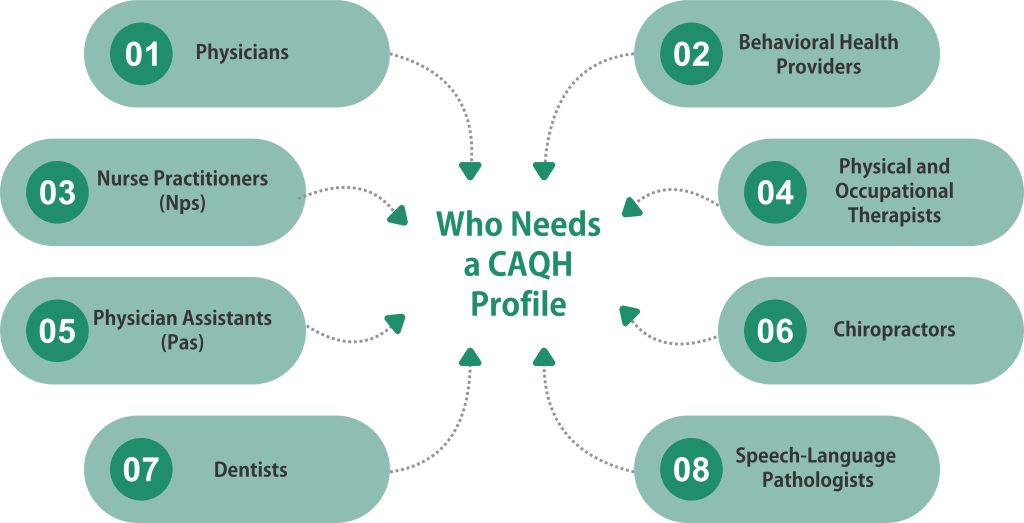
Who Needs a CAQH Profile?
Not every healthcare professional is required to have a CAQH profile, but many providers who accept commercial insurance will find it extremely beneficial—and often necessary.
Here are the healthcare professionals who are commonly asked to maintain an active CAQH profile:
Physicians: Whether you’re a primary care physician or a specialist, most commercial insurers request a completed CAQH profile during credentialing.
Nurse Practitioners (NPs): Independent and collaborative nurse practitioners frequently use CAQH when joining insurance networks or changing employers.
Physician Assistants (PAs): Many healthcare organizations require physician assistants to maintain current CAQH information for credentialing purposes.
Dentists: Dental insurance carriers increasingly use CAQH for credential verification and provider enrollment.
Behavioral Health Providers: Psychologists, psychiatrists, licensed counselors, therapists, and clinical social workers commonly rely on CAQH to credential with behavioral health insurance plans.
Physical and Occupational Therapists: Rehabilitation providers often complete CAQH profiles before contracting with commercial insurance companies.
Chiropractors: Many chiropractic providers maintain CAQH profiles to simplify participation with multiple insurance carriers.
Speech-Language Pathologists: Speech therapists accepting insurance frequently encounter CAQH requirements during enrollment.
Home Health Providers: Healthcare professionals working in home health settings may need CAQH depending on employer and payer requirements.
Telehealth Providers: As virtual healthcare continues to expand, many telehealth organizations require providers to maintain updated CAQH profiles before joining their networks.
Group Practices: Healthcare groups often encourage or require every credentialed provider to keep an active CAQH profile to streamline enrollment with multiple payers.
When Is CAQH Required?
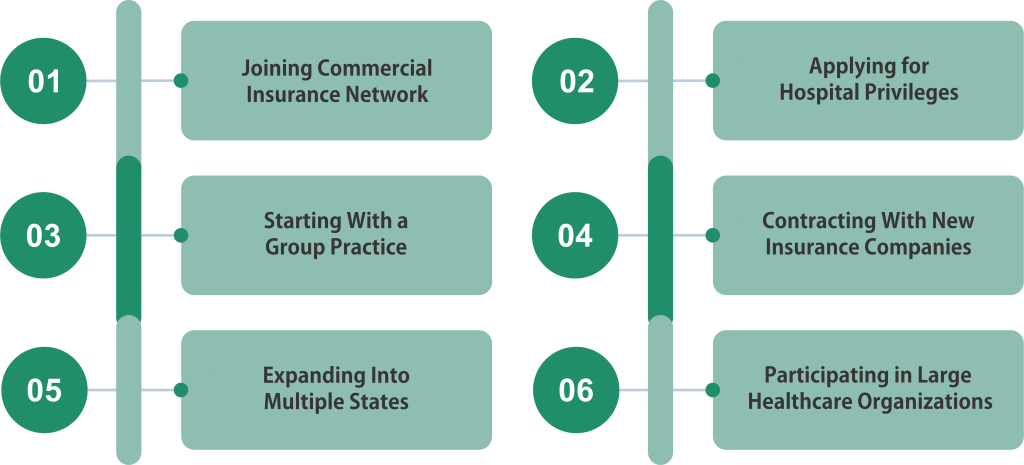
Although CAQH isn’t required by law, there are several situations where maintaining an active profile becomes an important part of the credentialing process.
Joining Commercial Insurance Networks:
Most commercial insurance companies request CAQH authorization before reviewing a provider’s credentialing application. Without it, enrollment may be delayed or placed on hold.
Applying for Hospital Privileges:
Some hospitals and healthcare systems use CAQH to collect provider credentials before granting clinical privileges or onboarding new practitioners.
Starting With a Group Practice:
Many medical groups ask newly hired providers to complete their CAQH profile before employment begins, making credentialing with participating insurance plans much easier.
Contracting With New Insurance Companies:
Whenever providers expand their accepted insurance plans, CAQH often serves as the primary source of credential verification.
Expanding Into Multiple States:
Providers practicing across multiple states frequently find CAQH especially valuable because many regional and national insurers rely on the platform during credentialing.
Participating in Large Healthcare Organizations:
Integrated health systems and multispecialty organizations often standardize credentialing by requesting every provider maintain an updated CAQH profile.
While CAQH is rarely a legal requirement, it is often a business requirement. If your goal is to accept commercial insurance, grow your practice, or reduce credentialing delays, maintaining an accurate and regularly updated CAQH profile is one of the smartest administrative steps you can take.
When Is CAQH NOT Required?
Although CAQH has become a standard part of provider credentialing, there are several situations where maintaining a CAQH profile may not be necessary. The deciding factor is usually whether you plan to work with insurance companies or operate independently.
Cash-Pay Practices: Healthcare providers who accept only direct payments from patients generally do not need a CAQH profile because they aren’t credentialing with commercial insurance companies.
Concierge Medicine: Many concierge practices charge membership or subscription fees instead of billing insurance. In these cases, CAQH is often unnecessary unless the provider also contracts with insurance plans.
Self-Pay Clinics: Clinics that exclusively serve self-paying patients typically complete very little insurance credentialing, reducing the need for CAQH.
Medicare-Only Providers: If you only participate in Medicare, you may not need CAQH since Medicare enrollment primarily occurs through the PECOS system. However, some organizations that employ Medicare providers may still request a CAQH profile for internal credentialing purposes.
Certain Medicaid Programs: Traditional Medicaid enrollment often follows state-specific procedures rather than CAQH. However, many Medicaid Managed Care Organizations (MCOs) use CAQH during credentialing, so requirements vary depending on your state and participating health plans.
Retired or Non-Practicing Providers: Providers who are no longer treating patients or participating in insurance networks usually have no reason to maintain an active CAQH profile.
Which Insurance Companies Require CAQH?
Many of the largest commercial health insurance companies use CAQH ProView as part of their credentialing and provider enrollment process. While some insurers make CAQH mandatory, others strongly recommend it to simplify application reviews.
Keep in mind that requirements may differ based on the insurance company, the provider’s specialty, and the state where services are offered.
| Insurance Company | Uses CAQH? | Notes |
| Aetna | ✅ Yes | Commonly requests CAQH during credentialing |
| Cigna Healthcare | ✅ Yes | Widely uses CAQH ProView |
| UnitedHealthcare | ✅ Yes | Frequently requires CAQH authorization |
| Humana | ✅ Yes | Standard credentialing process includes CAQH |
| Elevance Health (formerly Anthem) | ✅ Yes | Used in many provider enrollment workflows |
| Blue Cross Blue Shield Plans | ✅ Often | Requirements vary by state and local plan |
| Molina Healthcare | ✅ Often | Depends on state and product line |
| Centene Health Plans | ✅ Often | Many affiliated plans use CAQH |
| WellCare | ✅ Often | Varies by region |
| Kaiser Permanente | ⚠️ Varies | Credentialing requirements differ by market |
Medicare vs. CAQH
| Medicare Enrollment | CAQH ProView |
| Used for Medicare participation | Used primarily for commercial payer credentialing |
| Managed through PECOS | Managed through CAQH ProView |
| Federal government system | Industry-supported credentialing platform |
| Required for Medicare billing | Not legally required by Medicare |
Does Medicaid Require CAQH?
The answer depends on your state’s Medicaid program.
Traditional fee-for-service Medicaid programs generally have their own provider enrollment procedures and may not require CAQH. However, many Medicaid Managed Care Organizations (MCOs) use CAQH as part of their credentialing process because they operate similarly to commercial insurance companies.
This means a provider could encounter different requirements even within the same state.
For example:
- Traditional Medicaid enrollment may only require state-specific forms.
- Medicaid managed care plans may request an active CAQH profile.
- Some states integrate CAQH into portions of their credentialing workflow.
- Others rely entirely on separate provider enrollment systems.
If You’re Applying to Multiple Medicaid Plans
Maintaining an updated CAQH profile can still save time because many managed care organizations participate in the platform. Even when it’s not mandatory, having your documents readily available reduces repetitive paperwork and accelerates credential verification.
How to Register for CAQH?
Creating a CAQH profile is a straightforward process, but accuracy is essential. Completing every section carefully can help prevent credentialing delays later.
Step 1: Create Your CAQH Account
Visit the CAQH ProView portal and register as a healthcare provider. Some providers receive an invitation from an insurance company, while others create an account independently.
Step 2: Verify Your Identity
You’ll be asked to confirm your identity using professional details such as your National Provider Identifier (NPI), license information, and other identifying credentials.
Step 3: Complete Your Provider Profile
Enter all required information, including:
- Personal information
- Practice locations
- Education and training
- Employment history
- Professional licenses
- Hospital affiliations
- Board certifications
- Malpractice insurance
- Disclosure questions
Take your time to ensure all information is complete and consistent.
Step 4: Upload Supporting Documents
Attach current copies of all required documentation, such as licenses, certifications, malpractice insurance, and DEA registration (if applicable).
Step 5: Authorize Participating Organizations
Grant permission for insurance companies, hospitals, or credentialing organizations to access your CAQH profile during the enrollment process.
Step 6: Review Your Information
Before submitting, carefully review every section for accuracy. Small errors can delay credentialing and require follow-up corrections.
Step 7: Submit Your Profile
Once all required fields are complete, submit your profile for use by participating organizations.
Step 8: Complete Your Initial Attestation
Finally, attest that all information is accurate. This verification is required before organizations can rely on your CAQH profile during credentialing.
Documents You’ll Need for CAQH
Having your documents organized before creating or updating your CAQH profile can make the credentialing process much smoother. Since insurance companies use this information to verify your qualifications, it’s important to ensure every document is current, accurate, and easy to access.
While document requirements can vary slightly depending on your specialty and the insurance company, most providers should have the following ready.
1. Personal and Professional Information
Start by gathering your basic professional details, including:
- Full legal name
- Date of birth
- Contact information
- National Provider Identifier (NPI)
- Social Security Number or Tax Identification Number (where applicable)
2. State Medical Licenses
Upload copies of all active professional licenses for every state where you practice. Expired or inactive licenses should be updated or removed as appropriate.
3. DEA Registration
If you prescribe controlled substances, you’ll typically need your current DEA registration certificate.
4. Board Certifications
Include documentation for all active board certifications, along with expiration dates if applicable.
5. Education and Training Records
Be prepared to provide information about:
- Medical school or professional education
- Residency programs
- Fellowship training
- Internships
- Graduation dates
6. Employment and Work History
Most payers expect a complete work history with minimal unexplained gaps. Include:
- Previous employers
- Practice locations
- Employment dates
- Current practice information
7. Malpractice Insurance
You’ll usually need your current malpractice insurance certificate showing:
- Insurance carrier
- Policy number
- Coverage dates
- Coverage limits
8. Hospital Affiliations
If you have admitting privileges or other hospital affiliations, include the relevant information.
9. Practice Information
Prepare details about your current practice, such as:
- Office locations
- Phone and fax numbers
- Office hours
- Tax ID
- Billing information
- Specialty and subspecialty
10. Additional Supporting Documents
Depending on your profession or payer requirements, you may also need:
- Curriculum Vitae (CV)
- Professional references
- Continuing education information
- Immunization records
- Government-issued identification
CAQH vs. Traditional Credentialing
Before CAQH became widely adopted, providers typically completed a separate credentialing application for every insurance company. This repetitive process required submitting the same documents multiple times, increasing both administrative work and the likelihood of errors.
CAQH streamlines this process by allowing providers to maintain a single, centralized profile that multiple participating organizations can access with authorization.
Here’s how the two approaches compare:
| Feature | CAQH | Traditional Credentialing |
| Single provider profile | ✅ Yes | ❌ No |
| One application for multiple payers | ✅ Yes | ❌ No |
| Centralized document storage | ✅ Yes | ❌ No |
| Reduced paperwork | ✅ Yes | ❌ No |
| Easier profile updates | ✅ Yes | ❌ Updates required for each payer |
| Recredentialing process | Generally faster | Often more time-consuming |
| Administrative workload | Lower | Higher |
| Risk of inconsistent information | Lower | Higher |
CAQH vs. PECOS
Because both CAQH and PECOS are used during provider enrollment, many healthcare professionals assume they’re the same system. In reality, they serve different purposes and are managed by different organizations.
PECOS (Provider Enrollment, Chain, and Ownership System) is the official enrollment system used by the Centers for Medicare & Medicaid Services (CMS) for Medicare participation. CAQH ProView, on the other hand, is an industry-supported platform primarily used by commercial insurance companies for credentialing.
| Feature | CAQH ProView | PECOS |
| Primary Purpose | Provider credentialing | Medicare enrollment |
| Used By | Commercial insurance companies, hospitals, healthcare organizations | Medicare (CMS) |
| Required by Federal Law | ❌ No | ✅ Yes, for Medicare participation |
| Stores Provider Credentials | ✅ Yes | Limited to Medicare enrollment information |
| Used for Commercial Insurance | ✅ Yes | ❌ No |
| Used for Medicare Billing | ❌ No | ✅ Yes |
| Requires Ongoing Updates | ✅ Yes | ✅ Yes, when enrollment information changes |
CAQH vs. NPPES
Another common source of confusion is the difference between CAQH ProView and the National Plan and Provider Enumeration System (NPPES).
Although both contain provider information, they perform entirely different functions.
NPPES is the federal system used to issue and manage your National Provider Identifier (NPI). Every healthcare provider who bills HIPAA-covered entities generally needs an NPI, making NPPES the official source for provider identification.
CAQH, by contrast, is used to store credentialing information for insurance companies and healthcare organizations.
| Feature | CAQH ProView | NPPES |
| Primary Purpose | Credentialing and provider enrollment | NPI registration and management |
| Managed By | CAQH | Centers for Medicare & Medicaid Services (CMS) |
| Issues an NPI | ❌ No | ✅ Yes |
| Stores Professional Credentials | ✅ Yes | ❌ No |
| Used by Commercial Insurers | ✅ Yes | Indirectly |
| Used for Credentialing | ✅ Yes | ❌ No |
Final Verdict
So, is CAQH mandatory? The answer is no; not from a legal standpoint. There is no federal law requiring healthcare providers to register with or maintain a CAQH profile. However, for many providers, the practical reality is different.
Most commercial insurance companies rely on CAQH ProView to simplify provider credentialing and enrollment. If you plan to join private insurance networks, work with hospitals or healthcare systems, or expand your practice, maintaining an active and accurate CAQH profile is often an essential step.
It helps reduce paperwork, speeds up credentialing, and minimizes delays that could affect your ability to see patients and receive reimbursements.