

Do you know about NPI claim rejection and NPI errors? Many healthcare providers and billing teams face claim rejections due to missing or incorrect NPI details. CMS requires the National Provider Identifier as a mandatory HIPAA standard for all electronic healthcare transactions in 2026. Even small issues like incorrect entry, taxonomy mismatch, or wrong provider mapping can stop claims at the clearinghouse level. These problems directly impact physicians, nurse practitioners, billing staff, and revenue cycle teams.
How many NPIs does Medicare require, according to the NPPES update 2026? As of 2026, according to CMS data, there are over 6 million active National Provider Identifiers assigned to individual and organizational providers in the United States. The NPI system is still required for Medicare, Medicaid, and commercial payer billing. CMS continues to update the NPPES database to improve data accuracy and reduce mismatches between provider and payer records.
When reading this guide on Everything You Need To Know About NPI Numbers, you will understand how NPIs function as a permanent 10-digit identifier used across billing, credentialing, and enrollment workflows. Many claims are still denied even with correct NPIs because payers also verify taxonomy codes, enrollment status, and contract details separately. Understanding these layers helps reduce billing errors and improve reimbursement accuracy.
What is an NPI Number and Why It Matters in Healthcare Billing
This section explains the National Provider Identifier and its role in healthcare transactions. It covers why it is required for billing, credentialing, and provider identification. This forms a key part of Everything You Need To Know About NPI Numbers and supports accurate claim submission and provider enrollment processes.
Definition of NPI in Healthcare Systems
What is NPI, NPI definition, CMS provider ID? An NPI is a 10-digit numeric identifier assigned to healthcare providers in the United States. CMS issues it through the National Plan and Provider Enumeration System (NPPES). It does not carry personal or geographic information. It only serves as a standard identifier in healthcare systems.
Key points:
- 10-digit fixed number
- Assigned by CMS
- Permanent once issued
- Used in HIPAA-standard transactions
Role of NPI in Medical Billing
NPI billing use, claim submission requirements, and billing errors NPI
The NPI is required on all electronic and paper claims. It identifies the provider delivering the service. Claims without a valid NPI are rejected at the clearinghouse or payer level. Incorrect pairing between NPI and taxonomy code can also lead to denial.
Main functions in billing:
- Required on CMS-1500 and UB-04 forms
- Used in claim routing to payers
- Linked with provider taxonomy codes
- Validates provider identity in billing systems
Who Must Have an NPI
Healthcare providers and organizations that bill for services must have an NPI. This includes individuals and group entities. The requirement applies across Medicare, Medicaid, and most commercial payers.
Entities required to obtain NPI:
- Physicians and surgeons
- Nurse practitioners and physician assistants
- Dentists and specialists
- Hospitals and clinics
- Group practices and organizations
- Billing agencies submitting claims
Types of NPI Numbers and How They Are Assigned
This section explains the two categories of NPI numbers and how CMS assigns them in healthcare systems. It is a core part of Everything You Need To Know About NPI Numbers because correct type selection directly affects billing accuracy, credentialing approval, and claim acceptance.
NPI Type 1, individual provider NPI, physician NPI number
NPI Type 1 is assigned to individual healthcare providers. This includes physicians, nurse practitioners, physician assistants, and other licensed professionals. Each provider receives one permanent NPI that stays with them across jobs and practice changes.
Key points:
- Assigned to individuals only
- One provider equals one NPI
- Remains unchanged even if workplace changes
- Used for individual billing identity
NPI Type 2, group NPI, organization billing NPI
NPI Type 2 is assigned to healthcare organizations such as clinics, hospitals, and group practices. It represents the legal entity that bills for services rather than the individual provider.
Key points:
- Assigned to organizations and facilities
- Used for group billing structures
- Linked with Tax Identification Number (TIN)
- Required for institutional claims
Common Errors in Type Selection
NPI mistakes, billing errors NPI type, credentialing NPI issues
Incorrect selection between Type 1 and Type 2 is a frequent cause of claim rejections and enrollment delays. Many billing issues occur when providers submit claims under the wrong NPI structure or mix individual and organizational identifiers.
Common errors:
- Using Type 1 NPI for group billing
- Submitting claims without matching organization NPI
- Mismatch between billing entity and enrollment records
- Incorrect provider linkage in payer systems
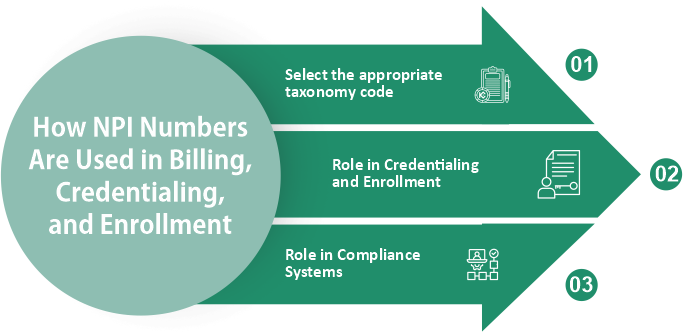
How NPI Numbers Are Used in Billing, Credentialing, and Enrollment
This section explains how NPI numbers function across billing, credentialing, and enrollment workflows in healthcare systems. It is a core part of Everything You Need To Know About NPI Numbers because incorrect use leads to claim rejections, enrollment delays, and payer verification issues.
Role in Claims Submission
NPI is required on all claims submitted to Medicare, Medicaid, and commercial payers. It identifies the provider responsible for the service and connects the claim to payer systems for processing.
If the NPI is missing or incorrect, the claim is rejected at the clearinghouse stage before reaching the payer. Even valid claims can fail if the billing or rendering NPI does not match payer records.
Billing teams must ensure NPI accuracy on CMS-1500 and UB-04 forms. It also needs correct pairing with taxonomy codes to avoid claim validation errors.
Role in Credentialing and Enrollment
NPI is required during provider credentialing and enrollment with insurance payers. It links provider identity with contracts, applications, and payer directories.
Without a valid NPI, enrollment applications are often delayed or rejected. Payers use it to verify provider identity and practice affiliation before approval.
Credentialing teams must ensure NPI consistency across all applications. Any mismatch between individual and group records can stop the onboarding process.
Role in Compliance Systems
NPI is used to support HIPAA standard transactions and maintain consistent provider identification across systems. It helps align billing, EHR, and payer databases.
Incorrect or outdated NPI data can trigger audit issues or reporting mismatches. This affects data accuracy across claims and compliance systems.
Healthcare organizations use NPI data for internal audits and verification checks. Regular updates in NPPES help reduce inconsistencies in provider records.
How to Apply for an NPI Number Step by Step
This section explains the step-by-step process of applying for an NPI through the official NPPES system. It is a core part of Everything You Need To Know About NPI Numbers because incorrect application details can delay enrollment, credentialing, and billing activation.
Information Required for Application
NPI application requirements, NPPES form details, provider data needed
The NPI application requires basic provider identity details, including legal name, practice address, and contact information. Applicants must also select the correct taxonomy code that defines their specialty.
Missing or incorrect information can delay approval or require corrections later. This is a common issue for new providers entering payer enrollment systems.
Providers should ensure consistency between licensing documents and application data. Any mismatch may create validation issues during credentialing.
Application Submission Process
submit NPI application, NPPES registration steps, CMS NPI portal
The application is submitted online through the CMS National Plan and Provider Enumeration System (NPPES). Providers create an account, enter required details, and submit the form for processing.
Once submitted, CMS reviews the application and assigns a 10-digit NPI if approved. Most applications are processed within a few days if information is accurate.
Applicants should verify all entries before submission. Errors can result in delays or rework requests from CMS.
Common Application Issues
NPI application errors, NPPES mistakes, delayed NPI approval
Many delays occur due to incorrect taxonomy selection or incomplete provider details. These issues are common among first-time applicants.
Duplicate applications or mismatched identity information can also slow down approval. This often happens when providers reapply instead of correcting existing records.
Applicants should review all data carefully before submission. Small errors can impact credentialing timelines and billing readiness.
How to Update or Correct NPI Information
NPI update process, NPPES correction steps, change NPI details
This section explains how providers and organizations update or correct NPI data in the CMS system. It is a key part of Everything You Need To Know About NPI Numbers because outdated or incorrect records can lead to claim rejections, enrollment delays, and payer mismatches.
When Updates Are Required
update NPI information, change provider details, NPPES update rules
NPI updates are required when provider or organization details change. This includes name changes, address updates, or changes in practice location or affiliation.
Outdated records can create mismatches during claim submission and payer verification. This often results in delayed reimbursements or credentialing issues.
Healthcare providers should review their NPI record regularly. Even small changes in practice details should be updated in the NPPES system.
Updating Process in NPPES
how to update NPI, NPPES login update, CMS provider record change
NPI updates are completed through the CMS National Plan and Provider Enumeration System (NPPES). Providers log in using their credentials and access their existing record.
After login, users can edit fields such as contact details, taxonomy code, or practice location. All changes must be saved and submitted for system update.
CMS processes updates and reflects changes in the public NPI registry. Accurate submission reduces delays in billing and credentialing workflows.
Impact of Outdated Information
outdated NPI issues, claim denial NPI mismatch, credentialing delays
Incorrect or outdated NPI data can lead to claim rejections and payer mismatches. This affects both individual providers and group practices during billing cycles.
Credentialing teams may face delays if payer records do not match NPI details. This can slow down enrollment or contract approval processes.
Regular updates help maintain consistency across billing systems, payer databases, and EHR platforms. This reduces administrative errors and claim disruptions.
Conclusion
A strong understanding of NPI numbers helps healthcare providers, billing teams, credentialing specialists, and administrators maintain accurate provider identification across billing, enrollment, and compliance processes. Proper NPI management reduces claim rejections, supports faster payer approvals, and improves data consistency throughout the revenue cycle.
By applying the practices outlined in this guide, healthcare organizations can strengthen billing accuracy, reduce administrative delays, and maintain compliance with CMS and HIPAA requirements. Regular review and maintenance of NPI records remain essential for efficient healthcare operations and long-term reimbursement success.
FAQs
What is an NPI number, and why is it important?
An NPI (National Provider Identifier) is a unique 10-digit identification number assigned to healthcare providers by CMS through the National Plan and Provider Enumeration System (NPPES).
What is the difference between NPI Type 1 and NPI Type 2?
NPI Type 1 is assigned to individual healthcare providers such as physicians, nurse practitioners, physician assistants, and dentists. NPI Type 2 is assigned to healthcare organizations, including hospitals, clinics, group practices, and healthcare facilities.
How do I apply for an NPI number?
Providers can apply for an NPI through the National Plan and Provider Enumeration System (NPPES) website. The application requires basic information such as legal name, practice address, contact details, and taxonomy code.
Can claims be denied because of incorrect NPI information?
Yes. Claims may be rejected or denied if the NPI is missing, inactive, entered incorrectly, or does not match payer enrollment records.
When should healthcare providers update their NPI information?
Providers should update their NPI record whenever there is a change in name, practice address, contact information, taxonomy code, or organizational affiliation.