
In 2026, commercial insurance credentialing is expected to be one of the most prominent causes of provider onboarding delays and revenue loss. Why are fully licensed providers still waiting months to join insurance networks and bill commercial payers? A review of industry data indicates that commercial payer credentialing times range from 90 to 180 days, depending on payer requirements, specialized risk category, and the correctness of the application. During this time, providers are frequently unable to submit claims, causing immediate revenue disruption for practices and billing teams.
The financial consequences are measurable. Healthcare businesses lose an estimated $8,000 to $10,000 per clinician per day due to credentialing delays that prevent patient scheduling and scheduling delays. A typical 120-day delay can result in over $120,000 in lost billable income per provider. Furthermore, studies show that up to 85% of credentialing applications include missing or wrong data, resulting in rework, payer rejections, and longer enrollment delays.
Despite these risks, effective commercial insurance credentialing increases network participation, reduces claim denials, and increases regulatory compliance. When credentialing, contracting, and insurance network registration are done correctly, providers get speedier access to payer panels and more predictable reimbursement.
This blog explains the commercial payer credentialing process, differentiates between credentialing and contracting, and discusses why providers are denied enrollment in insurance networks.
What is Commercial Insurance Credentialing
Commercial Insurance Credentialing is the process by which commercial payers verify provider qualifications before allowing insurance network enrollment. It determines whether a provider can join insurance networks and submit reimbursable claims.
The Credentialing Process
Commercial payer credentialing begins when a provider requests that an insurer credential them through a payer or delegated platform. Each payer has its own review standards, increasing the administrative burden on billing and credentialing teams.
The process typically includes:
- Verification of state licenses, DEA registration, and board status
- Review of education, training, and work history
- Malpractice coverage validation and claims history review
- National database checks, including NPI and sanction records
- Cross-checking data against CAQH and payer-specific portals
Credentialing alone does not allow billing. Providers must also complete payer contracting and credentialing to receive a fee schedule. Until contracting is finalized, in-network provider enrollment remains incomplete. Any mismatch between submitted data and payer records often results in application suspension or reset.
Credentialing Timeline and Challenges
Commercial payer credentialing timelines in 2026 vary between 90 and 180 days, depending on the payer type and provider risk level. High-volume commercial plans routinely halt assessments when documentation demands clarification.
Common delays include:
- Incomplete insurance network enrollment applications
- Conflicts between credentialing and contracting records
- Expired licenses or malpractice certificates
- Missing explanations for work history gaps
- Unresolved ownership or billing structure issues
Providers are often denied or delayed during joining insurance networks due to preventable data errors. These denials increase claim rejection rates and delay revenue recognition across revenue cycle teams.
Insurance Network Enrollment in Commercial Insurance Credentialing
Insurance network enrollment is the phase where credentialed providers request participation with commercial payers. It has direct influence over claim eligibility, reimbursement access, and payer registration accuracy.
Steps in Network Enrollment
Insurance network enrollment begins only after commercial insurance credentialing approval. Many providers face delays because credentialing and enrollment are submitted together, despite being reviewed separately by payers.
Standard enrollment steps include:
- Selection of target commercial payers based on patient mix
- Submission of enrollment applications through payer portals
- Linking provider records to group or facility contracts
- Validation of billing identifiers, including NPI and tax data
- Confirmation of payer contracting and credentialing status
Importance of Network Enrollment
In-network provider enrollment determines whether services are reimbursed at contracted rates. Providers listed incorrectly or excluded from payer directories experience lower patient access and higher denial rates.
Enrollment failures affect:
- Claim acceptance and payment timing.
- Patient cost-sharing accuracy
- Directory compliance requirements
- Revenue forecasting for billing teams
Insurance Network Enrollment in Commercial Insurance Credentialing
Insurance network enrollment determines whether a credentialed provider can bill and receive payment from commercial payers. Errors at this stage cause claim rejections, directory gaps, and delayed revenue.
Steps in Network Enrollment
Enrolment in the insurance network begins once the payer approves the provider’s credentials. Credentialing confirms eligibility. Enrollment establishes billing rights.
Key steps include:
- Selection of commercial payers based on patient demand
- Submission of enrollment forms through payer portals
- Linking providers to existing group or facility contracts
- Validation of NPI, tax ID, service locations, and billing addresses
- Confirmation of in-network provider enrollment effective dates
Importance of Network Enrollment
Network participation controls patient access, billing authority, and contracted payment rates. Providers listed incorrectly or excluded from payer directories face reduced referrals and higher denial exposure.
Proper insurance network enrollment supports:
- Clean claim submission
- Accurate patient cost-sharing
- Compliance with payer directory rules
- Predictable revenue for billing teams
Credentialing vs Contracting in Commercial Insurance Credentialing
Credentialing and contracting are often treated as one task, but they serve separate functions.
Confusing the two leads to enrollment gaps, billing denials, and delayed payer participation.
Credentialing
Credentialing verifies whether a provider meets payer eligibility standards. It is a validation step. It does not grant billing access.
During the commercial payer credentialing process, insurers review:
- Education, training, and board status
- State licensure and DEA registration
- Work history and malpractice coverage
- Sanctions, exclusions, and adverse actions
Contracting
Contracting defines the business relationship between the provider and the payer. It controls reimbursement.
Key contracting elements include:
- Fee schedules and payment methodologies
- Covered services and limitations
- Participation status for joining insurance networks
- Termination clauses and amendment rules
Why Providers Get Denied in Commercial Insurance Credentialing
Provider denials remain one of the most costly failures in insurance network enrollment.
In 2026, payer data shows that denials delay in-network provider enrollment by 30–90 days.
Common Denial Reasons
Most competitors list denial causes broadly. This section focuses on payer-verified failure points seen across commercial payer credentialing process reviews.
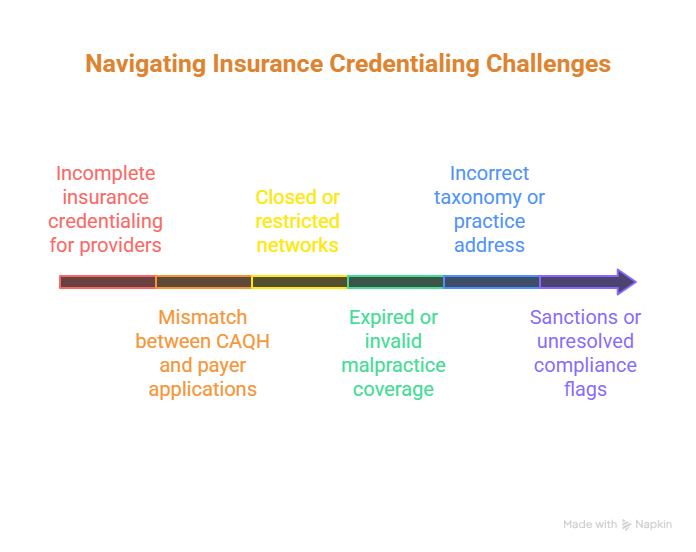
Common denial triggers include:
Incomplete insurance credentialing for providers: Missing work history gaps, unsigned attestations, or expired licenses stop payer review.
Mismatch between CAQH and payer applications: Even minor data conflicts cause automated rejections during payer contracting and credentialing.
Closed or restricted networks: Many commercial plans limit joining insurance networks by specialty or geography.
Expired or invalid malpractice coverage: Limits below payer thresholds remain a top denial driver in 2026 audits.
Incorrect taxonomy or practice address: Errors here affect in-network provider enrollment eligibility and claims routing.
Sanctions or unresolved compliance flags: OIG, SAM, or state board discrepancies result in immediate denial.
Strategies to Avoid Denials
Denial prevention begins before application submission. High-performing enrollment teams follow structured controls.
Effective prevention steps include:
- Validate CAQH data against each payer’s insurance network enrollment form.
- Confirm network participation status before submission.
- Review payer-specific credentialing vs contracting rules.
- Track license, DEA, and malpractice expiration dates centrally
- Verify taxonomy codes align with contracted services.
- Monitor payer re-credentialing timelines proactively.
Conclusion
Commercial insurance credentialing directly affects revenue access, claim acceptance, and payer participation. Errors across credentialing, contracting, and insurance network enrollment continue to delay reimbursement and disrupt provider onboarding in 2026.
Providers who apply structured controls, verify data accuracy, and separate credentialing from contracting reduce denials and gain faster, more stable entry into commercial insurance networks.
FAQs
What is commercial insurance credentialing?
Commercial insurance credentialing is the payer review process that verifies provider qualifications before insurance network enrollment and claim submission approval.
How long does commercial insurance credentialing take in 2026?
Most commercial payers take 90 to 180 days, depending on payer policies, specialty risk level, and application accuracy.
Is credentialing the same as contracting?
No. Credentialing verifies eligibility, while contracting establishes reimbursement terms and billing authority with the payer.
Why do providers get denied during insurance network enrollment?
Denials commonly result from data mismatches, expired licenses, closed networks, malpractice gaps, or unresolved compliance flags.
How can providers reduce credentialing denials?
By validating CAQH data, confirming network status, tracking expirations, and separating credentialing from contracting workflows.