
Healthcare providers depend on proper credentialing to bill Medicare and remain compliant with federal regulations. Are you sure your practice is fully up to date with the latest CMS credentialing requirements for 2026? Many providers struggle to track policy changes, which can lead to delayed payments, claim denials, or even loss of Medicare billing privileges.
The complexity of the issue is massive. As of 2025, Medicare covers over 68.6 million beneficiaries, with about 32.8 million enrolled in Medicare Advantage plans, accounting for more than half of the eligible population. With millions of claims handled each year, CMS is strengthening credentialing and enrollment procedures to improve program integrity and prevent fraud. For providers, this includes stricter compliance standards and closer monitoring of enrollment information.
Recent CMS updates have expanded monitoring and compliance. To preserve accurate enrollment records, providers must now notify certain changes, such as ownership transfers, adverse legal actions, or new practice locations, within 30 days, and other modifications within 90 days. Failure to notify these changes can result in enrollment revocation or reimbursement issues. CMS requires provider revalidation every three years, and failure to meet deadlines might result in billing credentials being deactivated.
Why Credentialing Policy Changes Matter for Healthcare Organizations
This section explains why understanding and implementing CMS updates is critical. Failing to comply can disrupt revenue, billing, and operational efficiency.
Growth of Federal Oversight in Provider Enrollment
CMS has expanded audits and revalidation processes in 2026. Providers must submit updated licenses, certifications, and malpractice coverage on schedule. Revalidation delays now account for an average of 15% of temporary billing suspensions in hospitals and clinics nationwide. Federal oversight also includes increased scrutiny of provider affiliations and ownership changes.
Credentialing Impact on Billing and Revenue Cycle Operations
Credentialing errors directly affect claim processing and reimbursement. Studies show that nearly 20% of delayed Medicare claims occur due to incomplete credentialing data. Revenue cycle teams must integrate credentialing updates into billing workflows. Automated alerts and regular audits reduce errors and maintain smooth cash flow.
Increasing Compliance Expectations for Healthcare Providers
CMS now mandates providers report changes within 30 days, including adverse legal actions, new practice sites, and changes in ownership. Compliance expectations also include monthly monitoring of credentialing changes to ensure that all staff and systems are aligned with updated 2026 policies. Noncompliance can trigger audits, penalties, or suspension of Medicare billing privileges.
Recent Credentialing Policy Changes CMS
This section summarizes the most critical CMS updates affecting provider credentialing in 2026. Each change impacts provider enrollment, billing workflows, and compliance oversight.
Changes in Medicare Provider Screening Requirements
CMS now requires enhanced background checks and identity verification for all new and revalidating providers.
- Providers must submit updated licenses, DEA registration, and malpractice coverage.
- Screening now includes more frequent site visits for outpatient clinics and group practices.
- Delays in verification can result in temporary suspension of billing privileges.
Revised Provider Enrollment Reporting Deadlines
CMS updated reporting timelines for all provider changes effective January 2026.
- Changes in ownership, affiliations, or practice locations must be reported within 30 days.
- Late reporting can trigger claims audits or payment interruptions.
- Credentialing teams should integrate these deadlines into their internal compliance calendar to avoid gaps.
CMS Enforcement Trends Affecting Credentialing Teams
CMS continues to increase enforcement actions against providers with incomplete or outdated credentialing information.
- In 2026, nearly 18% of providers undergoing revalidation received audit notices due to missing documentation.
- Enforcement emphasizes accuracy in provider directories, licensure, and ownership disclosures.
- Credentialing teams should implement monthly monitoring of credentialing changes and regular internal audits to ensure compliance.
2026 Credentialing Requirements for Providers
Healthcare providers and credentialing teams must follow the updated CMS requirements for 2026. These changes affect enrollment verification, background checks, and documentation processes. Staying compliant ensures uninterrupted Medicare/Medicaid reimbursements and reduces audit risk.
Updated Provider Enrollment Verification Standards
CMS now enforces stricter verification for all new and revalidating providers.
- Providers must confirm current state licensure, DEA registration, and Medicare/Medicaid participation status.
- Verification timelines are shortened; revalidation must occur within 60 days of notification.
- Delays or missing documentation can result in the temporary suspension of billing privileges.
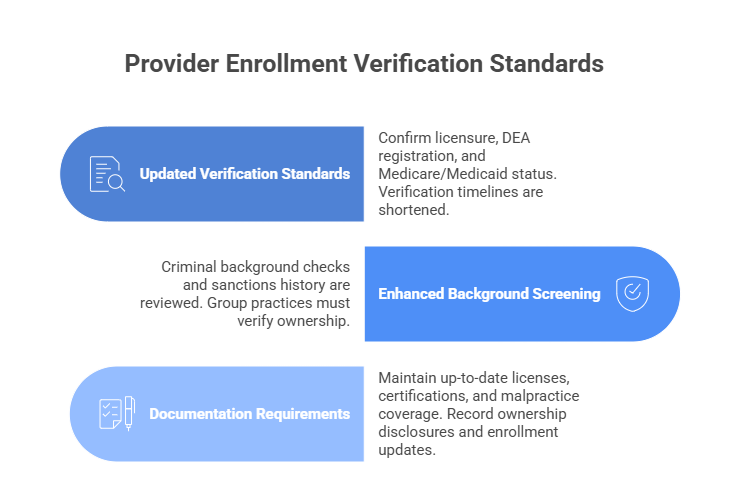
Enhanced Background Screening and Identity Verification
CMS requires more detailed identity and background checks for providers in 2026.
- Criminal background checks and sanctions history are reviewed for all practitioners and organizational providers.
- Group practices must verify ownership and affiliations for all managing members.
- Monthly monitoring of credentialing changes is recommended to ensure compliance with recent CMS oversight.
Documentation Requirements for Provider Credentialing
Accurate and complete documentation is critical to avoid claims denials or penalties.
- Credentialing teams must maintain up-to-date licenses, board certifications, and malpractice coverage for all providers.
- Ownership disclosures, practice addresses, and enrollment updates must be recorded and reported promptly.
- Implementing an internal audit schedule helps ensure compliance with CMS’s 2026 credentialing rules.
New Credentialing Rules for Medicare and Medicaid Programs
CMS has issued updated credentialing rules for Medicare and Medicaid in 2026. These changes impact enrollment processes, provider screening, and state-specific requirements. Understanding these rules helps credentialing teams and providers maintain compliance and avoid billing disruptions.
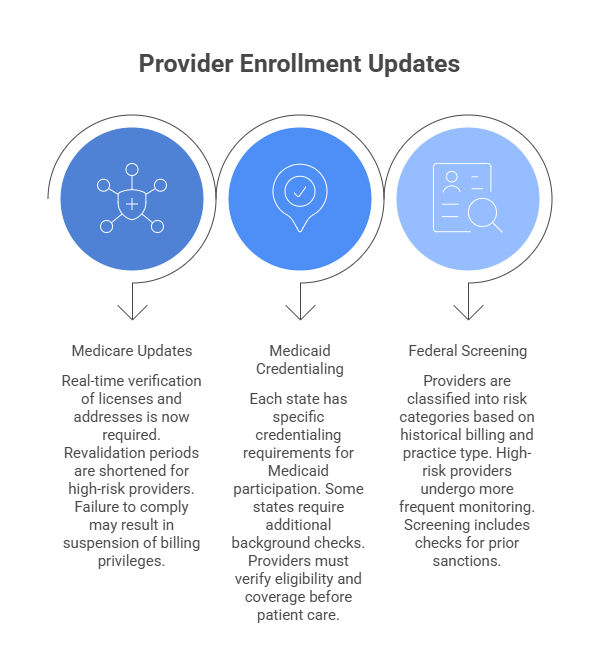
Medicare Provider Enrollment Updates
Medicare enrollment in 2026 requires updated PECOS applications, current licenses, and high-risk specialty documentation to prevent claim delays.
- CMS now requires real-time verification of provider licenses and practice addresses before approving enrollment.
- Revalidation periods have been shortened to every 3 years for high-risk providers.
- Failure to meet these requirements may result in suspension of Medicare billing privileges until corrections are completed.
- Providers must ensure all National Provider Identifier (NPI) data is current and accurately reported to avoid delays in claims processing.
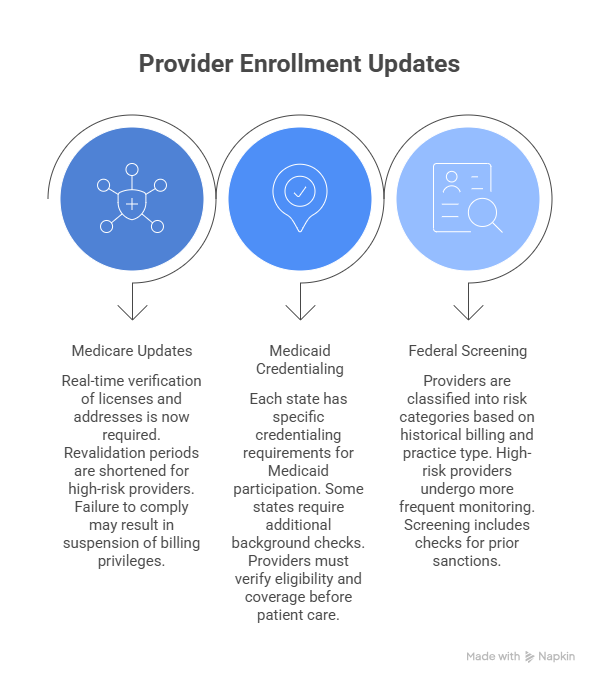
Medicaid Provider Credentialing and State-Level Variations
Medicaid credentialing varies by state, requiring monitoring of application timelines, verification methods, and sanctions to maintain participation.
- Each state has specific 2026 credentialing requirements for Medicaid participation, including licensure, DEA registration, and malpractice documentation.
- Some states require additional background checks or fingerprinting for new providers.
- Providers must verify eligibility and coverage prior to patient care using the state’s Medicaid Management Information System (MMIS).
- Keeping up with monthly monitoring credentialing changes ensures compliance with state-specific updates.
Federal Provider Screening Categories and Risk Levels
CMS categorizes provider risk, particularly high-risk physicians, as subject to more severe assessments and extra compliance monitoring.
- CMS classifies providers into Low, Moderate, and High Risk categories based on historical billing, ownership structure, and practice type.
- High-risk providers undergo more frequent monitoring, including monthly updates and site visits.
- Screening includes checks for prior sanctions, revocations, or participation in federal healthcare programs.
- Accurate risk-level documentation is required for both Medicare and Medicaid to prevent enrollment delays.
NCQA Credentialing Updated Timelines
NCQA has revised its credentialing timelines for 2026. These updates affect verification steps, decision deadlines, and recredentialing cycles. Staying current with NCQA changes helps providers and credentialing teams maintain compliance and prevent delays in network participation.
NCQA Credentialing Verification Requirements
- All provider credentials, including licensure, board certification, education, and work history, must be verified directly with primary sources.
- NCQA now requires verification of malpractice history and sanctions within the last 24 months for all high-risk specialties.
- Credentialing teams must document each verification step and maintain a clear audit trail.
- Monthly monitoring of updates is recommended to catch any changes in provider status or NCQA guidance.
Credentialing Decision Timeframes
- NCQA requires credentialing decisions to be made within 60 calendar days after receiving a complete application.
- Delays may occur if verification responses from primary sources are pending; teams should track responses properly.
- Automated credentialing software can help ensure timelines are met and reduce manual follow-ups.
Re-credentialing Cycle Requirements
- Providers must be recredentialed every 36 months, unless the payer indicates otherwise.
- Recredentialing includes verification of licensure, malpractice coverage, sanctions, and professional references.
- Keeping records updated and addressing monthly monitoring credentialing changes helps avoid recredentialing denials.
- NCQA emphasizes documentation accuracy and timely submission to maintain network status.
Monthly Monitoring Credentialing Changes
Monthly monitoring of credentialing information is critical to ensure compliance and prevent disruptions in provider enrollment. Staying proactive helps healthcare organizations manage risk and avoid claim denials due to outdated provider credentials.
Monthly License and Certification Monitoring
- Providers’ licenses, board certifications, and specialty credentials must be checked monthly to detect expirations or status changes.
- Any lapse in licensure or certification can lead to delayed reimbursements or participation restrictions.
- Credentialing teams should maintain logs of monthly verifications for audit readiness.
Sanctions Screening and Exclusion Database Checks
- Providers must be screened against OIG, GSA, and state-level exclusion lists every month.
- Any match requires immediate action, including suspension from patient care or claims processing until resolved.
- Regular checks reduce the risk of non-compliance penalties and protect the organization from federal sanctions.
Automated Credential Monitoring Systems
- Automated monitoring platforms can track licenses, certifications, sanctions, and expirations in real time.
- Alerts notify teams of upcoming credential issues, helping avoid gaps in provider eligibility.
- Integration with billing systems ensures that claims are only submitted for fully credentialed providers, reducing denials.
Regulatory Changes Affecting Credentialing in 2026
Regulatory updates in 2026 focus on ensuring accurate provider data and compliance across programs. These changes impact credentialing, billing, and patient access, requiring healthcare organizations to adapt their processes.
Provider Directory Accuracy Requirements
- CMS now mandates that provider directories are updated at least every 90 days, reflecting accurate practice locations, specialties, and contact details.
- Inaccurate directories can lead to penalties, patient complaints, and delayed care.
- Credentialing teams must establish verification processes to meet CMS requirements and reduce errors.
Cross-Program Enrollment Enforcement
- Providers participating in Medicare, Medicaid, and commercial plans must comply with cross-program credentialing audits.
- CMS emphasizes enforcement for providers with multiple program enrollments to prevent fraud, duplicate billing, and non-compliance.
- Organizations must maintain consistent documentation across programs to meet verification standards.
Telehealth and Multi-State Credentialing Compliance
- Telehealth growth requires providers to maintain credentials in each state where services are offered.
- Credentialing policies now include state-specific licensing, background checks, and telehealth regulations.
- Automated tracking and cross-state verification systems help organizations remain compliant while expanding service access.
Credentialing Workflow for Compliance with CMS Updates
A structured workflow ensures healthcare organizations comply with CMS updates while reducing claim denials and administrative delays. Following a consistent process improves accuracy, accountability, and regulatory adherence.
Step 1: Provider Information Collection
1. Collect all necessary provider data, including licenses, certifications, education, employment history, and DEA/NPI numbers.
2. Verify that all documentation is current and complete before submission to prevent delays in enrollment.
Step 2: Primary Source Verification
Confirm credentials directly with the issuing organization or authority, including state licensing boards, specialty boards, and educational institutions.
Ensure verification records are documented and accessible for audits or payer reviews.
Step 3: Payer Enrollment and Application Submission
1. Submit enrollment applications to Medicare, Medicaid, and commercial payers according to updated CMS rules.
2. Track submission deadlines, supporting documents, and follow up on any payer requests to avoid processing delays.
Step 4: Credentialing Committee Review
1. A credentialing committee evaluates provider qualifications against NCQA, CMS, and state-specific standards.
2. Approvals, denials, or requests for additional information should be documented with a clear rationale.
Step 5: Ongoing Monitoring and Recredentialing
1. Monitor licenses, sanctions, exclusions, and certifications monthly to remain compliant with CMS updates.
2. Establish a recredentialing schedule aligned with NCQA and payer-specific timelines to maintain active provider status.
Conclusion
Staying current with recent credentialing policy changes, CMS is essential for healthcare providers to maintain compliance, avoid claim denials, and protect revenue streams. Implementing structured workflows and monthly monitoring ensures provider credentials remain accurate and verified.
Credentialing teams and healthcare organizations must integrate CMS updates into daily operations, including revalidation schedules, enrollment verification, and sanctions screening. Proactive compliance reduces audit risk and supports uninterrupted Medicare and Medicaid participation.
FAQs
What are the recent credentialing policy changes CMS introduced for 2026?
CMS updated provider verification, screening levels, and compliance monitoring rules.
These changes aim to improve provider data accuracy and reduce fraud.
How often must providers complete credentialing revalidation under CMS rules?
CMS typically requires providers to complete Medicare revalidation every three years.
Missing the deadline can lead to billing privilege deactivation.
Why is monthly credential monitoring important for healthcare organizations?
Monthly monitoring helps detect license expirations and exclusions before status changes.
It reduces compliance risks and prevents claim denials.
How do NCQA credentialing timelines affect healthcare providers?
NCQA requires credentialing decisions within 60 days of a complete application.
Providers must also complete recredentialing every 36 months.
What risks occur if providers fail to follow the recent credentialing policy changes, CMS?
Non-compliance may cause claim denials, payment delays, or enrollment termination.
Organizations may also face audits and regulatory penalties.