
Delays in credentialing have a financial impact. In 2026, more than half of hospitals and provider groups reported financial losses attributable to credentialing bottlenecks, with many organizations experiencing losses exceeding $1 million annually due to restricted billing and delayed enrollment. Credentialing delays cause cash-flow problems and impede access to care in more than 40% of healthcare organizations.
Many credentialing teams still use manual stages, and average onboarding times remain 90-120 days. Each day a provider remains inactive, costing facilities over $10,000 in lost billable revenue; it adds up to more than $300,000 per provider when credentialing takes too long.
This guide compares Medical Credentialing Software vs Services from a financial buyer’s perspective. Should you invest $50 per user for a platform or $500 (or more) per provider for a full-service team? We evaluate ROI, implementation timelines, and hidden labor costs to help you make a decision.
Medical Credentialing Software vs Services
This section compares two credentialing approaches that affect cost, speed, and internal workload. We present core functions and operational impact to assist in decision-making.
What Is Medical Credentialing Software
Medical credentialing software is a cloud-based platform for managing provider credentials. It stores provider data, tracks licenses, and manages payer applications. Cloud-based credentialing benefits include real-time access, automated primary source verification, and dashboard reporting. Staff still perform entry, updates, and submissions inside the system. Software reduces paperwork and centralizes provider records. Monthly costs range from $30 – $150 per user, depending on modules and support levels.
Credentialing staff salaries vs. service fees matter here. An in-house specialist earning $55,000–$75,000 annually may also use credentialing software. Combined costs are more than platform fees alone. Software requires initial training, internal oversight, and ongoing user management.
What Are Credentialing Managed Services
Credentialing managed services outsource the operational work to an external team. These teams handle payer enrollment, recredentialing, verifications, and renewals. Outsource-credentialing services charge primarily by provider, usually $350–$600 annually per provider. Fees cover verification, application submissions, follow-ups, and status reporting.
Third-party teams often maintain higher throughput due to experience and process focus. Managed services aim to reduce delays in provider onboarding. They also report fewer rejections and revisions than internal teams lacking practice-specific experience.
Key Operational Differences
| Operational Aspect | Credentialing Software | Managed Services |
| Work Location | Handled internally by your organization | Handled internally by your organization |
| Responsibility | Internal team manages deadlines and compliance | The service provider manages execution and updates |
| Cost Scaling | Costs increase with the number of users | Costs increase with the number of providers |
| Control | Full control over processes and system setup | Limited control; relies on provider workflows |
| Internal Capacity Requirement | Requires trained internal staff | Reduces internal staffing burden |
| Consistency | Depends on internal team performance | Provider ensures consistent, standardized execution |
Cost Comparison: Software vs Outsourcing
This section compares the direct and indirect costs of credentialing platforms and third‑party services. We present hard numbers, staff cost differences, and hidden expense factors that affect budget decisions.
Cost of Credentialing Software
Credentialing software is usually priced per user or per seat. Most platforms charge between $40 and $150 per user per month in 2026. Cloud‑based credentialing benefits include automated primary source verification and centralized record tracking. Internal credentialing staff still perform uploads, reviews, and submissions. Software requires training time and ongoing user support. Typical annual software license cost ranges from $5,000 to $18,000 for small to mid‑sized practices. Larger facilities with many users may spend over $25,000 per year.
Total cost depends on:
- Annual license fees
- Onboarding and staff training
- IT support for integrations.
- Data migration expenses
Cost of Outsourced Credentialing
Outsourced credentialing pricing depends on the provider service. In 2026, most service fees range from $350 to $700 per provider annually. Some vendors include setup fees from $500 to $1,500 per provider. These fees cover primary source verification, application submissions, payer follow‑up, and status reporting. Outsourced services reduce internal workload and often speed credentialing. Billing teams and RCM professionals see fewer delays.
Key cost factors include:
- Service fee per provider
- Provider count
- Volume of payer applications
- Frequency of recredentialing
Comparison Cost Table for Both Services
| Cost Category | Credentialing Software | Outsourced Credentialing |
| Base Cost | $40–$150/user/month | $350–$700/provider/year |
| Setup/Training | Internal cost | $500–$1,500/provider |
| Internal Labor | Required | Minimal |
| IT Involvement | Required | Not required |
| Hidden Costs | Staff time | Fewer internal hours |
Credentialing Outsourcing ROI
This section compares the financial returns of credentialing systems and third‑party services. We analyze measurable gains, cost offsets, and overall impact on revenue performance.
ROI of Credentialing Software
Credentialing software reduces manual effort and centralizes credential data. Cloud-based credentialing benefits include automated primary source verification and real-time status dashboards. Key points include:
- Reduces data entry errors and rework.
- Shortens application cycles if staff fully utilize features.
- ROI depends on internal staff capacity and efficiency.
- Larger organizations benefit from lower per-provider costs over time.
- Improves overall accuracy and internal workflow tracking.
ROI of Outsourced Credentialing
Outsourced credentialing shifts execution to specialized teams, allowing providers to focus on patient care. Key points include:
- Reduces credentialing cycle times by 30–50%.
- Ensures compliance with up-to-date payer requirements.
- Handles renewals and ongoing credentialing automatically.
- Predictable service fees compared to combined software + internal labor costs.
- Often faster measurable ROI for small and mid-sized practices.
Revenue Impact Comparison
Faster credentialing directly improves revenue capture and operational efficiency. Key points include:
- Accelerates provider onboarding and billing.
- Limits lost billable days due to delayed credentialing.
- Clean provider data improves claims acceptance rates.
- Outsourced teams reduce repeated application revisions.
- Compare credentialing staff salary vs service fees to determine optimal ROI.
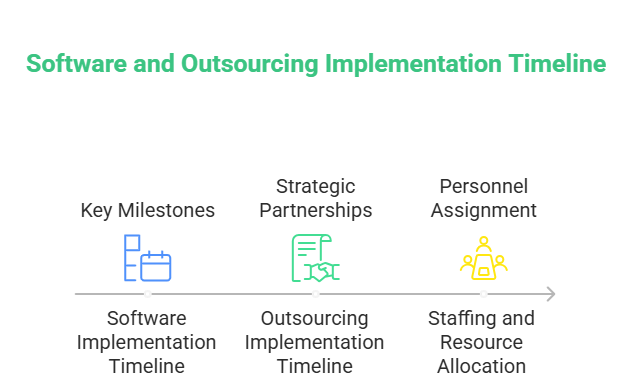
Implementation Timeline and Resource Allocation
This section examines the time and resources needed to implement credentialing solutions. Understanding these differences helps practices decide whether software or outsourced services deliver faster and more efficient results.
Software Implementation Timeline
Implementing credentialing software requires internal planning, configuration, and training. Key points include:
- Initial setup can take 4–8 weeks for small to mid-sized practices.
- Staff training on platform features may require 10–20 hours per user.
- Integration with EMRs or payroll systems adds 2–4 weeks.
- Automated primary source verification reduces some verification time but still relies on staff input.
- Full operational efficiency may be reached after 2–3 credentialing cycles.
Outsourcing Implementation Timeline
Outsourced credentialing shifts responsibilities to experienced teams, often accelerating onboarding. Key points include:
- Onboarding typically completes within 1–2 weeks.
- Outsourced teams immediately begin primary source verification and payer enrollment.
- Renewals, recredentialing, and ongoing compliance tasks are handled automatically.
- Less reliance on internal staff reduces downtime and operational delays.
- Faster provider activation compared to internal software-only approaches.
Staffing and Resource Allocation
Resource requirements vary significantly between software and outsourcing. Key points include:
- Software: requires credentialing staff or administrative support to manage entries, updates, and follow-ups.
- Outsourced services: staff allocation is minimal; internal team monitors progress and handles exceptions.
- Large organizations may combine software with partial outsourcing for optimal efficiency.
- Credentialing staff salary vs service fees should be weighed for cost-effectiveness.
- Cloud-based credentialing benefits reduce internal IT maintenance and overhead costs.
Best Credentialing Platforms (What to Look For)
Selecting the right credentialing platform can save time and reduce errors. This section highlights the essential features to evaluate and the common limitations of software solutions for 2026.
Core Features to Evaluate
Effective credentialing platforms offer functionality that streamlines verification and compliance. Key points include:
1. Automated primary source verification for licenses, board certifications, and DEA registration.
Integration with EMRs, billing systems, and HR databases.
2. Real-time expiration alerts for licenses, certifications, and insurance.
3. Customizable reporting dashboards for compliance and performance tracking.
4. Cloud-based credentialing benefits, such as remote access and secure data storage.
5. Multi-provider management for larger practices and hospital networks.
Limitations of Credentialing Software
Despite advances, software has constraints compared to full-service solutions. Key points include:
1. Requires dedicated internal staff to manage updates and exceptions.
2. Initial setup and configuration can take several weeks.
3. Limited support for payer-specific enrollment requirements.
4. Compliance gaps may occur if staff fail to input complete or accurate data.
5. ROI depends on staff efficiency and proper platform adoption.
When to Choose Software vs Outsourcing
Deciding between software and managed services requires evaluating cost, internal resources, and operational priorities. This section guides healthcare providers to make informed choices for 2026.
Choose Software If:
Credentialing software is ideal for your organization if it has dedicated staff and a structured workflow. Consider these points:
- The internal credentialing team is trained and can manage ongoing updates.
- Budget allows $50–$100 per user annually for platform licenses.
- Multiple integrations with EMR, HR, and billing systems are required.
- Focus is on automating primary source verification without external dependency.
- You want cloud-based credentialing benefits, such as remote access and secure storage.
Choose Outsourcing If:
Outsourced credentialing services can be used by organizations that want to reduce administrative burden. Consider these points:
- Lack of internal staff or high turnover in credentialing roles.
- Desire to offload regulatory compliance and payer-specific enrollment tasks.
- Willing to pay $400–$600 per provider annually for full-service management.
- Need faster onboarding for new providers with minimal internal effort.
- Aim to reduce the risk of missed deadlines and delayed revenue cycles.
Conclusion
In 2026, choosing between Medical Credentialing Software vs Services comes down to balancing cost, internal capacity, and speed. Software works best for organizations with trained staff and a need for system control, while managed services offer reduced internal workload and faster provider onboarding.
Evaluating ROI, hidden labor costs, and implementation timelines ensures informed decisions that protect revenue and improve operational efficiency. By aligning credentialing strategy with organizational resources, healthcare providers can minimize delays, optimize cash flow, and maintain compliance without overburdening their teams.
FAQs
What is the main difference between credentialing software and managed services?
Credentialing software keeps work internal, requiring staff to manage updates and compliance. Managed services outsource these tasks to an external team for execution and tracking.
Which option provides faster provider onboarding?
Outsourced credentialing typically accelerates onboarding, completing verification and payer enrollment in 1–2 weeks. Software depends on internal staff and can take 4–8 weeks.
How do costs compare between software and managed services?
Software costs $40–$150 per user per month plus staff time, while managed services cost $350–$700 per provider annually, often including verification and submission.
Can credentialing software fully replace staff?
No, software requires trained internal staff to enter, update, and verify provider data. Managed services reduce internal workload but involve ongoing service fees.
When is a hybrid model beneficial?
A hybrid approach combines software with partial outsourcing, ideal for large practices that require control plus faster onboarding and reduced internal burden.