
Most “Provider Not Found” claim rejections are not caused by credentialing errors; they are caused by using the wrong NPI type for your business structure. More than 8.9 million National Provider Identifier (NPI) records exist in the U.S. as of January 2026, and this number continues to grow as healthcare delivery expands. Every HIPAA‑covered provider must use the correct NPI type on claims to avoid denials and administrative delays.
Choosing the right NPI type has an impact on credentialing, enrollment, and revenue cycle workflows. A Type-1 NPI identifies a single provider, but a Type-2 NPI identifies an organization, like a group practice or hospital. Every electronic claim, eligibility check, and remittance advice in HIPAA standard transactions must contain the correct NPI.
This guide breaks down the differences between Type 1 and Type 2, explains how each affects your billing and compliance, and shows how to register and maintain NPIs in the NPPES system. We also add updated practice data and practical context for coders, billers, administrators, and revenue cycle professionals. The goal is to reduce denials, improve payer communication, and help your team operate more efficiently.
H2: Understanding NPI and Its Role in Billing (NPI Type 1 vs Type 2)
This section explains what an NPI is and why it matters for claims processing and revenue cycle outcomes. You will see how NPIs connect to billing, payer systems, and regulatory compliance.
An NPI is a unique 10‑digit numeric identifier assigned by the Centers for Medicare & Medicaid Services (CMS). It is required for all HIPAA standard transactions used in electronic claims, eligibility checks, claim status, and remittance advice. Every provider and organization that submits electronic transactions must have an NPI to be recognized by payers and clearinghouses.
What Is NPI?
An NPI identifies a healthcare provider or organization in electronic transactions. NPIs are mandated under HIPAA Administrative Simplification Standards for all transactions that involve health plan payers. Without an NPI, electronic claims can be rejected or denied.
Providers, group practices, pharmacies, and institutional facilities must have the correct NPI on every electronic claim. An individual provider uses an individual NPI (Type 1). A clinic, group, or hospital uses an organizational NPI (Type 2). The right NPI type ensures payers can route claims and payments properly.
Core Functions of NPI
- Claims Submission: Required for submitting electronic claims to Medicare, Medicaid, and commercial payers.
- Eligibility and Claim Status: Used in eligibility checks and status inquiries that impact cash flow.
- Attachments and Coordination: Needed for claims attachments and coordination of benefits.
- Credentialing and Enrollment: Used by credentialing departments for onboarding providers and group practices.
NPI Type 1 vs Type 2
This section explains the key differences between the two NPI types. It clarifies which identifier fits your practice structure and how each supports billing and compliance.
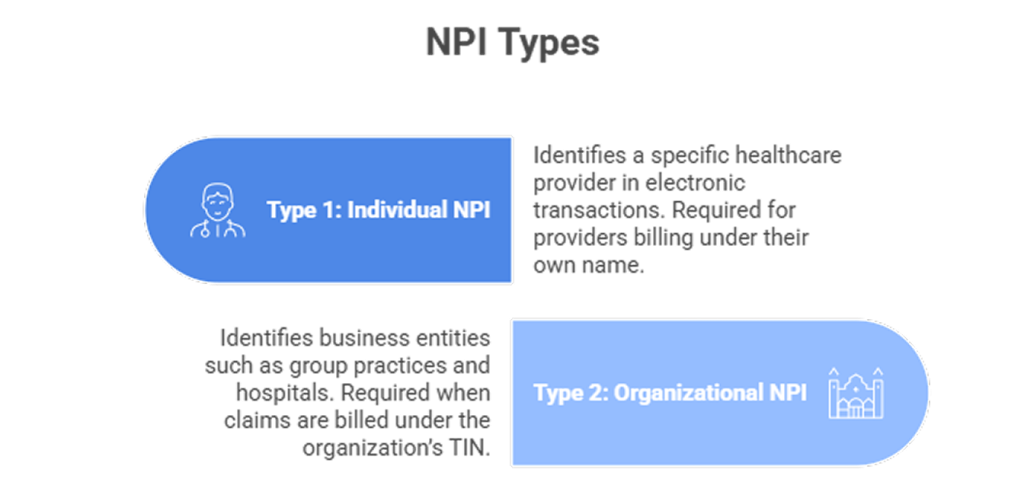
Type 1: Individual NPI
An individual NPI (Type 1) identifies a specific healthcare provider in electronic transactions. It is required for providers who bill under their own name and Social Security Number (SSN) or Individual Tax Identification Number (ITIN). Providers such as physicians, nurse practitioners, psychologists, and therapists must have a Type 1 NPI before submitting electronic claims.
Individual NPI requirements include accurate provider name, date of birth, taxonomy code, and contact details. It is used in claims submission, eligibility checks, claim status inquiries, claim attachments, and electronic health exchanges. The NPPES registration guide mandates Type 1 providers update changes within 30 days, including changes to practice address, name, or taxonomy.
Using the correct Type 1 NPI on claims supports accurate payment routing. It reduces “Provider Not Found” rejections that often arise when an organizational or wrong NPI is used in place of a provider’s individual identifier. Providers with multiple practice locations should still maintain a single Type 1 NPI tied to their credentials.
Type 2: Organizational NPI
An organizational NPI (Type 2) identifies business entities such as group practices, clinics, hospitals, and pharmacies. It is required when claims are billed under the organization’s Tax Identification Number (TIN). The organizational NPI supports billing under a business NPI instead of individual providers.
Type 2 NPIs require an accurate legal business name, TIN, taxonomy codes for services, and primary practice location. Multiple Type 2 NPIs may be needed for entities with separate TINs or billing units. For example, a health system with distinct billing departments may assign separate NPIs to each billable entity.
Correct use of a Type 2 NPI prevents misrouting of claims and payer misidentification. It ensures revenue cycle professionals can group claim submissions under the business entity. Practice managers and compliance officers rely on organizational NPI application data for credentialing and payer enrollment.
How They Work Together?
Individual and organizational NPIs often coexist. A solo provider in a group practice needs a Type 1 NPI for personal services and a Type 2 NPI for organizational billing. In group billing, the Type 2 NPI appears on the claim header, while the Type 1 NPI appears in the service provider field.
Multi‑location practices with multiple TINs may require separate NPIs to match each billing unit’s financial and compliance structure. Revenue cycle teams must align NPIs with payer expectations to avoid denials and payment delays. Accurate pairing of Type 1 and Type 2 NPIs reduces claim errors and supports eligibility checks and claim tracking in clearinghouses.
Group NPI vs Individual NPI
This section clarifies when to use a group (Type 2) versus an individual (Type 1) NPI. Proper selection ensures accurate claims, faster reimbursements, and compliance with CMS requirements.
When to Use Group NPI
A group NPI is used whenever billing is submitted under an organization’s Tax Identification Number (TIN). This applies to:
- Group practices and multi-provider clinics
- Hospitals or outpatient departments
- Pharmacies and durable medical equipment suppliers
Use a group NPI on claims to represent the organization as the billing entity. It centralizes payment processing and prevents misrouting. Practices with multiple locations may require separate group NPIs for each billing unit. Using the wrong NPI type here is a leading cause of “Provider Not Found” denials, affecting up to 12% of claims in 2026 audits.
When to Use Individual NPI
An individual NPI should be used for providers billing under their personal credentials and Social Security Number (SSN) or Individual Tax Identification Number (ITIN). Providers include:
- Physicians, nurse practitioners, and clinical specialists
- Independent therapists or consultants
- Licensed prescribers submitting claims directly.
Type 1 NPIs track the exact provider delivering the service. Claims submitted with only a group NPI can trigger payer confusion if the provider is expected to appear as the servicing professional. Ensuring the correct individual NPI reduces rejections and improves claim transparency.
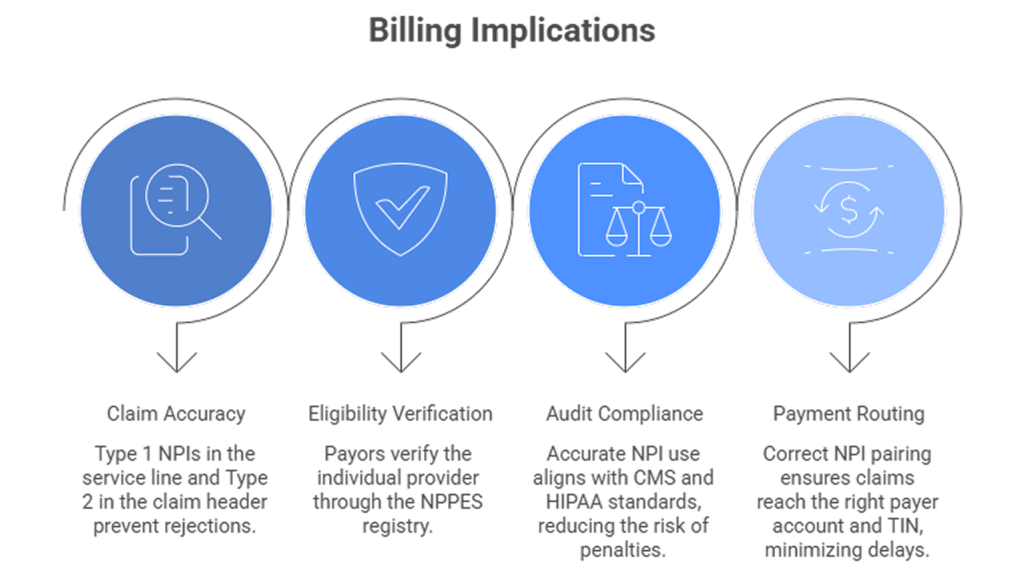
Billing Implications
Pairing NPIs correctly is critical for revenue cycle efficiency. Key points for billing teams:
1. Claim Accuracy: Type 1 NPIs in the service line and Type 2 in the claim header prevent rejections.
2. Eligibility Verification: Payors verify the individual provider through the NPPES registry.
3. Audit Compliance: Accurate NPI use aligns with CMS and HIPAA standards, reducing the risk of penalties.
4. Payment Routing: Correct NPI pairing ensures claims reach the right payer account and TIN, minimizing delays.
NPI Registration & Taxonomy Codes
Accurate NPI registration and correct taxonomy selection are essential for clean claims and regulatory compliance. Errors in either can result in claim denials, delayed reimbursements, and potential compliance reviews.
NPPES Registration Guide
Providers must register with the National Plan and Provider Enumeration System (NPPES) to obtain their NPI. Key points include:
Type 1 NPI: For individual healthcare providers.
Type 2 NPI: For organizations, clinics, and group practices.
Required information: Legal names, licenses, practice addresses, and contact details.
Confirmation: Keep the registration confirmation for compliance and payer verification.
Updates: Any changes in provider or organizational details must be updated within 30 days to avoid claim rejections.
Choosing the Correct Taxonomy
Correct taxonomy selection ensures claims are submitted under the right provider type and specialty. Key considerations include:
Type 1 providers: Taxonomy must reflect individual license, specialty, and practice location.
Type 2 organizations: Taxonomy must match the organization’s service type and structure.
Common errors: Using the wrong taxonomy leads to “Provider Not Found” and other claim denials.
Verification: Use the CMS Taxonomy Lookup Tool to confirm accuracy before billing.
Payer requirements: Check each payer’s guidelines for acceptable taxonomy codes to reduce claim delays.
Taxonomy Codes
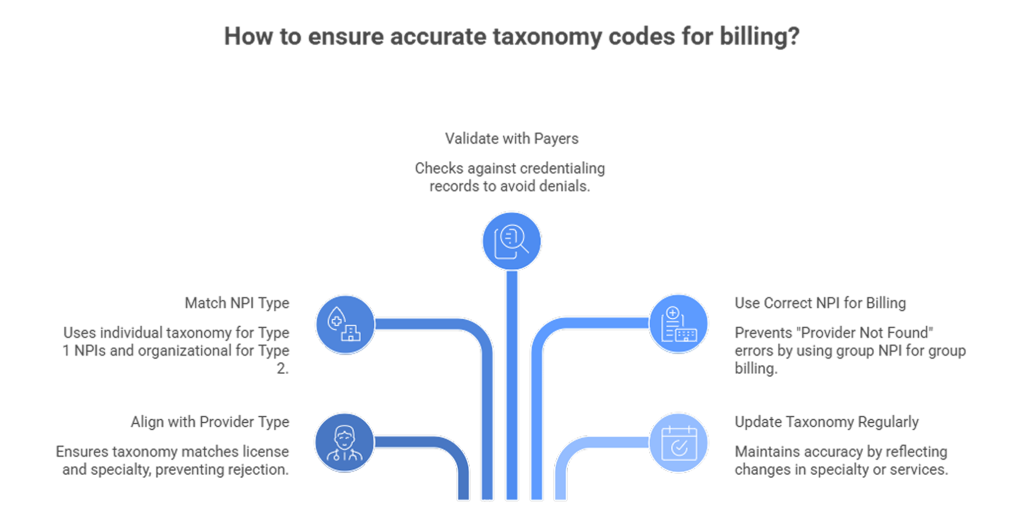
Incorrect or outdated taxonomy codes are a common cause of claim errors. Taxonomy must align with the provider’s role, specialty, and billing structure. Key issues include:
- Mismatch with provider type: Using a taxonomy that does not match the provider’s license or specialty leads to claim rejection.
- Conflict with NPI type: Type 1 NPIs require individual provider taxonomy, while Type 2 NPIs require organizational taxonomy aligned with services.
- Payer-specific validation failures: Some payers validate taxonomy codes against credentialing records, causing denials if mismatched.
- Incorrect billing under a business NPI: Using an individual taxonomy when billing under a group NPI can trigger “Provider Not Found” errors.
- Outdated taxonomy selection: Changes in specialty or services must be updated in NPPES to maintain accuracy.
Updating and Maintaining Your NPI
Keeping your NPI current is critical for accurate billing, claims processing, and compliance. Using outdated NPI information can lead to denied claims, delays, or compliance issues. This section explains when to update your NPI and the consequences of outdated information.
When to Update NPI
Healthcare providers must update their NPI information promptly to reflect changes in practice or credentials. Updates should be made within 30 days of any relevant change. Key scenarios include:
- Change of practice location: Moving your business or practice site requires updating your NPI address.
- Change in provider status: New licenses, certifications, or retirements must be reflected.
- Ownership or organizational changes: Mergers, acquisitions, or group affiliations affect your NPI designation.
- Taxonomy updates: Ensure your NPI taxonomy codes accurately reflect your current specialty or role.
- Contact information updates: Business phone numbers or emails must remain current for payer communications.
Consequences of Outdated Information
Failing to maintain accurate NPI information can disrupt revenue cycles and create compliance risks. Key consequences include:
- Claim denials or rejections: Insurers may reject claims if your NPI is incorrect or inactive.
- Delayed reimbursements: Incorrect NPI data can slow payment processing and increase accounts receivable cycles.
- Compliance penalties: Medicare and Medicaid consider outdated NPIs a regulatory violation; complaints can be filed against providers or organizations.
- Inaccurate reporting: Prescription Drug Event records and other reporting require correct NPIs to avoid legal or administrative scrutiny.
Common Pitfalls in Using NPIs
Even experienced healthcare providers face challenges when managing NPIs. Using the wrong NPI type or failing to coordinate across multiple practice locations can trigger claim rejections and administrative delays. This section highlights frequent pitfalls and how to avoid them.
Claim Rejections from Wrong NPI
Using the incorrect NPI type, individual (Type 1) versus organizational (Type 2), can lead to:
- Denied claims: Payers often reject claims when the NPI submitted does not match the provider type on file.
- Increased follow-ups: Billing teams must spend extra time correcting claims and resubmitting them.
- Credentialing confusion: Pharmacies and insurers may flag “provider not found” errors if the NPI type is mismatched.
Multi‑Location and Multi‑TIN Errors
Providers with multiple practice sites or Tax Identification Numbers (TINs) face additional challenges:
- Incorrect location billing: Claims submitted under the wrong practice location NPI are often denied.
- TIN-NPI mismatches: Billing under an NPI linked to a different TIN can trigger audits or rejections.
- Duplicate record issues: Multiple NPIs for the same provider across sites can create reporting errors and administrative burden.
Conclusion
Selecting the correct NPI type is essential for accurate billing, clean claims, and consistent reimbursement. Using the right combination of Type 1 and Type 2 NPIs reduces rejections, supports payer validation, and aligns with HIPAA and CMS requirements.
Regular updates, correct taxonomy selection, and proper NPI pairing improve claim acceptance rates and reduce administrative delays. A structured NPI approach strengthens revenue cycle performance and ensures compliance across all billing operations.
FAQs
What is the difference between NPI Type 1 and Type 2?
Type 1 NPI identifies an individual provider, while Type 2 NPI identifies an organization. Each must be used correctly in claims to avoid rejections.
Can a provider have both Type 1 and Type 2 NPIs?
Yes. Individual providers use a Type 1 NPI, while their organization or group practice uses a Type 2 NPI for billing purposes.
How does incorrect NPI usage affect claims?
Using the wrong NPI type can lead to “Provider Not Found” errors, claim denials, and delays in reimbursement.
When should NPI information be updated in NPPES?
NPI details must be updated within 30 days of changes such as address, taxonomy, ownership, or provider status.
Why are taxonomy codes important with NPIs?
Taxonomy codes define provider specialty and must match the NPI type and payer records to ensure accurate claim processing.