

What is the real cost of a delayed credentialing process to your medical practice? Credentialing delays directly impact revenue loss because providers cannot bill payers until enrollment is complete. This increases accounts receivable and raises denial rates. Many practices face extended processing times due to incomplete applications and multi-state requirements, which is why many rely on provider enrollment and credentialing services.These delays affect cash flow and overall financial performance.
Telehealth rules for 2026 now include extended Medicare flexibilities through December 31, 2027, allowing broader telehealth billing without geographic restrictions. Medicare and many state programs reimburse telehealth services, and behavioral health telehealth often receives parity with in-person rates. Around 41 states and DC require private insurers to cover telehealth similarly to in-person services, and about 23 states have payment parity laws in place.
This blog explains how credentialing ROI works and why it matters for financial stability. It links credentialing to licensing, multi-state billing, telehealth reimbursement, and payer requirements. You will also see practical strategies to improve credentialing speed, reduce revenue delays, and measure financial return.
What Is Credentialing and Why Does It Impact Revenue
Understanding credentialing is essential for measuring Credentialing ROI for Medical Practices.
It determines whether providers can bill payers and generate revenue without delay.
Credentialing is the process of verifying provider qualifications and enrolling them with insurance payers. Without it, claims are rejected or delayed. This directly affects cash flow, denial rates, and administrative workload. For expanding practices, especially those using telehealth and cross-state services, credentialing becomes a critical financial factor.
Core Components of Credentialing
Credentialing includes verification, enrollment, and approval steps. Each step affects how quickly a provider can begin billing.
- Primary Source Verification: Confirms education, training, and licenses.
- Payer Enrollment: Registers providers with insurance networks for billing rights.
- Re-credentialing and Revalidation: Required to maintain active billing status with payers.
For multi-state practices, credentialing must align with regulatory requirements. For example, providers using the Interstate Medical Licensure Compact can easily obtain multi-state licenses compared to traditional state-by-state licensing.
Connection to Revenue Cycle
Credentialing is the starting point of the revenue cycle. Delays here affect every downstream process.
Delayed Billing: Providers cannot submit claims until credentialing is complete.
Increased Denials: Errors in enrollment lead to claim rejections.
Longer AR Days: Payments are delayed due to incomplete provider setup.
Reduced Cash Flow: Revenue generation starts later than planned.
Telehealth expansion and cross-state billing increase the importance of credentialing accuracy. Compliance with telehealth parity laws in 2026 and virtual care payer requirements ensures that services are reimbursed correctly. Errors in credentialing or enrollment often lead to rejected claims, especially in multi-state billing scenarios.
Credentialing ROI for Medical Practices
Credentialing ROI for Medical Practices measures the financial return from faster enrollment and reduced administrative errors. It links credentialing performance directly to revenue generation and cost control.
ROI Formula for Credentialing
ROI must be calculated to understand financial performance. The formula helps quantify gains and losses from credentialing.
Formula:
ROI = (Revenue gained + Cost saved − Credentialing cost) ÷ Credentialing cost × 100
Key inputs include:
- Revenue generated per active provider
- Time taken to complete credentialing
- Cost of internal staff or external services
- Denial rates linked to credentialing errors
Revenue Impact of Delays
Credentialing delays create direct revenue loss. Providers cannot submit claims until enrollment is approved.
Key impacts include:
- Lost daily revenue per provider during delays
- Increased accounts receivable (AR) days
- Higher denial rates due to inactive or incomplete credentials
- Delayed access to payer networks for billing
Cost Savings from Efficiency
Efficient credentialing reduces operational cost and improves billing speed. It also lowers administrative burden.
Cost-saving factors include:
- Reduced staff time spent on manual follow-ups
- Lower denial management costs
- Fewer resubmissions of claims
- Faster provider activation and billing
In-House vs Outsourced Credentialing ROI Comparison
Choosing between in-house and outsourced credentialing directly affects revenue, cost, and claim accuracy. Each model has a different impact on turnaround time, staffing, and overall credentialing ROI for medical practices.
Below is a clear comparison of in-house and outsourced credentialing models. It highlights differences in cost, time, and performance. This helps evaluate credentialing ROI for medical practices.
| Factor | In-House Credentialing | Outsourced Credentialing |
| Cost Structure | Fixed costs (salaries, training, software, overhead) | Variable costs (per-provider or per-application fees) |
| Staff Requirements | Requires trained internal credentialing staff | No internal staffing needed for credentialing tasks |
| Time to Enrollment | Reduced workload for internal staff | Typically 60–100 days |
| Administrative Burden | High workload on the internal team | Reduced workload for internal staff |
| Error Rate | Higher due to manual processes | Lower due to standardized workflows |
| Denial Rates | Higher if follow-up is inconsistent | Lower with dedicated follow-up processes |
| Scalability | Limited by internal capacity | Easier to scale with provider growth |
| Compliance Management | Managed internally, requires constant monitoring | Handled by the vendor with updated regulatory processes |
| Technology Use | Requires internal systems and tracking tools | The vendor often provides integrated systems |
| Cash Flow Impact | Slower revenue due to the delay | Faster revenue due to quicker enrollment |
| Best For | Large practices with established internal teams | Small to mid-sized practices and growing organizations |
How Licensing Impacts Credentialing ROI for Medical Practices
Licensing directly affects how quickly a provider can begin credentialing and billing.
Delays in licensing extend the time to revenue and increase financial risk.
Credentialing cannot proceed without valid and active state licenses, making physician credentialing services essential for faster onboarding. Any delay in licensing causes a bottleneck in enrollment, payer approval, and billing activation. For clinics expanding into different states or using telemedicine, the licensing method has a direct impact on revenue timing and operating expenses.
Interstate Medical Licensure Compact (IMLC) Overview
The Interstate Medical Licensure Compact allows physicians to apply for licenses across multiple states through a streamlined process.
Key points:
- Faster access to multiple state licenses
- Single application process for participating states
- Reduced administrative work for physicians and staff
- Improved speed of credentialing initiation
The IMLC supports faster provider activation in multi-state medical practices. It helps reduce delays in credentialing and allows quicker entry into payer networks. This is important for telehealth services and cross-state medical billing operations.
IMLC vs Traditional Licensing
The licensing model chosen affects both time and cost. It also impacts how quickly credentialing begins and revenue flows.
Interstate Medical Licensure Compact (IMLC):
- Centralized application process
- Faster approval timelines
- Reduced paperwork and administrative delays
- Supports multi-state practice expansion
Traditional Licensing:
- State-by-state applications
- Longer processing times
- Higher administrative workload
- Delayed credentialing start
Revenue Impact of Licensing Delays
Licensing delays directly reduce revenue potential. Every day without a valid license delays credentialing and billing.
Financial impact includes:
- Lost daily revenue per provider
- Increased accounts receivable (AR) days
- Delayed telehealth and in-person billing
- Higher operational costs due to prolonged onboarding
Role of Credentialing in Multi-State and Telehealth Expansion
Credentialing determines whether providers can bill across multiple states and deliver telehealth services.
It directly affects expansion speed, payer access, and reimbursement across regions.
For growing practices, credentialing is not limited to local operations. Expansion into multi-state medical practice and virtual care requires proper enrollment with each payer and compliance with state-specific rules. Errors or delays in this stage slow down revenue generation and limit scalability.
Cross-State Medical Billing Requirements
Cross-state medical billing requires providers to meet state licensing and payer enrollment rules before submitting claims.
Key requirements include:
- Active license in the state where the patient is located
- Credentialing with each payer in that state
- Correct place of service and billing codes
- Compliance with state and federal billing rules
Billing across multiple states increases administrative workload. Each state may have different payer guidelines, enrollment timelines, and documentation standards. For practices expanding into telehealth or physical multi-location services, this creates complexity in claim submission and reimbursement tracking.
Telehealth Parity Laws 2026
Telehealth parity laws determine how virtual services are reimbursed compared to in-person care.
Key points for 2026:
- Many states require equal reimbursement for telehealth and in-person services
- Medicare continues to expand telehealth coverage through 2027
- Behavioral health telehealth often has strong parity support
- Payer rules vary by state and insurance type
These laws impact revenue generation directly. Without proper credentialing and compliance, telehealth claims may be denied even if services are covered. Practices must ensure that providers are credentialed with the correct payers before offering virtual care.
Virtual Care Payer Requirements
Virtual care requires strict adherence to payer-specific requirements. Each insurer sets rules for telehealth billing and provider eligibility.
Common payer requirements include:
- Provider credentialing with telehealth approval
- Use of approved telehealth platforms
- Documentation of patient consent
- Correct CPT and modifiers for telehealth services
Failure to meet these requirements leads to claim denials or reduced payments. Credentialing must be completed before virtual care billing begins.
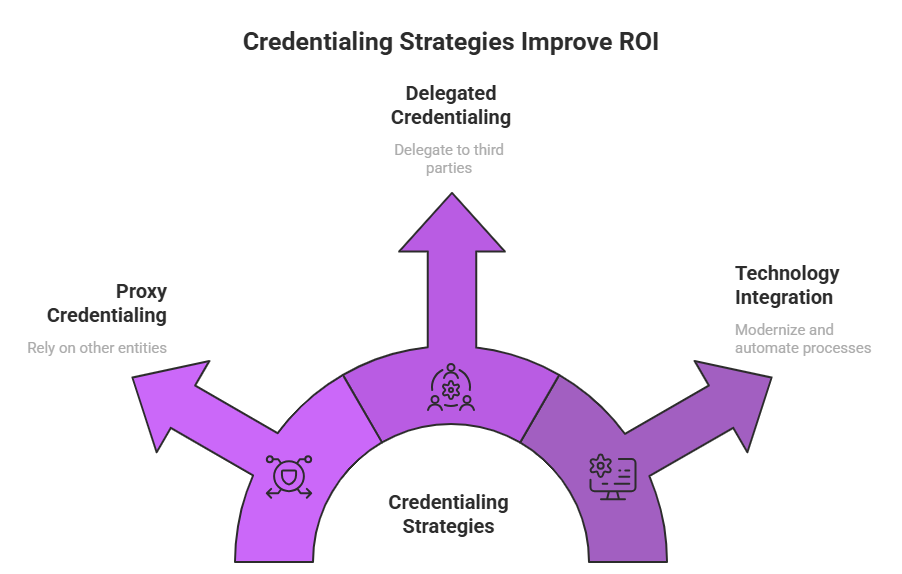
Credentialing Strategies That Improve ROI
Credentialing strategies determine how fast providers can start billing and generating revenue.
Strong processes reduce delays, errors, and administrative burden, which improves credentialing ROI for medical practices.
Modern practices use structured workflows to handle applications, payer follow-ups, and compliance checks. Delays in these areas increase accounts receivable and reduce cash flow. Efficient strategies help providers enter payer networks faster and maintain billing continuity.
Credentialing by Proxy
Credentialing by proxy allows institutions to streamline onboarding for telehealth providers.
Key benefits:
- Faster onboarding for remote providers
- Reduced administrative steps and manual verification
- Improved access to virtual care markets
This model supports telehealth growth and helps practices meet demand in multiple states through efficient telehealth credentialing services. It reduces delays in provider activation and allows faster billing for virtual services. For practices expanding into telehealth, this strategy improves speed without compromising compliance.
Delegated Credentialing
Delegated credentialing shifts the approval process from payers to the healthcare organization.
Key benefits:
- Reduced approval timelines
- Faster payer enrollment
- Internal control over provider verification
Payers grant authority to organizations that meet strict standards. Once approved, the practice can credential providers internally without waiting for payer review each time. This reduces delays and improves revenue flow.
Technology Integration
Technology integration improves the management, tracking, and updating of credentialing data. Systems that connect EHR platforms, credentialing software, and billing systems reduce manual entry errors. This improves coordination between departments and ensures that provider data remains accurate across systems. It also helps track application status, renewals, and payer responses in real time.
Key components include:
- EHR and credentialing system integration
- Automated application tracking
- Real-time status updates
- Centralized provider data management
Conclusion
Credentialing directly influences revenue, compliance, and operational efficiency in medical practices. Delays in licensing, enrollment, or payer approval increase accounts receivable and lead to claim denials, while efficient processes improve cash flow and financial stability. Strong credentialing practices ensure providers can bill without interruption and expand services across states and telehealth platforms.
Improving credentialing ROI requires a structured approach that includes streamlined workflows, technology integration, and models such as delegated credentialing. Practices that invest in accurate, timely credentialing reduce costs, improve claim acceptance, and strengthen long-term financial performance. Consistent monitoring and process optimization are key to maintaining steady revenue growth.
FAQs
What is credentialing ROI for medical practices?
Credentialing ROI measures the financial return from faster provider enrollment and reduced administrative costs. It shows how efficient credentialing improves revenue and lowers denials.
How do credentialing delays affect revenue?
Delays prevent providers from billing payers, leading to lost revenue and increased accounts receivable. They also raise denial rates and slow down cash flow.
What factors are included in calculating credentialing ROI?
Key factors include revenue per provider, time to credential, staffing or outsourcing costs, and denial rates. These help determine the overall financial impact.
Is outsourced credentialing better than in-house credentialing?
Outsourced credentialing often reduces errors, speeds up enrollment, and lowers denial rates. In-house credentialing may offer control but requires more resources and time.
How does credentialing support telehealth and multi-state expansion?
Credentialing ensures providers meet payer and state requirements for billing across regions. It enables faster telehealth deployment and compliance with 2026 reimbursement rules.