

Many NEMT providers reach a point where they ask, “I have the vans and insurance, but Medicaid keeps denying me. What am I doing wrong?” In 2026, this problem is more common because Medicaid transportation programs now use stricter verification systems, including driver exclusion checks, EVV validation, and broker-level compliance audits. Industry reports show that documentation and compliance errors account for a large share of Medicaid NEMT claim denials, often exceeding one-third of rejected claims in audited operations.
NEMT credentialing requires more than simply filling out forms. It currently includes cross-verification of business data, driver eligibility screening, vehicle compliance checks, and integration with state Medicaid enrollment systems. When providing certification, providers must validate that drivers are not banned from participating in federal healthcare programs, have valid licenses, and meet safety requirements. Failure in any one part may stop the entire application process.
This blog discusses where providers fall short, what hidden checks exist, and how to comply with NEMT vehicle requirements, driver background checks, and the Medicaid site visit checklist to increase approval rates.
NEMT Credentialing: Why Applications Get Denied Despite Meeting Basic Requirements
Many providers assume approval depends on having vans, insurance, and a completed application. In 2026, Medicaid systems and brokers apply deeper verification layers beyond basic documentation. Denials often occur even when surface-level requirements appear complete.
Incomplete Medicaid Transportation Provider Enrollment
Incomplete enrollment is one of the most common reasons for rejection in NEMT credentialing cases. Applications are often submitted without fully aligned business, tax, and ownership records.
Key failure points include:
- Missing or inconsistent EIN details
- Ownership disclosure gaps
- Incorrect service location or coverage data
- Unsubmitted supporting documents required by Medicaid systems
Failure to Meet Hidden Compliance Checks
Beyond paperwork, Medicaid and brokers evaluate operational readiness. These checks are not always clearly listed in application guides.
Key compliance checks include:
- NEMT vehicle compliance verification (inspection, safety, and maintenance records)
- Driver background checks, including exclusion list screening
- Validation of CPR, First Aid, and driver training certificates
- Review of insurance coverage limits and active policy status
Documentation Mismatch Across Systems
Many denials result from inconsistent information across enrollment platforms, insurance records, and internal business files. Medicaid systems now cross-verify all submitted data.
Common mismatch issues include:
- Business name differences across licenses and insurance policies
- Vehicle list not matching fleet registration documents
- Driver records not aligned with background check reports
- Insurance policy details not matching enrollment submissions
Medicaid Transportation Provider Enrollment: What Payers Actually Verify in NEMT Credentialing
Medicaid transportation provider enrollment is not limited to form submission. Payers verify whether the provider can operate safely, consistently, and in compliance with state Medicaid rules before approval is granted.
This section explains what Medicaid reviewers verify during enrollment. It focuses on three core areas: business identity checks, financial responsibility standards, and operational readiness linked to NEMT credentialing.
Business Verification Requirements
Business verification confirms that the provider is legally authorized to operate. Medicaid first validates whether the business exists as a registered entity in state records. This includes checking registration status, legal structure, and active standing with state authorities. The same data is cross-checked with federal identifiers such as EIN records.
This step also includes a review of ownership information. Any inconsistency between ownership information, tax data, and enrollment papers increases the risk of rejection. Medicaid programs do not manually adjust for irregularities. When enrolling as a Medicaid transportation provider, providers must submit fully aligned and accurate data.
Insurance and Liability Standards
Insurance validation confirms that the provider carries financial protection for patient transport services. Medicaid reviews active auto and general liability insurance policies before approving participation. Coverage limits must meet state-specific minimum requirements without exception.
The insured entity name must match the registered business exactly. Even small differences in spelling or structure can trigger denial. Policy start and end dates are also reviewed to confirm continuous coverage during the enrollment period.
Insurance gaps are a frequent cause of delays in NEMT credentialing. Expired policies, incorrect coverage amounts, or mismatched documentation often result in immediate application holds.
Operational Readiness Checks
Operational readiness checks confirm whether the provider can actually deliver transportation services at the level declared in the application. Medicaid evaluates fleet size, vehicle registration status, and driver availability. The goal is to verify that service claims match operational capacity.
Drivers are screened through background checks and exclusion databases. Any driver listed on federal or state exclusion lists is automatically disqualified. Training records, such as CPR and First Aid certifications, are also reviewed during this stage.
Operational inconsistencies are a major issue in Medicaid transportation provider enrollment. If declared capacity does not match verified documentation, applications may be delayed or denied until corrections are submitted.
NEMT Vehicle Compliance: Standards That Trigger Approval or Rejection in NEMT Credentialing
NEMT vehicle compliance is a core checkpoint in Medicaid transportation provider enrollment. Approval is not based only on ownership of vehicles but on whether each unit meets safety, inspection, and operational standards required by state Medicaid programs.
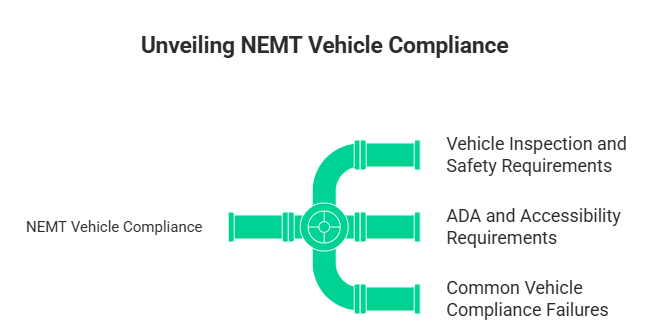
Vehicle Inspection and Safety Requirements
Vehicle inspection is the first layer of compliance review. Medicaid requires valid inspection certificates issued by authorized state agencies. These inspections confirm road safety, mechanical condition, and passenger protection readiness.
In addition to inspection reports, maintenance logs are reviewed to ensure ongoing safety. Vehicles must show consistent servicing records. Missing or outdated inspection documents often lead to immediate application delays during Medicaid transportation provider enrollment.
ADA and Accessibility Requirements
ADA compliance ensures vehicles can safely transport patients with mobility limitations. Medicaid reviews whether vehicles meet required accessibility standards, especially for wheelchair and stretcher transport services.
Required features may include wheelchair lifts, secure restraint systems, and proper entry and exit configurations. Any mismatch between declared vehicle capability and actual equipment can result in denial during NEMT credentialing review.
Common Vehicle Compliance Failures
One of the most frequent issues is expired inspection documents. Even if the vehicle is operational, outdated certification leads to rejection. Another common failure is missing maintenance records, which raises concerns about safety tracking.
Incorrect vehicle listings also create problems. If fleet records do not match registration documents or insurance records, Medicaid flags the application. These inconsistencies often delay approval in Medicaid transportation provider enrollment until corrections are submitted.
Driver Background Checks: The Most Overlooked Credentialing Barrier in NEMT Credentialing
Driver background checks are a strict requirement in Medicaid transportation provider enrollment. Many applications fail even after meeting vehicle and insurance standards because driver eligibility is not fully verified or properly documented.
Driver Qualification Requirements
Driver qualification is the first checkpoint in the review process. Medicaid requires valid and current driver’s licenses for all listed staff. Licenses must match the state of operation and remain active throughout the enrollment period.
Additional requirements include medical fitness clearance and completion of safety training such as CPR and First Aid. Some states also require defensive driving certification or passenger assistance training, depending on service type.
Key requirements include:
- Valid state-issued driver’s license
- Active medical clearance (if required by state rules)
- CPR and First Aid certification
- Defensive driving or safety training (where applicable)
- Clean driving record in most states
Driver Exclusion List Checks
Medicaid programs screen every driver against federal and state exclusion databases. This includes the Office of Inspector General (OIG) exclusion list and other state Medicaid exclusion systems. Any match results in automatic disqualification.
Key exclusion checks include:
- OIG (Office of Inspector General) exclusion database screening
- State Medicaid exclusion list verification
- SAM (System for Award Management) cross-check
- Criminal background disqualification flags
- Fraud or abuse record identification
Common Driver-Related Denial Triggers
One of the most common triggers is incomplete background verification. Submitting drivers without full screening results leads to immediate application delays or rejection. Expired certifications also create compliance issues during review.
Another frequent issue is undisclosed violations such as DUIs or serious traffic offenses. Inconsistent driver records across application systems also cause denial. These errors directly impact NEMT credentialing approval timelines and often require full resubmission of corrected data.
Common denial triggers include:
- Missing or incomplete background check reports
- Expired CPR, First Aid, or safety certifications
- DUI or major traffic violation history
- Driver listed on exclusion databases
- Mismatch between driver records and application data
Medicaid Site Visit Checklist: What Inspectors Actually Evaluate in NEMT Credentialing
A Medicaid site visit is a required step in Medicaid transportation provider enrollment for many providers. Approval is not based only on submitted documents. Inspectors verify whether the business physically operates as declared in the application.
Physical Office Requirements
The physical office is verified to confirm that the business is active and operational. Inspectors check whether the location exists, is accessible, and is used for business activity related to NEMT services. A registered address alone is not enough for approval.
The site must reflect a functioning business environment. Empty or residential-only setups often raise concerns during review. Inspectors also check the visibility of the business identity and the availability of responsible staff during the visit.
Key requirements include:
- Valid physical business location (not only a mailing address)
- Visible business identification or signage, where applicable
- Dedicated workspace for administrative operations
- Staff availability during the inspection window
- Proof of active business operations at the site
Recordkeeping and Compliance Documentation
Inspectors review whether the provider maintains organized compliance records. This includes driver files, vehicle documents, insurance records, and training certifications. Files must be complete and accessible during inspection.
Inconsistent or missing records create immediate concerns about operational readiness. Medicaid reviewers expect structured documentation systems that support ongoing compliance monitoring, not ad-hoc record storage.
Key documentation requirements include:
- Driver qualification files with licenses and certifications
- Vehicle inspection and maintenance records
- Active insurance policies with coverage details
- Training records (CPR, First Aid, safety programs)
- Internal compliance tracking logs (if maintained)
Common Site Visit Failures
Many providers fail site visits due to gaps between application data and physical verification, which is why many turn to NEMT credentialing services for support. One common issue is a listed office that is not actively used for operations. This creates immediate doubt about business legitimacy.
Another frequent failure is missing or disorganized documentation. Even if records exist, the inability to present them during inspection leads to negative findings. These issues directly impact Medicaid transportation provider enrollment outcomes.
Common site visit failures include:
- No active business presence at the listed address
- Missing driver or vehicle documentation on-site
- Disorganized or incomplete compliance files
- Unavailable staff during the inspection visit
- Differences between application data and physical setup
How to Prevent NEMT Credentialing Delays and Denials
Delays in Medicaid transportation provider enrollment often occur before the application is even reviewed. Most issues come from missing details, mismatched records, or incomplete internal checks before submission.
Pre-Submission Internal Audit Checklist
A pre-submission audit ensures that all application data is accurate and aligned across systems. Many denials occur because providers submit forms without verifying consistency between business, insurance, and operational records.
This step reduces avoidable errors. It confirms that all required documents are valid, updated, and correctly matched before submission to Medicaid or brokers.
Key audit checks include:
- Verify EIN, business name, and ownership details across all documents
- Confirm insurance policy numbers and coverage limits match the application forms
- Cross-check vehicle lists with registration and inspection records
- Validate driver background checks and certification status
- Ensure all required Medicaid forms are fully completed
Ongoing Compliance Monitoring
Ongoing compliance monitoring ensures provider records remain valid after approval. Medicaid requires continuous accuracy, not just a correct initial submission.
This process prevents issues like expired documents or outdated records. It supports stable operations and reduces risks during audits or revalidation.
Key monitoring actions include tracking expiration dates for licenses, insurance, and inspections. Driver qualification and training records must stay updated at all times. Vehicle compliance status should be reviewed on a scheduled basis.
Response Strategy for Medicaid Corrections
Medicaid correction requests are common during enrollment review. These requests indicate missing or inconsistent information that must be resolved before approval can continue. Slow response times often extend the overall timeline.
A quick response is necessary to avoid extended delays. Each correction must be resolved with accurate and aligned documentation across all systems.
Key response steps include reviewing the correction notice carefully to identify the exact issue. Updated or corrected documents should be collected without delay. All revised records must remain consistent across systems before resubmission.
Conclusion
NEMT credentialing is not only a document submission process. It is a verification system where Medicaid evaluates business identity, vehicle safety, driver eligibility, and operational readiness before approval. Small inconsistencies in records can directly lead to delays or denial.
Successful Medicaid transportation provider enrollment depends on strict internal control of compliance data. Providers who maintain accurate documentation, monitor ongoing requirements, and respond quickly to corrections often benefit from healthcare audit protection services.
FAQs
Why do Medicaid applications get denied even after submitting all documents?
Most denials happen due to mismatched records, missing compliance data, or unverified driver and vehicle details. Medicaid systems now cross-check all information automatically before approval.
What are the most common hidden requirements in NEMT credentialing?
Hidden requirements include driver exclusion list checks, ADA vehicle compliance, site visits, and insurance validation. Many providers miss these even when basic documents are complete.
How important are driver background checks in Medicaid enrollment?
Driver background checks are critical because Medicaid screens all drivers against federal and state exclusion lists. Any flagged record leads to automatic rejection.
What causes delays in Medicaid transportation provider enrollment?
Delays are usually caused by incomplete applications, documentation mismatches, expired insurance, or delayed responses to Medicaid correction requests during review.
How can providers improve approval chances for NEMT credentialing?
Providers can improve approval by conducting internal audits, maintaining updated compliance records, ensuring vehicle and driver eligibility, and responding quickly to Medicaid correction notices.