When providers enter telehealth practice, a common issue appears early. A typical question from physicians is: “I joined the Interstate Medical Licensure Compact and got 5 state licenses, why can’t I bill Blue Cross in those states yet?” This confusion is common and often leads to delayed reimbursements and rejected claims. A state license is often assumed to be enough to start billing, but that is where delays begin. In 2026, more than 60% of provider organizations report revenue disruption linked directly to credentialing or enrollment delays, with some systems reporting losses exceeding $1 million annually per organization due to delayed payer activation and billing freezes.
The main gap is between licensing and payer enrollment. Licensing confirms legal permission to practice in a state. It does not confirm that a payer will accept claims. Insurance companies still require separate enrollment and contract approval before reimbursement starts. Industry data in 2026 shows that credentialing and enrollment timelines still range from 60 to 120 days on average, depending on payer verification speed and documentation accuracy. Even small errors in CAQH or enrollment submissions can extend this timeline by several weeks.
This article explains three core points. First query: Why is a license not a billing contract? Second, how physical location rules affect out-of-state enrollment. Third, how can a home state enrollment model reduce repeated credentialing steps across multiple payers? It also addresses why providers holding Interstate Medical Licensure Compact (IMLC) licenses still face payer enrollment rejection when billing is not properly set up.
Telehealth credentialing and multi-state provider enrollment
Many providers assume that once they hold multiple state licenses through the Interstate Medical Licensure Compact, billing can start immediately. This is incorrect. Licensing is only one part of the approval chain. Payers still control reimbursement through separate enrollment contracts. In 2026, payer enrollment delays remain a leading cause of claim rejection, especially in cross-state telemedicine billing setups.
The key issue is the separation between legal practice rights and financial billing rights. A provider may be licensed in five states, but still not enrolled with Blue Cross or other commercial payers in those states. Enrollment requires separate validation, documentation, and approval per payer network rules.
Difference between licensing and credentialing
Licensing confirms legal authority to practice in a state. It is issued by state medical boards. Credentialing is a verification process used by payers and organizations to confirm education, training, and qualifications.
Key differences:
- Licensing = state authorization to practice
- Credentialing = verification of provider qualifications
- Enrollment = payer approval for reimbursement
Why is multi-state provider enrollment required
Multi-state provider enrollment is required because payers operate under state-specific agreements. Each contract defines where services can be billed and reimbursed. Even with Interstate Medical Licensure Compact approval, enrollment must be completed separately for each payer in each state.
Important requirements include:
- Separate payer enrollment per state
- Matching of provider taxonomy and practice location
- Validation of service address for telemedicine billing setup
- Compliance with cross-state payer contracts
Common misunderstanding: License does not equal billing approval
A common misunderstanding is that holding a state license automatically allows billing in that state. This is not correct. Licensing only confirms legal practice rights. It does not activate payer reimbursement systems.
In telehealth credentialing, billing approval depends on:
- Completed payer enrollment
- Approved service location (physical location rule)
- Valid provider-payer contract linkage
Many Blue Cross and similar payers require a defined physical practice location or registered billing address before claims are accepted. This is why providers with multiple licenses still face claim denials until enrollment is completed.
Interstate Medical Licensure Compact and cross-state payer contracts in telehealth credentialing
The Interstate Medical Licensure Compact (IMLC) is often misunderstood as a complete solution for multi-state practice. It simplifies the licensing process, but it does not establish billing rights. In telehealth credentialing, this gap creates repeated enrollment failures even when providers hold multiple valid licenses. In 2026, payer-specific approval remains mandatory for reimbursement under cross-state payer contracts.
What IMLC covers
The Interstate Medical Licensure Compact supports faster licensing across participating states. It reduces administrative steps for physicians who qualify under a home state license.
Key functions:
- Fast-track state medical licensing
- Verification through a designated home state
- Standardized eligibility review
- Access to multiple state licenses without full reapplication
What IMLC does not cover
IMLC does not create billing authority. It does not replace payer enrollment or cross-state payer contracts. Many providers assume that approval under the compact includes reimbursement rights. This is incorrect.
IMLC does NOT:
- Approve payer enrollment
- Establish billing privileges with insurers
- Replace CAQH or credentialing files
- Remove physical location requirements for billing
Cross-state payer contract rules
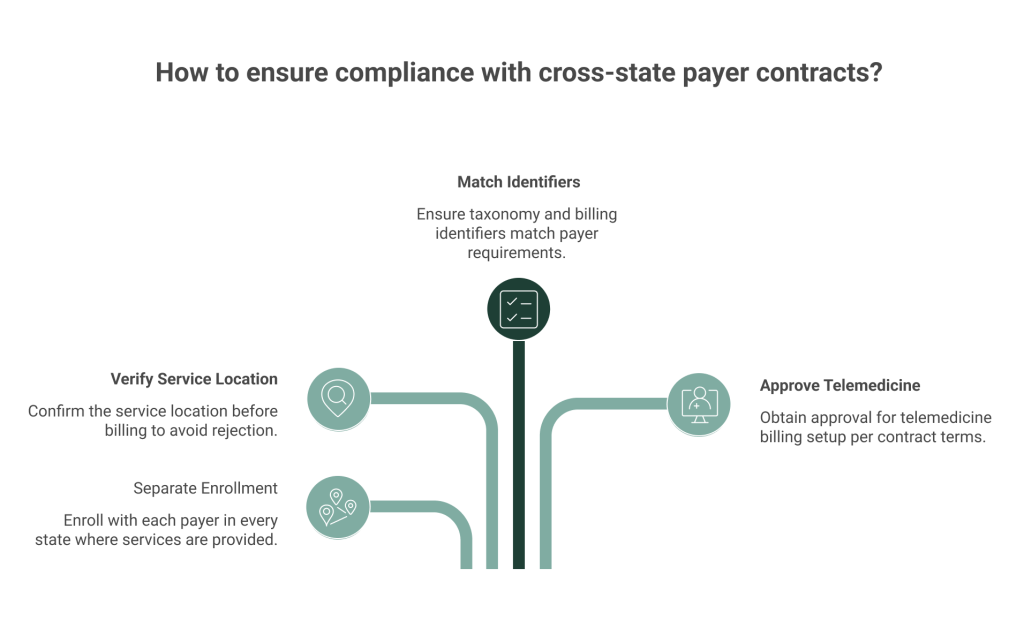
Cross-state payer contracts specify where and how services may be billed. Each insurance payer sets different enrollment rules for each state. These regulations apply even if a provider possesses several IMLC licenses.
Key rules include:
- Separate enrollment per payer per state
- Verification of service location before approval
- Matching taxonomy and billing identifiers
- Approval of telemedicine billing setup per contract terms
Physical location rules in the telemedicine billing setup for telehealth credentialing
In telehealth credentialing, physical location rules are a major reason for claim rejection, even when providers are fully licensed and enrolled. Many Nurse Practitioners, physicians, and billing teams assume that a valid state license and payer enrollment are enough. In practice, payers still require clear service location validity before claims are processed. In 2026, location-based denial patterns remain a consistent issue in multi-state provider enrollment workflows.
Service location vs provider license location
Service location and provider license location are not the same. This difference is central to telemedicine billing setup and telehealth credentialing workflows.
- Service location = where the patient receives care
- License location = where the provider is legally approved to practice
- Billing eligibility depends on service location records in payer systems
Why do payers require location-based enrollment
Payers use location-based enrollment to control reimbursement rules. Each state has different coverage policies, fee schedules, and compliance checks. This is why cross-state payer contracts require location-specific validation before claims are accepted.
Key reasons include:
- State-specific reimbursement rules
- Fraud and duplication control systems
- Contract-based service area restrictions
- Verification of telemedicine billing setup compliance
Common billing rejection causes
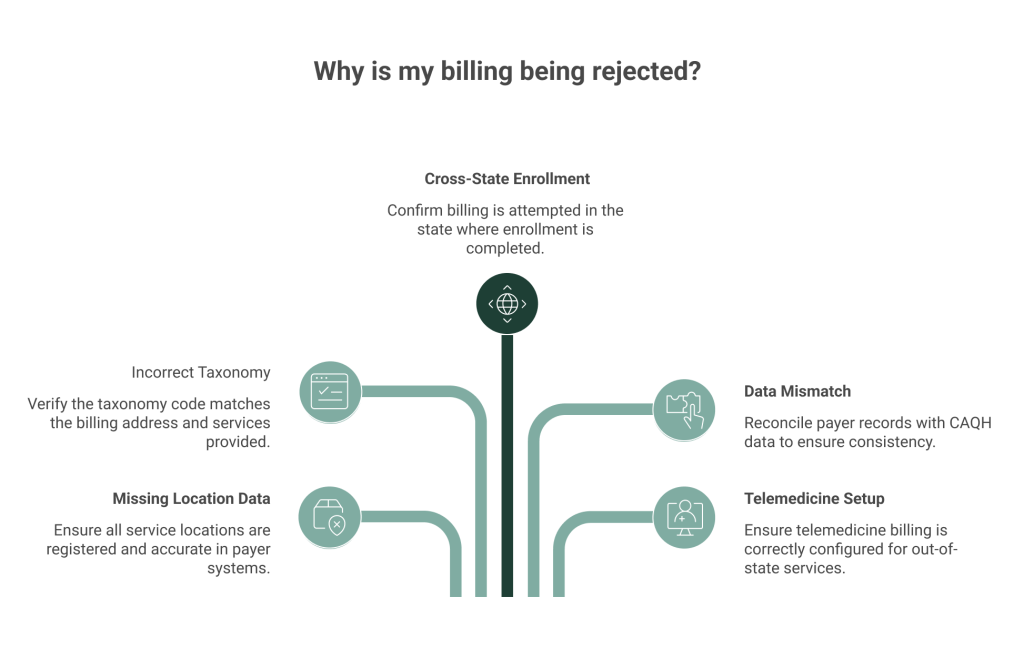
Billing rejection often occurs due to incorrect or incomplete location data in payer systems. These issues appear frequently in multi-state provider enrollment cases.
Common causes include:
- Missing or unregistered service location
- Incorrect taxonomy linked to billing address
- Enrollment completed in one state, but billing attempted in another
- Mismatch between payer records and CAQH data
- Incomplete telemedicine billing setup for out-of-state services
Home state enrollment model in telehealth credentialing
This model supports consistency in telemedicine billing setup. It centralizes provider data such as CAQH, taxonomy, and credentials. However, each payer still requires separate enrollment under cross-state payer contracts.
What is home state enrollment
Home state enrollment refers to selecting one primary state for initial credentialing and payer setup. This state acts as the main reference point for provider records in telehealth credentialing systems.
All core data is maintained through this base structure. It includes CAQH profiles, provider identifiers, and primary payer links. Other states then use this data as a reference during multi-state provider enrollment.
- Central source for provider credentialing data
- Base structure for payer enrollment tracking
- Reference point for multi-state expansion
Benefits of home state structure
A home state structure reduces repeated data entry across multiple payer systems. It improves consistency in provider records and lowers the risk of mismatched information in telemedicine billing setup.
It also helps billing teams track enrollment status more efficiently. Centralized records make it easier to manage updates, renewals, and compliance checks. This reduces delays linked to incomplete or inconsistent credentialing data.
- Reduces duplicate enrollment work
- Improves data accuracy across payers
- Simplifies credentialing updates and monitoring
Limitations of home state enrollment
Home state enrollment does not replace payer-specific contracts. Each payer still requires separate approval for billing under cross-state payer contracts. Without this step, claims will not be reimbursed.
It also does not remove physical location requirements. Providers must still register service locations in each state where care is delivered. This means telehealth credentialing remains dependent on both enrollment and location validation.
- Separate payer approval still required
- Physical location rules still apply
- Does not guarantee billing activation
Impact of telehealth credentialing on billing and revenue cycle
Telehealth credentialing directly affects claim approval, payment timelines, and overall revenue flow. Even with correct coding and documentation, claims fail if enrollment and credentialing are incomplete. This issue is common in multi-state provider enrollment and telemedicine billing setup.
Claim denial risks due to enrollment gaps
Claim denials often occur when provider enrollment is incomplete or not aligned with payer records. In telehealth credentialing, even one missing link between provider data and payer systems can stop claim processing. This issue is common in cross-state payer contracts.
Many denials are triggered before claim adjudication. Payers check enrollment status, service location, and provider identifiers during initial validation. If any of these elements are missing, the claim is rejected without review.
Common risk areas include incorrect enrollment state, inactive payer contracts, and mismatched CAQH data. These errors are preventable but frequent in multi-state provider enrollment. They increase denial rates and require resubmission.
Revenue delays caused by credentialing issues
Credentialing delays directly impact revenue flow. Claims may remain on hold until enrollment is approved in payer systems. This delays the first payment cycle for providers entering new states.
In telemedicine billing setup, each payer follows its own approval timeline. When multiple states are involved, delays increase due to repeated verification steps. This slows down billing activation across all locations.
Even minor documentation gaps can extend timelines beyond 60–120 days. These delays affect cash flow, increase outstanding receivables, and create backlog for billing teams. Timely credentialing is necessary for stable revenue cycles.
Role of RCM teams in credentialing tracking
RCM teams are responsible for tracking credentialing and enrollment status before claim submission. They ensure that provider data is complete and aligned with payer systems. This reduces rejection risk in telehealth credentialing workflows.
They also coordinate with credentialing teams to verify approvals across states. This includes checking payer responses, validating service locations, and confirming active contracts. Their role is critical in multi-state provider enrollment.
RCM teams identify gaps early and prevent billing errors. They monitor pending enrollments, update records, and support compliance checks. This improves claim acceptance rates and supports consistent reimbursement.
Conclusion
Telehealth credentialing requires clear alignment between licensing, payer enrollment, and service location validation. A state license allows practice, but payer contracts control reimbursement. Without proper enrollment and location setup, claims will continue to be denied or delayed.
Providers and billing teams must treat multi-state provider enrollment as a structured process, not a one-time approval. Consistent tracking, accurate data, and correct telemedicine billing setup are necessary to reduce denials and maintain steady revenue flow.
FAQs
Why can’t I bill insurance after getting multiple state licenses?
A state license allows you to practice, not bill. You must complete payer enrollment and contract approval in each state before claims are accepted.
What is the difference between credentialing and payer enrollment?
Credentialing verifies your qualifications. Payer enrollment links you to an insurance network and allows you to submit claims for reimbursement.
Does the Interstate Medical Licensure Compact (IMLC) allow billing in multiple states?
No. IMLC only speeds up licensing. It does not approve payer contracts or billing rights under telehealth credentialing.
Why do payers require a physical service location for telehealth billing?
Payers use service location to apply state-specific rules and validate claims. Without an approved location, claims are often denied.
How can I reduce delays in multi-state provider enrollment?
Maintain updated CAQH data, track enrollment status for each payer, and ensure service location and taxonomy details match across all systems.