

Why are claims still denied even when CPT and ICD-10 codes are correct? Many Nurse Practitioners and billing teams face this issue due to an incorrect or missing Nurse Practitioner Taxonomy Code in the NPI record. CMS confirms that taxonomy codes are required for NPI enrollment and are used to identify provider specialty in all HIPAA-standard transactions. In 2026, stricter payer validation has made taxonomy accuracy more important than ever, especially for reducing preventable claim rejections.
In 2026, the enforcement of taxonomy usage has become stricter across payer systems. Several Medicare-linked and commercial payer updates require taxonomy codes on professional claims, with some systems denying claims after short compliance windows if the code is missing or invalid. In certain payer rollouts, claims without valid taxonomy details are being rejected during initial submission stages.
At the same time, NPPES validation rules are stricter in 2026. Incorrect or invalid taxonomy entries can now fail system-level validation and be rejected before claim submission. CMS systems also require one primary taxonomy per NPI record, making accuracy critical for credentialing, enrollment, and billing alignment.
Nurse Practitioner Taxonomy Code
This section explains the definition, purpose, and structure of the Nurse Practitioner Taxonomy Code. It also shows how it supports NPI enrollment, billing accuracy, and payer validation.
What is a Nurse Practitioner Taxonomy Code?
A Nurse Practitioner Taxonomy Code is a 10-character alphanumeric code used to identify an NP’s provider type and specialty. It is assigned through the NUCC taxonomy set and recorded in the NPPES system.
Key points:
- Identifies the provider as a Nurse Practitioner
- Specifies clinical specialization (e.g., family, psychiatric)
- Used in HIPAA-standard electronic transactions
- Required in the NPI application records
Why Nurse Practitioner Taxonomy Codes Are Required
Taxonomy codes are required for enrollment, billing, and compliance validation. They define the provider’s specialty in NPI records and are used across payer systems for verification.
Main reasons:
1. Mandatory for NPI enrollment through NPPES
2. Required for Medicare and payer credentialing
3. Used by payers to validate provider specialty
4. Ensures services billed match provider classification
The Nurse Practitioner Taxonomy Code directly affects claim processing and payment outcomes. Errors in taxonomy selection create mismatches between provider data and billed services.
Billing impact:
1. Incorrect taxonomy leads to claim rejection or denial
2. Missing taxonomy can stop claims before adjudication
3. Payer systems rely on taxonomy for provider recognition
Structure of NP Taxonomy Codes
NP taxonomy codes follow a standard classification structure defined by NUCC.
| Level | Description | Examples |
| Provider Grouping | A broad category that groups similar healthcare providers | Nursing Service Providers |
| Classification | Identifies the provider type within the grouping | Nurse Practitioner |
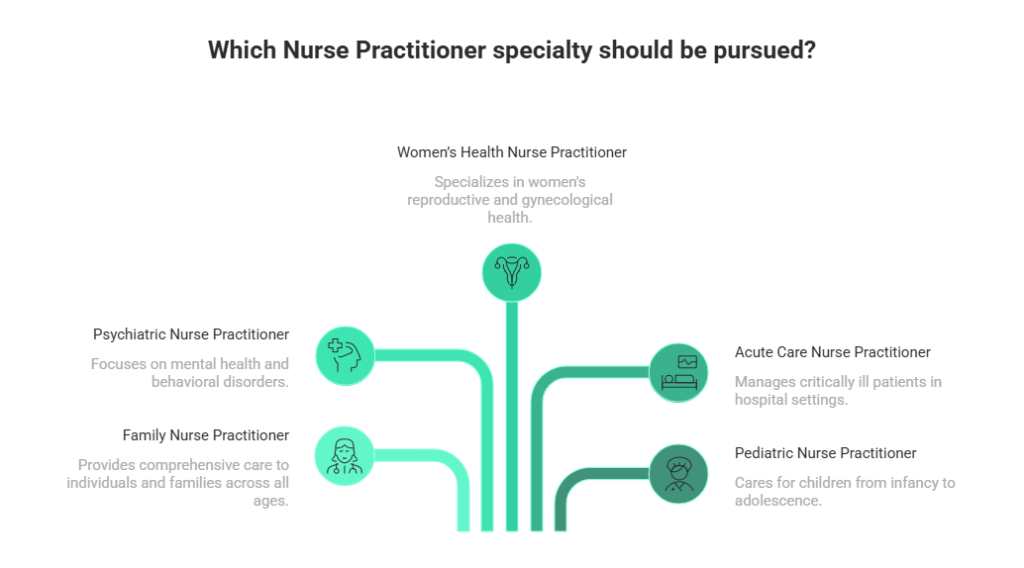
| Specialization | Defines the clinical focus of the Nurse Practitioner | Family Nurse Practitioner (363LF0000X)Psychiatric Nurse Practitioner (363LP0808X)Pediatric Nurse Practitioner (363LP0200X)Women’s Health Nurse Practitioner (363LW0102X)Acute Care Nurse Practitioner (363LA2100X) |
Types of Nurse Practitioner Taxonomy Codes
This section lists the main Nurse Practitioner taxonomy codes used in billing and enrollment.
Each code reflects a specific clinical specialty and affects payer recognition.
Taxonomy Code for Family Nurse Practitioner
The taxonomy code for a psychiatric nurse practitioner is 363LP0808X. It applies to NPs providing mental health and behavioral care.
| Element | Details |
| Code | 363LF0000X |
| Specialty | Family Nurse Practitioner |
| Scope | Primary care across all age groups |
| Common Settings | Family clinics, outpatient centers |
| Billing Impact | Must align with general evaluation and management services |
Taxonomy Code for Psychiatric Nurse Practitioner
The taxonomy code for a psychiatric nurse practitioner is 363LP0808X. It applies to NPs providing mental health and behavioral care.
| Element | Details |
| Code | 363LP0808X |
| Speciality | Psychiatric Nurse Practitioner |
| Scope | Mental health and behavioral care |
| Common Settings | Behavioral health clinics, psychiatric facilities |
| Billing Impact | Required for mental health claims; mismatch leads to denial |
Women’s Health Nurse Practitioner Taxonomy Code
The women’s health nurse practitioner taxonomy code is 363LW0102X. It supports services related to women’s health and reproductive care.
| Element | Details |
| Code | 363LW0102X |
| Speciality | Women’s Health Nurse Practitioner |
| Scope | Reproductive and gynecological care |
| Common Settings | OB-GYN clinics, women’s health centers |
| Billing Impact | Required for women’s health services and screenings |
Acute Care Nurse Practitioner Taxonomy Code
The acute care nurse practitioner taxonomy code is 363LA2100X. It is used for NPs managing patients with severe or complex conditions.
| Element | Details |
| Code | 363LA2100X |
| Speciality | Acute Care Nurse Practitioner |
| Scope | Management of severe and complex conditions |
| Common Settings | Hospitals, ICUs, and emergency departments |
| Billing Impact | Must align with inpatient and high-acuity service claims |
Pediatric Nurse Practitioner Taxonomy Code
The pediatric nurse practitioner taxonomy code is 363LP0200X. It is used for care provided to infants, children, and adolescents.
| Element | Details |
| Code | 363LP0200X |
| Speciality | Pediatric Nurse Practitioner |
| Scope | Care for infants, children, and adolescents |
| Common Settings | Pediatric clinics, hospitals |
| Billing Impact | Must match pediatric services and age-specific claims |
How to Find Nurse Practitioner Taxonomy Code
This section explains how to locate the correct Nurse Practitioner Taxonomy Code using official sources. It also shows how to select the correct code in NPI records to avoid claim issues.
Using the NUCC Taxonomy Lookup Tool
The NUCC tool is the official source for all taxonomy codes. It allows providers and billing teams to identify the correct classification and specialty.
Steps to find the code:
1. Go to the NUCC taxonomy lookup database
2. Enter “nurse practitioner” or a specialty keyword
3. Review the list of matching taxonomy codes
4. Select the code that matches the provider’s clinical role
5. Confirm the description before use in NPI
Key checks:
- Match the code with the actual services provided
- Verify specialty alignment with payer requirements
- Cross-check with credentialing records
Selecting Primary vs Secondary Taxonomy Code
Providers can report more than one taxonomy code, but one must be marked as primary in the NPI record.
Primary taxonomy code
- Represents the main area of practice
- Used by payers for claim processing
- Must match the majority of billed services
Secondary taxonomy codes
- Represent additional specialties
- Used for the expanded scope of services
- Do not replace the primary code in billing
Common errors
- Selecting the wrong primary taxonomy
- Leaving the primary field blank
- Using outdated specialty codes
Impact on billing
- Incorrect primary taxonomy causes claim denial
- Payers may reject claims due to a specialty mismatch
- Credentialing records may not align with billing data
Importance of Nurse Practitioner Taxonomy Code in Medical Billing
This section explains how the Nurse Practitioner Taxonomy Code affects billing workflows and payer validation. It also shows its role in claim approval, denial prevention, and provider enrollment.
Role in Claim Processing
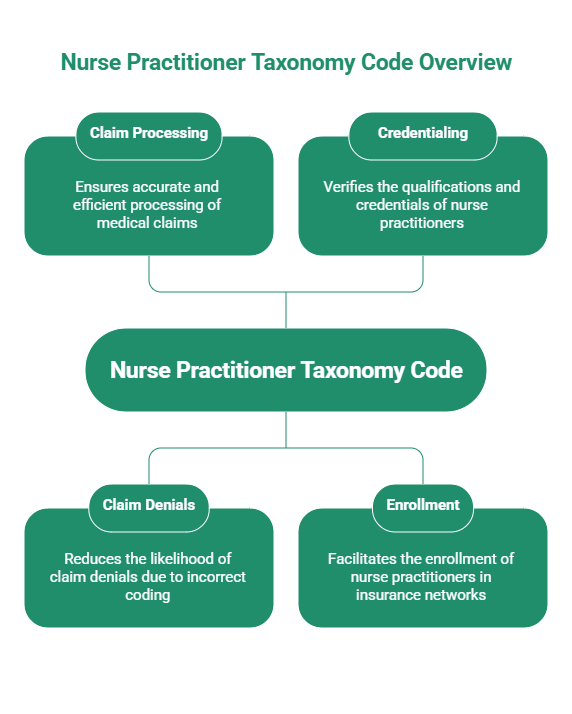
The Nurse Practitioner Taxonomy Code is included in electronic claims to identify provider specialty. Payer systems use this code with the NPI to validate the provider type before processing. It ensures that billed services match the provider’s classification.
Key functions:
1. Links the provider specialty with CPT services
2. Validates provider type in payer systems
3. Supports accurate claim routing
During claim submission, systems check taxonomy against CPT and diagnosis codes. If the specialty does not align, the claim may stop before adjudication. Correct taxonomy supports clean claim flow and reduces processing delays.
Impact on Claim Denials
Incorrect or missing taxonomy codes often lead to claim rejection. A mismatch between taxonomy and services billed creates validation errors in payer systems. These errors are detected early in clearinghouse or payer edits.
Common denial causes:
1. Incorrect taxonomy code selection
2. Missing taxonomy in claim
3. Inactive or outdated taxonomy in NPI
Denied claims require correction and resubmission, which delays payment cycles. Repeated errors increase workload for billing teams. Accurate taxonomy selection helps reduce denial rates and supports faster reimbursement.
Credentialing and Enrollment Role
The Nurse Practitioner Taxonomy Code is required during NPI registration and payer enrollment. It defines the provider’s specialty for Medicare and commercial insurance networks.
Payers use this data to approve participation and service eligibility.
Key roles in enrollment:
1. Submitted to NPPES during NPI setup
2. Used in Medicare and payer credentialing
3. Defines provider specialty for network inclusion
If the taxonomy code is incorrect, credentialing may be delayed or rejected. A mismatch between enrollment and billing records creates payment issues. Accurate taxonomy ensures consistency across NPPES, payer systems, and claims.
Conclusion
The Nurse Practitioner Taxonomy Code is a required element for accurate NPI enrollment, claim processing, and payer validation. It directly impacts billing accuracy, credentialing approval, and reimbursement outcomes across healthcare systems.
Incorrect or missing taxonomy data can lead to claim denials, enrollment delays, and mismatches between provider records and payer systems. Maintaining correct taxonomy selection ensures consistent billing performance and supports smooth revenue cycle operations.
FAQs
What is a Nurse Practitioner Taxonomy Code?
A Nurse Practitioner Taxonomy Code is a 10-character code used to identify an NP’s specialty and provider type. It is required in NPI enrollment and used in billing and payer systems for claim validation.
Why is the Nurse Practitioner Taxonomy Code important in billing?
It helps payers verify the provider’s specialty before processing claims. An incorrect or missing taxonomy code can lead to claim denials, delays, or rejection at the clearinghouse level.
Can a Nurse Practitioner have more than one taxonomy code?
Yes. An NP can list multiple taxonomy codes in their NPI record. However, only one code must be selected as the primary taxonomy for billing and claim processing purposes.
How do I find the correct Nurse Practitioner Taxonomy Code?
You can find it using the official NUCC Taxonomy Lookup Tool. Search by specialty (such as family, pediatric, or psychiatric NP) and select the code that matches your clinical practice.
What happens if the taxonomy code is incorrect or outdated?
Incorrect or outdated taxonomy codes can cause claim denials, credentialing delays, and payer mismatches. It may also stop claims from being processed until the record is corrected in NPPES.