
Credentialing is one of the most important steps for healthcare providers who want to participate in insurance networks and receive timely reimbursements. During this process, insurance companies rely heavily on your CAQH ProView profile to verify your professional credentials, licenses, work history, malpractice insurance, and other essential information.
But what happens if your CAQH profile expires during credentialing?
The short answer is that your credentialing application usually doesn’t start over, but it can be placed on hold until your CAQH profile is updated and re-attested. Depending on the payer’s policies and how quickly you resolve the issue, this can delay provider enrollment, postpone your effective date, and impact reimbursements.
In this guide, we’ll explain exactly what happens when a CAQH profile expires during credentialing, how it affects insurance credentialing, and the steps you can take to minimize delays.
Understanding CAQH and Why It Matters in Provider Credentialing
The Council for Affordable Quality Healthcare (CAQH) ProView is a centralized provider database used by hundreds of insurance companies and healthcare organizations during the credentialing process.
Instead of submitting the same professional information to every payer individually, providers maintain a single CAQH profile containing:
- Professional licenses
- DEA registration
- NPI information
- Board certifications
- Education and training
- Employment history
- Practice locations
- Malpractice insurance
- Hospital affiliations
Insurance companies access this information during provider credentialing to verify your qualifications before approving your participation in their networks.
Because many payers rely on CAQH as a primary source of provider information, keeping your profile current is essential for smooth credentialing.
Does a CAQH Profile Actually Expire?
Yes—but not in the way many providers think.
Your CAQH profile doesn’t disappear after a certain date. Instead, CAQH requires providers to re-attest every 120 days, confirming that the information in their profile remains accurate.
If you don’t complete the re-attestation, your profile becomes outdated and may be considered inactive by insurance companies.
Understanding Different CAQH Profile Statuses
| Profile Status | What It Means | Potential Impact on Credentialing |
| Active | Profile is current and re-attested | Credentialing proceeds normally |
| Expired Attestation | Re-attestation is overdue | Credentialing review may be delayed |
| Incomplete Profile | Required information is missing | Additional documentation may be requested |
| Missing Documents | Expired licenses or insurance | Verification may pause until documents are updated |
Understanding these differences helps providers identify issues before they disrupt credentialing.
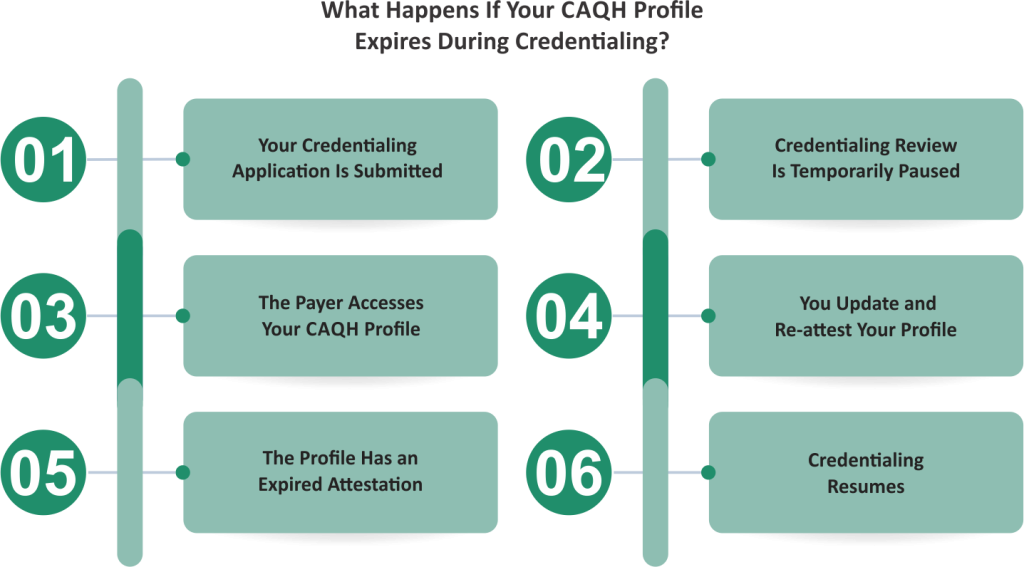
What Happens If Your CAQH Profile Expires During Credentialing?
This is one of the most common concerns among healthcare providers—and fortunately, an expired CAQH profile doesn’t automatically mean your application will be denied.
In most situations, here’s what happens:
Step 1: Your Credentialing Application Is Submitted
The payer receives your credentialing application and begins reviewing your qualifications.
Step 2: The Payer Accesses Your CAQH Profile
Credentialing specialists review your CAQH profile to verify your credentials and supporting documentation.
Step 3: The Profile Has an Expired Attestation
If your CAQH profile hasn’t been re-attested within the required timeframe, the payer may determine that the information is no longer considered current.
Step 4: Credentialing Review Is Temporarily Paused
Rather than denying your application immediately, many insurance companies place the review on hold until your CAQH profile is updated.
Step 5: You Update and Re-attest Your Profile
Once you review your information, upload any updated documents, and complete the attestation, the payer can continue reviewing your application.
Step 6: Credentialing Resumes
After your CAQH profile is current again, the payer typically resumes the credentialing process from where it stopped.
While every insurance company has its own credentialing policies, prompt action can significantly reduce delays.
How CAQH Expiration Can Affect the Credentialing Timeline
Even a short delay in updating your CAQH profile can extend the credentialing process.
| Timeline | Credentialing Activity |
| Day 1 | Credentialing application submitted |
| Day 15 | Insurance payer begins verification |
| Day 20 | CAQH attestation expires |
| Day 22 | Credentialing review placed on hold |
| Day 25 | Provider updates and re-attests profile |
| Day 28 | Payer resumes credentialing review |
Although this example represents a typical scenario, actual timelines vary depending on the insurance company and the complexity of the credentialing application.
Will You Have to Restart the Credentialing Process?
In most cases, no.
An expired CAQH profile generally causes a temporary delay rather than requiring you to begin the entire credentialing process again.
However, some situations may require additional review, including:
- Significant delays in updating your profile
- Expired professional licenses
- Expired malpractice insurance
- Missing supporting documents
- Inconsistent provider information
- Payer-specific credentialing policies
The faster you update your profile, the less likely you’ll experience prolonged credentialing delays.
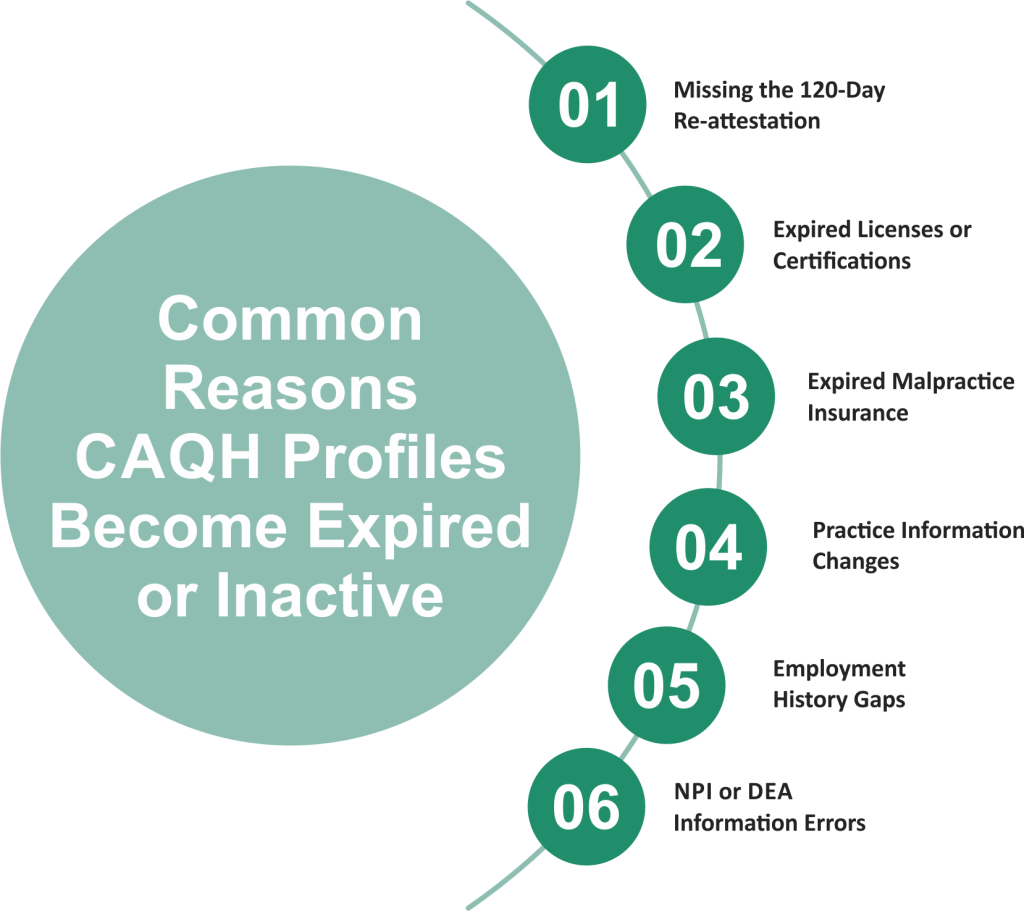
Common Reasons CAQH Profiles Become Expired or Inactive
Many providers assume their CAQH profile is active until a payer notifies them otherwise. In reality, several issues can cause a profile to become outdated.
Common causes include:
Missing the 120-Day Re-attestation
Busy schedules often cause providers to overlook CAQH reminder emails.
Expired Licenses or Certifications
If your professional license or board certification expires without being updated, your profile may no longer reflect current credentials.
Expired Malpractice Insurance
Insurance companies require current malpractice coverage during credentialing.
Practice Information Changes
Changes to addresses, phone numbers, tax IDs, or practice affiliations should be updated promptly.
Employment History Gaps
Incomplete or inconsistent work history can trigger additional verification requests.
NPI or DEA Information Errors
Incorrect provider identifiers may delay verification and payer enrollment.
How an Expired CAQH Profile Can Affect Your Practice
An expired profile doesn’t only affect credentialing—it can also impact your organization’s financial performance.
Credentialing Delays
Insurance companies may postpone reviewing your application until your CAQH information is current.
Delayed Provider Enrollment
Your effective participation date with insurance networks may be pushed back.
Reimbursement Delays
Delayed enrollment often means delayed claim submissions and slower payments.
Limited Patient Access
Patients may have difficulty scheduling appointments if you’re not yet listed as an in-network provider.
Increased Administrative Work
Credentialing staff may need to provide additional documentation, respond to payer requests, and follow up with insurance companies.
What to Do If Your CAQH Profile Expires During Credentialing
If you discover your CAQH profile has expired, take action immediately.
1. Log In to CAQH ProView
Review your profile to identify any alerts or missing information.
2. Update All Information
Verify:
- Licenses
- Practice addresses
- Employment history
- Hospital affiliations
- Malpractice insurance
- Board certifications
3. Upload Current Documents
Replace any expired or outdated documentation.
4. Complete Your Re-attestation
Confirm that all information is accurate by completing the required attestation.
5. Verify Payer Authorizations
Ensure insurance companies have permission to access your updated profile.
6. Notify Your Credentialing Team
If you’re working with an internal credentialing department or an external credentialing company, let them know the updates have been completed.
7. Follow Up with the Insurance Payer
Some payers automatically resume credentialing, while others may require confirmation that your profile has been updated.
How to Prevent Future CAQH Credentialing Delays
Preventing expiration is much easier than resolving delays after they occur.
Follow these best practices:
- Set calendar reminders before your 120-day attestation deadline.
- Enable CAQH email notifications.
- Update documents immediately after renewals.
- Review your profile quarterly.
- Monitor license and malpractice insurance expiration dates.
- Keep employment and practice information current.
- Conduct routine credentialing audits.
- Assign profile management to a credentialing specialist if possible.
Proactive maintenance helps ensure uninterrupted credentialing and payer enrollment.
Best Practices for Maintaining an Active CAQH Profile
Successful providers treat CAQH maintenance as an ongoing process rather than a one-time task.
Consider implementing these strategies:
- Schedule quarterly profile reviews.
- Keep digital copies of all credentialing documents.
- Track expiration dates for licenses, certifications, and insurance policies.
- Regularly verify your NPI, DEA, and practice information.
- Confirm payer authorizations remain active.
- Document all updates for future reference.
Consistent maintenance reduces administrative burden and supports faster credentialing.
When Should You Consider Professional Credentialing Support?
Managing CAQH profiles becomes increasingly challenging as practices grow.
Professional credentialing support may be beneficial if you:
- Operate a multi-provider practice.
- Participate with multiple insurance networks.
- Manage providers across multiple states.
- Frequently onboard new clinicians.
- Experience repeated credentialing delays.
- Lack dedicated credentialing staff.
Partnering with an experienced credentialing company can help ensure your CAQH profile remains accurate, current, and compliant while reducing administrative workload.
Conclusion
An expired CAQH profile during credentialing doesn’t necessarily mean you’ll have to start the process from the beginning—but it can create avoidable delays that affect provider enrollment, insurance participation, and reimbursements.
By regularly updating your CAQH profile, completing your 120-day re-attestation on time, and maintaining accurate supporting documentation, you can keep the credentialing process moving forward without unnecessary interruptions.
If managing CAQH updates, payer enrollment, and credentialing requirements feels overwhelming, Dr Credentialing can help. Our experienced credentialing professionals provide comprehensive CAQH profile management, insurance credentialing, provider enrollment, and medical billing support, allowing you to focus on delivering quality patient care while we handle the administrative complexities.
Frequently Asked Questions
Does an expired CAQH profile stop credentialing?
Not necessarily. Most insurance companies temporarily pause the review until your CAQH profile is updated and re-attested.
How often should I re-attest my CAQH profile?
CAQH requires providers to complete re-attestation every 120 days, even if no information has changed.
Can insurance companies still access an expired CAQH profile?
Many payers can still access your profile, but they may not consider the information current until it has been re-attested.
Will I have to restart credentialing?
Usually not. Most payers continue the review after your CAQH profile has been updated.
Can an expired CAQH profile delay reimbursements?
Yes. Credentialing delays may postpone payer enrollment and delay your ability to submit claims for reimbursement.
What documents should I keep updated in CAQH?
Maintain current copies of your professional licenses, malpractice insurance, board certifications, DEA registration, education records, employment history, and practice information.
Does Medicare use CAQH?
While many commercial insurance companies rely on CAQH, Medicare follows its own provider enrollment process. However, maintaining an accurate CAQH profile supports credentialing with many private payers.
Can someone else manage my CAQH profile?
Yes. Many providers authorize credentialing specialists or credentialing companies to help maintain their CAQH profiles and monitor important deadlines.