
Do credentialing mistakes cost your practice millions of dollars each year? Healthcare leaders are asking about this problem as more than half of hospitals and provider groups report measurable revenue loss caused by credentialing delays, with some organizations losing over $1 million per year due to sluggish approvals and operational failures.
Credentialing errors cause delays in provider enrollment, prevent payer access, and interrupt income before a single claim is made. Most credentialing applications have errors or missing information, extending review durations beyond the normal 90-120 days. When credentialing isn’t completed, providers can’t bill insurance companies, administrative costs rise, and revenue cycle teams face ongoing follow‑ups and rework.
When you visit our Credentialing Mistakes blog, you face operational challenges that cost both time and money. This section discusses the most common issues that cause credentialing delays, rejected credentialing applications, and provider enrollment mistakes. You’ll learn what causes delayed approvals and how to avoid them so you can keep payers engaged and revenue moving.
Understanding Credentialing Mistakes
Credentialing mistakes slow provider enrollment and delay revenue. These errors trigger rejected credentialing applications and extended credentialing delays across payers. This section breaks down common credentialing mistakes and how they affect approval timelines.
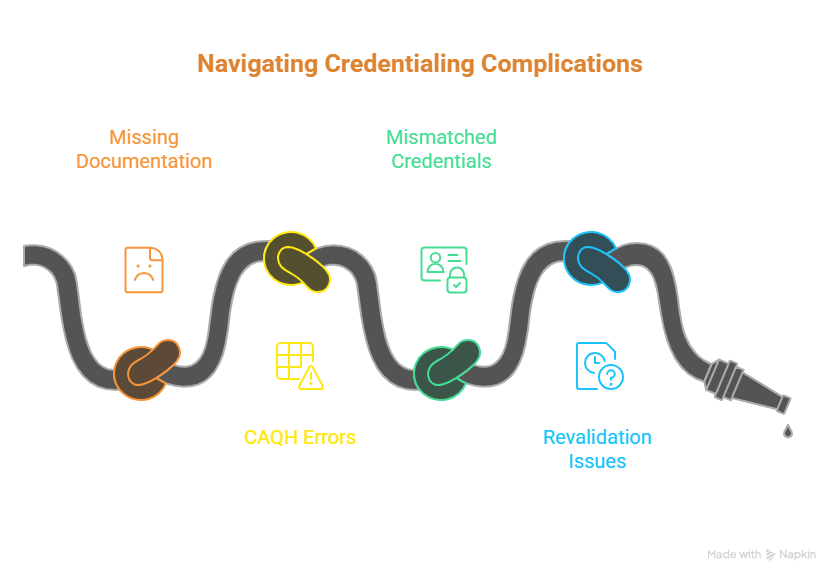
Missing Documentation
Incomplete files remain the leading cause of rejected credentialing applications.
Payers pause review when required records are missing or expired.
Common issues include:
- State licenses or DEA certificates expiring mid-review
- Malpractice insurance missing limits or effective dates
- Employment history gaps without written explanations
CAQH Errors
CAQH errors cause credentialing delays when profiles lack authorized payer access or current attestations. A CAQH profile must match NPPES and payer enrollment data. Expired attestations block applications from moving forward. Missing or inconsistent practice locations contribute to rejected credentialing applications. Providers should re‑attest every 120 days and verify that all fields align with payer records.
High-risk CAQH errors include:
- Expired attestations beyond 120 days
- Unverified practice locations
- Failure to authorize payer access
- Inconsistent data compared to NPPES or enrollment forms
License and Information Mismatches
License and information mismatches cause credentialing reviews to reset. Payers verify state medical licenses against practice addresses. If a provider practices in multiple states, each state license must be active. DEA registration must match the physical location. Taxonomy codes on applications must align with billing systems. Mismatch errors trigger secondary review and delay credentialing approval.
Any mismatch triggers secondary review.
Examples include:
- Multi-state providers lacking active licenses
- DEA registrations not aligned with practice addresses
- Incorrect taxonomy codes
Revalidation and Recredentialing Issues
Revalidation and recredentialing issues arise when deadlines are missed. Medicare, Medicaid, and commercial payers require periodic re‑credentialing. If teams overlook these timelines, providers can become inactive. Inactive status stops claims from being processed. Create a recredentialing calendar with owners assigned to each payer. Check status early and often to avoid gaps.
Common failures include:
- Ignored Medicare revalidation notices
- No recredentialing calendar
- Lack of ownership for renewals
How Credentialing Delays Impact Revenue
Credentialing delays directly affect a provider’s cash flow and practice operations. When a provider is not fully credentialed, claims submitted to insurance payers are often rejected, increasing accounts receivable and delaying payments.
Key Impacts:
- Denied Claims: Claims submitted before credentialing approval are rejected as “provider not credentialed,” requiring resubmission and creating avoidable administrative work.
- Revenue Loss: Practices can lose $1,000 to $5,000 per provider per day in potential reimbursements, especially in high-volume specialties.
- Reduced Patient Access: Credentialing delays prevent patients from using insurance coverage, which can reduce appointment volume and overall practice capacity.
- Operational Inefficiencies: Staff spends extra hours tracking denials, submitting updates, and following up with payers.
Mitigation Strategies
The following are the key strategies to overcome the delays:
1. Track credentialing timelines with a centralized dashboard.
2. Assign dedicated staff to monitor expiring licenses, DEA registration, and CAQH attestations.
3. Audit all submissions for accuracy before sending to payers.
4. Follow up promptly on requests for additional documentation.
5. Maintain clear communication with providers to avoid gaps in recredentialing or revalidation.
How to Avoid Delayed Credentialing Approval
Avoid delayed credentialing approval by enforcing clear processes.
- Assign ownership for each provider and payer.
- Use credentialing trackers with deadline alerts.
- Run regular primary source verifications.
- Reconcile CAQH, NPPES, and payer portal data monthly.
- Audit all submissions before filing.
Conclusion
Credentialing mistakes create avoidable delays, rejected applications, and revenue loss for providers and practices. By understanding missing documentation, CAQH errors, license mismatches, and recredentialing issues, teams can take precise steps to maintain approval timelines.
Implementing clear ownership, tracking systems, and regular audits ensures credentialing delays are minimized. Consistent follow-up and verification keep payers engaged, protect cash flow, and sustain practice operations efficiently.
FAQs
What are the most common credentialing mistakes?
Missing documentation, CAQH errors, license mismatches, and overlooked revalidation deadlines are the top causes of delays.
How do credentialing mistakes impact revenue?
Delays prevent providers from billing insurance, causing claim denials, lost reimbursements, and increased administrative costs.
How can CAQH errors delay credentialing approval?
Expired attestations, unverified practice locations, and missing payer authorizations block applications from progressing.
What should providers do to avoid recredentialing issues?
Maintain a recredentialing calendar, assign ownership for renewals, and monitor deadlines to prevent inactive status.
Can incorrect license information delay provider enrollment?
Yes, mismatched state licenses, DEA registrations, or taxonomy codes trigger secondary reviews and slow credentialing approval.