Hiring or credentialing a healthcare professional involves much more than verifying an active license. Healthcare organizations must also identify sanctions, exclusions, and disciplinary actions that could affect patient safety, regulatory compliance, and reimbursement eligibility. This is where many people encounter the term FACIS license number, often assuming it refers to a unique identification number issued by the FACIS system. In reality, the concept is frequently misunderstood.
In this article, you’ll learn what a FACIS license number actually means, how FACIS search works, what FACIS Level 1 includes, and why hospitals, clinics, staffing agencies, and credentialing teams rely on FACIS screening as part of a comprehensive provider verification process.
Whether you’re a healthcare administrator, compliance officer, or credentialing specialist, understanding FACIS can help you make informed hiring decisions, reduce compliance risks, and maintain a trusted workforce.
What Is a FACIS License Number?
A FACIS license number is one of the most misunderstood terms in healthcare credentialing. Contrary to what many professionals believe, FACIS (Fraud and Abuse Control Information System) does not issue its own license numbers. Instead, FACIS uses a healthcare provider’s existing professional license number and other identifying information to search thousands of federal, state, and licensing board records for sanctions, exclusions, disciplinary actions, and other compliance-related information.
When someone searches for a “FACIS license number,” they are usually referring to the professional license that is used during a FACIS screening. The healthcare professional’s license number serves as an identifier, allowing the system to match records accurately across multiple regulatory databases.
Professional License Number vs. FACIS Search
| Professional License Number | FACIS Search |
| Issued by a state licensing board | Conducts compliance screening using provider information |
| Identifies a healthcare professional | Identifies sanctions, exclusions, and disciplinary records |
| Confirms licensing status | Confirms regulatory and compliance standing |
| Required for professional practice | Used during hiring, credentialing, and ongoing monitoring |
By understanding how these two work together, healthcare organizations can perform more comprehensive background screening and make better credentialing decisions.
What Is FACIS and Why Is It Used in Healthcare?
The Fraud and Abuse Control Information System (FACIS) is a healthcare compliance screening solution designed to help organizations identify providers who have been excluded, sanctioned, disciplined, or restricted by federal agencies, state regulators, licensing boards, and other healthcare oversight organizations.
Instead of checking dozens or even hundreds of databases individually, healthcare organizations can perform a single FACIS search that consolidates information from multiple authoritative sources into one comprehensive report. This significantly reduces the time required for compliance screening while improving accuracy.
Healthcare organizations rely on FACIS because employing an excluded or sanctioned provider can result in serious financial penalties, reputational damage, denied reimbursements, and increased regulatory scrutiny.
FACIS Helps Healthcare Organizations
- Verify provider compliance before hiring.
- Identify federal and state exclusions.
- Detect disciplinary actions from licensing boards.
- Support provider credentialing and recredentialing.
- Reduce fraud and abuse risks.
- Maintain Medicare and Medicaid compliance.
- Prepare for audits and accreditation reviews.
- Protect patients through comprehensive screening.
Whether you’re onboarding a physician, nurse, therapist, pharmacist, or allied health professional, FACIS provides an additional layer of due diligence beyond standard license verification.
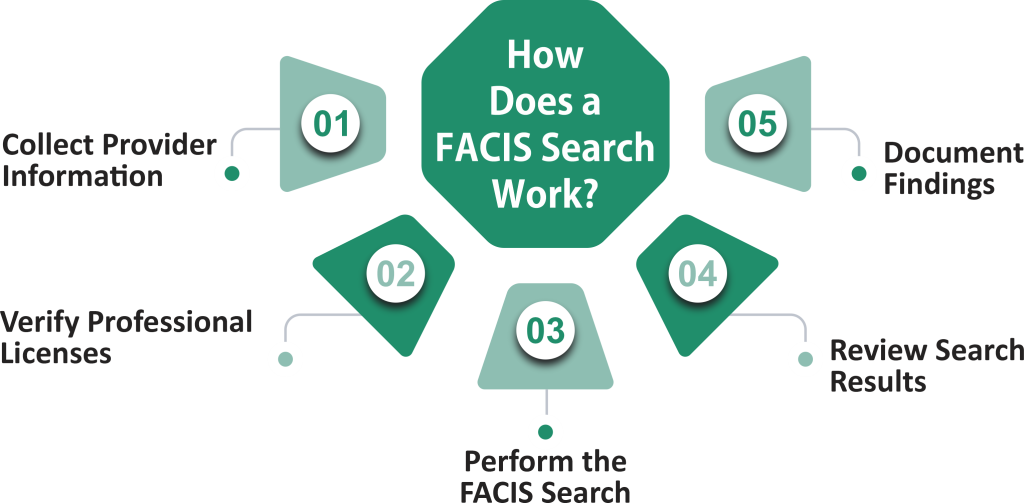
How Does a FACIS Search Work?
A FACIS search is designed to uncover compliance issues that may not appear during a standard license verification. Rather than simply confirming whether a professional license is active, FACIS searches multiple regulatory databases to identify exclusions, sanctions, disciplinary actions, and other records that could impact a provider’s eligibility to work within healthcare organizations.
The screening process is typically integrated into hiring, credentialing, provider enrollment, and ongoing compliance monitoring programs.
Step 1: Collect Provider Information
The organization gathers identifying details such as the provider’s name, date of birth, National Provider Identifier (NPI), professional license number, and other relevant credentials.
Step 2: Verify Professional Licenses
Before conducting a FACIS search, employers confirm that the provider’s professional license is valid, active, and issued by the appropriate licensing authority.
Step 3: Perform the FACIS Search
The provider’s information is screened against numerous federal, state, licensing board, and regulatory databases to identify potential compliance concerns.
Step 4: Review Search Results
Compliance teams evaluate any reported exclusions, sanctions, disciplinary actions, license restrictions, or enforcement actions to determine whether additional investigation is necessary.
Step 5: Document Findings
Organizations maintain records of the screening results as part of their credentialing and compliance documentation, supporting regulatory requirements and future audits.
By incorporating FACIS searches into routine credentialing workflows, healthcare organizations can identify risks early and maintain a compliant workforce.
What Information Can a FACIS Search Reveal?
A FACIS search goes far beyond simply confirming whether a healthcare provider holds an active license. It helps organizations uncover regulatory actions and compliance issues that could affect patient safety, reimbursement eligibility, or accreditation requirements.
Depending on the screening level, a FACIS report may reveal information from federal agencies, state regulators, licensing boards, and other healthcare oversight organizations.
Common Information Included in a FACIS Search
| Information Verified | Included in FACIS Search |
| Professional license status | ✔ |
| License disciplinary actions | ✔ |
| Federal exclusions | ✔ |
| Medicare sanctions | ✔ |
| Medicaid exclusions | ✔ |
| DEA enforcement actions | ✔ |
| State licensing board actions | ✔ |
| Administrative penalties | ✔ |
| Regulatory enforcement actions | ✔ |
Because FACIS aggregates information from numerous trusted sources, organizations gain a broader understanding of a provider’s compliance history than they would through license verification alone.
What Is FACIS Level 1?
FACIS Level 1 is the foundational level of FACIS screening and is commonly used by healthcare organizations that need to verify whether a provider appears on key federal exclusion and sanction lists.
Rather than searching every available state and licensing database, Level 1 focuses primarily on federal data sources that identify individuals and entities prohibited or restricted from participating in federally funded healthcare programs.
This level is often appropriate for organizations seeking an efficient baseline compliance review as part of their hiring or credentialing process.
FACIS Level 1 Typically Includes
- Federal exclusion databases.
- Office of Inspector General (OIG) exclusions.
- System for Award Management (SAM) records.
- Drug Enforcement Administration (DEA) enforcement actions.
- U.S. Food and Drug Administration (FDA) regulatory actions.
- Additional federal healthcare compliance sources.
Who Commonly Uses FACIS Level 1?
- Independent physician practices.
- Outpatient clinics.
- Healthcare staffing agencies.
- Small healthcare organizations.
- Ambulatory care centers.
- Organizations establishing baseline compliance screening.
For organizations operating across multiple states or managing larger provider networks, higher levels of FACIS screening may provide broader visibility into state sanctions and licensing board actions.
FACIS Level 1 vs. Level 2 vs. Level 3
Not every healthcare organization requires the same depth of compliance screening. FACIS offers multiple screening levels to accommodate different organizational needs, provider volumes, and regulatory requirements.
Understanding these differences helps compliance teams choose the most appropriate level of screening.
| Feature | FACIS Level 1 | FACIS Level 2 | FACIS Level 3 |
| Federal exclusion databases | ✔ | ✔ | ✔ |
| OIG and SAM screening | ✔ | ✔ | ✔ |
| One state sanction database | ✘ | ✔ | ✔ |
| Multiple state licensing boards | ✘ | Limited | ✔ |
| Nationwide state sanctions | ✘ | Limited | ✔ |
| Comprehensive disciplinary records | Basic | Moderate | Extensive |
| Best suited for | Small practices | Regional healthcare organizations | Hospitals, health systems, and enterprise healthcare organizations |
Selecting the appropriate FACIS level depends on your organization’s compliance obligations, geographic footprint, and risk management strategy. Many larger healthcare organizations prefer more comprehensive screening to ensure they identify both federal and state-level regulatory actions before making credentialing decisions.
Is a FACIS License Number Different from a Professional License Number?
Yes. A FACIS license number and a professional license number are not the same thing, even though they are often confused.
A professional license number is issued by a state licensing board to authorize a healthcare professional to practice within their scope of licensure. FACIS, on the other hand, does not issue licenses or assign license numbers. Instead, it uses the provider’s existing license number and other identifying information to perform a comprehensive compliance screening.
Think of it this way: your professional license confirms that you are legally authorized to practice, while a FACIS search determines whether there are any sanctions, exclusions, disciplinary actions, or regulatory issues associated with your professional record.
Professional License Number vs. FACIS License Number
| Professional License Number | FACIS License Number (Commonly Searched Term) |
| Issued by a state licensing board | Not an official number issued by FACIS |
| Confirms legal authority to practice | Refers to the license used during FACIS screening |
| Shows license status and expiration | Searches compliance databases for related records |
| Required for licensure | Used for compliance verification and credentialing |
Who Needs a FACIS Search?
A FACIS search is valuable for any healthcare organization responsible for hiring, credentialing, contracting, or monitoring licensed professionals. Since regulatory actions can affect a provider’s eligibility to participate in federally funded healthcare programs, conducting a FACIS search helps organizations reduce compliance risks before they become costly problems.
Organizations that regularly onboard physicians, nurses, therapists, pharmacists, dentists, and allied healthcare professionals often incorporate FACIS screening into their standard credentialing process.
Healthcare Organizations That Commonly Use FACIS
- Hospitals and integrated health systems.
- Physician groups and multispecialty practices.
- Ambulatory surgery centers.
- Outpatient clinics.
- Home healthcare agencies.
- Skilled nursing facilities.
- Behavioral health organizations.
- Healthcare staffing agencies.
- Telehealth providers.
- Pharmacies and specialty care providers.
- Dental service organizations.
- Medical billing and revenue cycle companies.
Regardless of the size of the organization, FACIS screening helps ensure providers meet regulatory expectations before delivering patient care.
Why Healthcare Organizations Perform FACIS Searches
Hiring a licensed healthcare professional without conducting a thorough compliance screening can expose an organization to significant legal, financial, and reputational risks. An active professional license alone does not guarantee that a provider has a clean regulatory history.
FACIS searches provide an additional layer of protection by identifying exclusions, sanctions, and disciplinary actions that may affect a provider’s ability to work within certain healthcare settings or participate in government-funded programs.
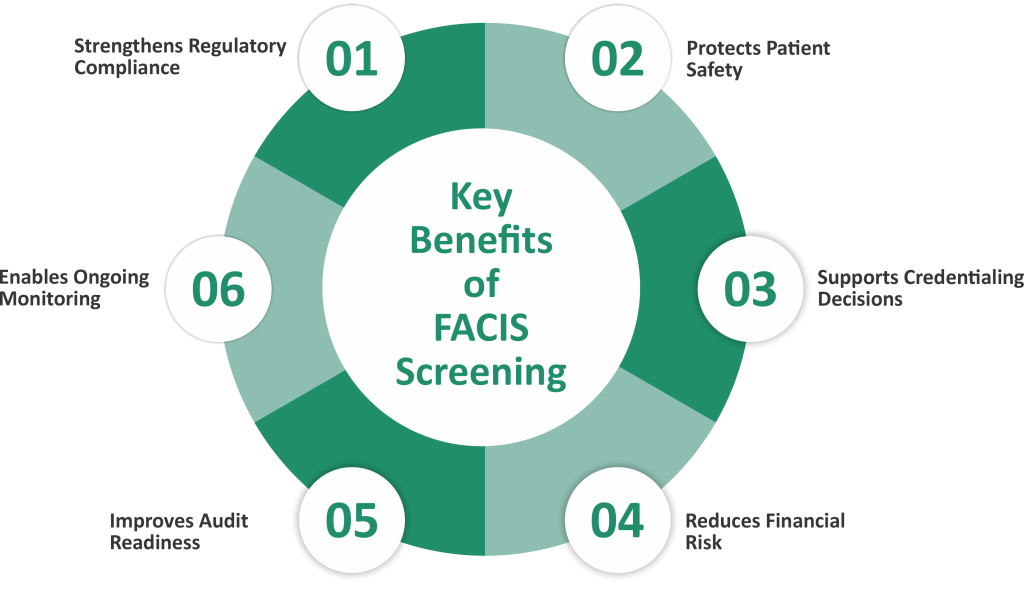
Key Benefits of FACIS Screening
Strengthens Regulatory Compliance: Organizations can demonstrate compliance with federal and state screening requirements while supporting accreditation standards.
Protects Patient Safety: Identifying sanctioned or excluded providers helps reduce risks associated with patient care and clinical operations.
Supports Credentialing Decisions: Credentialing teams gain a more complete picture of a provider’s professional standing before granting privileges or employment.
Reduces Financial Risk: Employing excluded providers may result in denied Medicare or Medicaid reimbursements, civil penalties, and repayment obligations.
Improves Audit Readiness: Maintaining documented FACIS screening results simplifies regulatory audits and accreditation reviews.
Enables Ongoing Monitoring: Many organizations perform recurring FACIS searches to identify new exclusions or disciplinary actions throughout a provider’s employment.
By making FACIS searches part of routine credentialing, healthcare organizations create a stronger and more defensible compliance program.
When Should a FACIS Search Be Performed?
A FACIS search should not be viewed as a one-time hiring task. Healthcare organizations should conduct screening throughout the provider lifecycle to maintain continuous compliance and reduce regulatory risk.
Performing searches at strategic points ensures that new sanctions or exclusions are identified before they affect patient care, reimbursement, or accreditation.
Recommended FACIS Screening Timeline
Before Employment
Verify compliance before extending an employment offer or finalizing provider contracts.
↓
During Initial Credentialing
Screen providers before granting clinical privileges or enrolling them with health plans.
↓
Before Provider Enrollment
Confirm eligibility before submitting Medicare, Medicaid, or commercial payer enrollment applications.
↓
During Recredentialing
Repeat FACIS searches during scheduled credentialing renewals to identify new compliance issues.
↓
Annual Compliance Reviews
Many healthcare organizations perform annual or semiannual FACIS screenings as part of their compliance program.
↓
Before Contract Renewals
Re-screen contracted physicians, vendors, and affiliated providers before renewing agreements.
Routine monitoring helps organizations stay ahead of regulatory changes and avoid unexpected compliance issues.
Common Reasons Professionals Appear in FACIS Search Results
Appearing in a FACIS search does not automatically mean a healthcare professional is permanently barred from practicing. Search results may include a variety of regulatory actions ranging from administrative penalties to serious federal exclusions.
Common Reasons Providers May Appear in FACIS
Office of Inspector General (OIG) Exclusions: Providers excluded from participating in federally funded healthcare programs.
Medicaid Exclusions: State agencies may restrict providers from participating in Medicaid programs due to compliance violations.
License Suspension or Revocation: State licensing boards may suspend or revoke licenses because of professional misconduct or regulatory violations.
License Probation or Restrictions: Providers may continue practicing under specific conditions imposed by a licensing board.
DEA Enforcement Actions: Controlled substance registration may be suspended, revoked, or restricted.
Professional Board Discipline: Medical, nursing, pharmacy, dental, or allied health boards may issue formal disciplinary actions.
Administrative Penalties: Civil monetary penalties or regulatory enforcement actions may be reported by government agencies.
Healthcare Fraud or Abuse Findings: Certain federal or state enforcement actions involving fraud investigations may also appear in FACIS search results.
Each result should be carefully reviewed within the context of the provider’s overall credentialing profile before making employment or privileging decisions.
Common Misconceptions About FACIS License Numbers
Because the term FACIS license number is widely searched online, many healthcare professionals and employers misunderstand what FACIS actually does. Clearing up these misconceptions helps organizations build a stronger and more accurate credentialing process.
| Myth | Reality |
| FACIS issues healthcare license numbers. | FACIS does not issue licenses or license numbers. |
| An active license means the provider will pass FACIS screening. | A provider may have an active license but still appear on sanction or exclusion lists. |
| FACIS only searches the OIG exclusion list. | FACIS searches multiple federal, state, and licensing databases depending on the screening level. |
| FACIS replaces license verification. | FACIS complements license verification by identifying compliance issues beyond license status. |
| FACIS is the same as a criminal background check. | FACIS focuses on healthcare sanctions, exclusions, disciplinary actions, and regulatory records rather than general criminal history. |
FACIS Search vs. OIG Exclusion List
Many people assume a FACIS search is the same as checking the Office of Inspector General (OIG) exclusion list. While the OIG database is an important component of compliance screening, it represents only one source of information.
A FACIS search expands the screening process by reviewing additional regulatory and licensing databases, giving organizations a broader picture of a provider’s compliance history.
| Feature | FACIS Search | OIG Exclusion List |
| OIG Exclusions | ✔ | ✔ |
| Federal Sanctions | ✔ | Limited |
| State Sanctions | Depends on FACIS Level | ✘ |
| Licensing Board Actions | Depends on FACIS Level | ✘ |
| Disciplinary Actions | ✔ | ✘ |
| Multiple Regulatory Sources | ✔ | ✘ |
| Comprehensive Compliance Screening | ✔ | ✘ |
For organizations responsible for provider credentialing, relying solely on the OIG exclusion list may leave important compliance risks undiscovered.
FACIS Search vs. License Verification
Although both processes are essential, they serve very different purposes during healthcare credentialing.
License verification confirms whether a healthcare professional is legally authorized to practice, while a FACIS search evaluates whether that provider has any regulatory issues that could affect employment, reimbursement, or compliance.
| License Verification | FACIS Search |
| Confirms active license status | Identifies sanctions and exclusions |
| Shows license expiration date | Reviews regulatory actions |
| Verifies licensing board information | Screens multiple compliance databases |
| Confirms legal authority to practice | Supports risk management and credentialing |
| Required during credentialing | Recommended for comprehensive compliance screening |
Healthcare organizations achieve the best results by using both processes together rather than relying on only one.
Best Practices for Healthcare Compliance Teams
Healthcare regulations continue to evolve, making ongoing provider monitoring more important than ever. Implementing standardized screening procedures helps organizations reduce compliance risks while maintaining accurate credentialing records.
Consider adopting these best practices:
- Verify every professional license before credentialing.
- Perform FACIS screening before hiring new providers.
- Re-screen providers during recredentialing cycles.
- Conduct periodic exclusion monitoring throughout employment.
- Investigate all sanction or disciplinary findings thoroughly.
- Maintain detailed documentation for every screening.
- Integrate FACIS searches into credentialing workflows.
- Keep compliance records organized for audits.
- Train HR and credentialing staff on regulatory requirements.
- Review compliance policies regularly to reflect changing regulations.
Following these practices helps create a proactive compliance program that protects both patients and healthcare organizations.
Simplify Provider Credentialing with Professional CVO Services
Running FACIS searches is only one part of a successful credentialing program. Healthcare organizations must also verify professional licenses, validate education and work history, enroll providers with payers, monitor ongoing compliance, and maintain accurate credentialing records.
A trusted Credential Verification Organization (CVO) can centralize these tasks into a streamlined workflow, helping your team reduce administrative burden, accelerate provider onboarding, improve audit readiness, and maintain continuous compliance. If you’re looking to simplify provider verification from start to finish, explore our CVO Credentialing Services to see how we can support your organization.
The Bottom Line
Exploring the difference between a FACIS license number and a professional license number is essential for anyone involved in healthcare hiring, credentialing, or compliance. While FACIS does not issue license numbers, it plays a critical role in identifying exclusions, sanctions, disciplinary actions, and other regulatory concerns that may not appear during standard license verification.
By combining professional license verification with comprehensive FACIS searches, healthcare organizations can make more informed credentialing decisions, strengthen regulatory compliance, reduce financial and legal risks, and protect patient safety.
Whether you’re onboarding a new provider or maintaining an existing workforce, incorporating FACIS screening into your credentialing process is a practical step toward building a compliant and trustworthy healthcare organization.