
If you are reading “How Long Does Provider Credentialing Take?” you are definitely wondering why credentialing causes delays in provider onboarding and impacts revenue. Credentialing is one of the most persistent operational challenges in health care in 2026. Most practices wait 3-6 months for credentialing clearance, while some government payer applications might take longer than 9 months in certain states due to backlogs and verification procedures.
These delays have a direct impact on the revenue cycle performance. According to industry data, the average credentialing procedure lasts 90-120 days, with over 80% of credentialing teams reporting turnaround rates of more than 15 days for basic enrollment tasks. Incomplete documentation, out-of-date CAQH profiles, and delayed primary source verification remain major variables.
This document discusses the timeline that healthcare providers should expect in 2026. We also discuss Medicare credentialing processes, Medicaid varies by state, and commercial payer gaps. You will learn common causes of delays and practical steps you can take to reduce credentialing time, protect revenue, and begin billing faster.
How Long Does Provider Credentialing Take?
Provider credentialing timelines affect patient access and revenue cycles. Providers, billers, and administrators need clear expectations before submitting applications. This section explains typical time frames and variations by payer in 2026.
Average Credentialing Timelines by Payer Type
Credentialing time frames vary by payers. Commercial insurers often need 90-150 days to complete credentialing. Some specialties and larger insurer networks report timelines closer to 180 days in recent 2026 credentialing data.
Medicare credentialing timeline averages 60–90 days after PECOS submission and verification completion. Delays in primary source verification or PECOS errors can extend this period beyond 100 days in some states.
Medicaid credentialing timeline differs by state. States with automated verification close applications in 45–75 days. States relying on manual verification still show 90+ day cycles. Credentialing teams must plan for these variations when forecasting provider readiness.
Hospital credentialing for facility privileges typically takes 60–120 days to complete. Re-credentialing processes often take 60-90 days to complete due to the availability of primary sources.
Government vs Commercial Timelines
Government payers follow structured verification, but their internal processing controls can lengthen timelines.
| Payer Type | Average Credentialing Timeline | Considerations |
| Medicare | 90–150 days | Primary source verification and background checks are mandatory. Delays may occur due to a backlog at CMS or missing provider information. |
| Medicaid | 90–180 days | State-specific variations exist; slower processing is more common in states with fewer resources or a higher volume of providers. |
| Commercial / Private Insurance | 60–120 days | Typically faster than government payers, but dependent on internal review cycles and completeness of applications. |
| Medicare Advantage / Managed Plans | 90–150 days | Combines government and commercial processes; may include additional plan-specific requirements. |
| Specialty Plans (e.g., Behavioral Health, Dental, Pharmacy) | 90–180 days | Slower credentialing is common due to additional documentation or specialty board verifications. |
What Causes Provider Credentialing Delays?
Credentialing delays directly affect provider start dates and revenue cycles. This section explains the main factors that extend the credentialing timeline. Understanding delay causes helps teams address issues early and reduce credentialing time.
Common Delay Factors
When asking How long does provider credentialing take?, delays often extend timelines beyond expectations. Key factors include:
Incomplete or inaccurate application data: Missing licenses, expired certificates, or outdated malpractice information trigger additional verification steps.
Slow responses from primary sources: Schools, previous employers, and licensing boards must confirm credentials; delayed replies add weeks to the process.
Internal payer backlogs: Some insurers review applications only during monthly committee meetings, which can add 30+ days.
Multi-state licensing requirements: Each state license requires separate verification, especially impacting Medicaid credentialing timelines.
Outdated or unsynchronized credentialing systems: Manual updates from PECOS, NPI registry, or payer databases increase errors and processing time.
High volume of applications: Large payers handling many applicants create bottlenecks, affecting both government and commercial timelines.
Delayed provider follow-ups: Slow responses to requests for corrections or additional documentation pause the process.
Requests for additional documentation: Mid-process clarifications or extra verification cycles extend the credentialing timeline further.
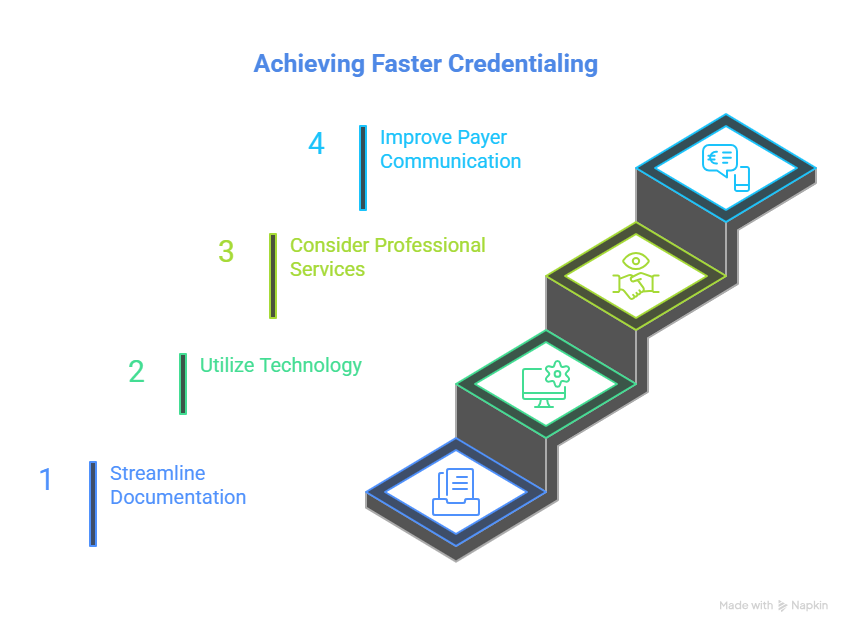
How to Speed Up Credentialing
Streamlining the credentialing process reduces delays and helps providers start seeing patients and receiving reimbursements faster. This section highlights proven strategies to shorten the credentialing timeline.
Streamline Documentation
Properly organized documents prevent errors and repeated follow-ups:
- Create a checklist of all required documents: licenses, certifications, DEA registration, malpractice insurance, and work history.
- Ensure all documents are current and valid; expired or incorrect documents cause delays.
- Submit standardized formats, such as PDFs, to avoid compatibility issues with payer systems.
- Review applications for completeness before submission to reduce back-and-forth requests.
Use Technology and Automation
Automation reduces manual errors and accelerates verification:
- Use credentialing software to auto-fill repetitive forms and track submissions.
- Automate primary source verification to validate licenses, board certifications, and education credentials.
- Maintain a centralized digital record of provider data for easy updates and audits.
- Set automated reminders for renewal of licenses or document expiration to prevent future delays.
Consider Professional Credentialing Services
Expert services can handle complex and time-consuming tasks efficiently:
- Outsource to certified credentialing companies familiar with Medicare, Medicaid, and commercial payers.
- They ensure applications are completed the first time accurately, reducing insurance credentialing delays.
- Services often have established connections with payers to expedite approvals.
- Managed Service Organizations (MSOs) provide full support, including enrollment, contracting, and updates.
Improve Payer Communication
Clear and consistent communication with payers reduces unnecessary delays:
- Assign a single point of contact within your practice for all payer communications.
- Respond promptly to any requests for additional information or clarification.
- Keep payers informed of updates to credentials, addresses, or affiliations.
- Regularly check the status of applications and follow up proactively to prevent backlogs.
Conclusion
Provider credentialing remains a critical step in ensuring timely revenue and patient access. Understanding average timelines, common delays, and variations by payer enables practices to plan efficiently and reduce credentialing time.
By streamlining documentation, using automation tools, engaging professional services, and maintaining proactive payer communication, healthcare teams can shorten credentialing cycles and start generating revenue faster. Effective preparation and strategic management of the credentialing process protect both operational efficiency and financial performance.
FAQs
What is provider credentialing?
Provider credentialing verifies a healthcare provider’s qualifications, licenses, certifications, and experience before joining a payer network. It ensures compliance and eligibility for reimbursement.
How long does provider credentialing take on average?
Credentialing typically takes 90–120 days for most providers, but government applications can extend to 180+ days depending on payer and state processes.
Why do credentialing delays happen?
Delays occur due to incomplete applications, slow primary source verification, multi-state licensing, payer backlogs, and outdated provider data systems.
Can technology speed up credentialing?
Yes, automation tools and credentialing software reduce manual errors, streamline documentation, and accelerate verification for faster payer approvals.
Should practices hire professional credentialing services?
Outsourcing to certified credentialing experts ensures applications are completed correctly, reduces insurance credentialing delays, and improves revenue cycle efficiency.