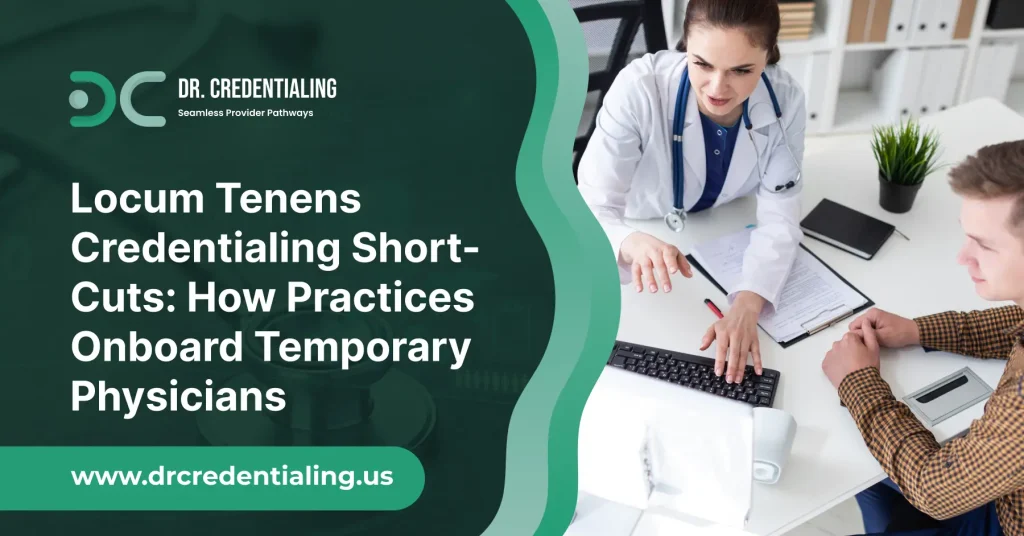
How can a practice bring a locum physician on board quickly without creating credentialing delays or payer problems? A physician may be ready to cover a staffing gap while credentialing, facility privileges, payer enrollment, and billing setup remain incomplete. In February 2026, CMS reported 70.1 million Medicare enrollees, making payer readiness critical for practices serving Medicare patients.
The most secure shortcuts include all necessary checks. They reduce avoidable delays through complete applications, early verification, clear ownership, and timely payer review. CMS reported a 6.55% Medicare Fee-for-Service improper payment rate for FY2025 and an 8.44% rate for Part B, reinforcing the need for documentation and billing controls.
This guide explains the locum tenens credentialing requirements, including documents, primary-source verification, privileging, payer enrollment, and billing readiness. You will learn which steps help save time and how to complete a go-live review before a physician begins seeing patients.
What Are Locum Tenens Credentialing Requirements?
Locum tenens credentialing requirements are the documents, qualifications, verifications, and facility checks used to confirm that a temporary physician is qualified for the proposed assignment.
They commonly cover identity, licensure, education, specialty credentials, professional history, malpractice coverage, sanctions, and facility-specific privileges.
Practices that need broader support can also review physician credentialing services to understand the credentialing process for physicians and healthcare organizations.
Why Locum Credentialing Can Require Additional Verification
Temporary physicians may move between states, hospitals, medical organizations, and specialties; therefore, earlier clearance may not always meet a new organization’s requirements. Each facility may apply its own credentialing and privileging standards, and the provider’s records must match the information submitted for the new assignment.
NCQA’s credentialing framework requires verification from a primary source, recognized source, or approved agency for credential areas such as licensing, education, board certification, work history, and professional standing.
A locum file may therefore require additional review when:
1. A license or certification has changed since the provider’s last assignment.
2. Employment history contains gaps or dates that do not match supporting records.
3. Procedure logs or clinical documentation are needed for facility privileges.
4. Malpractice, sanctions, or adverse-action information requires further review.
5. Payer or enrollment records do not match the provider’s current practice information.
For Medicare, credentialing and enrollment need to be unique. CMS’s current enrollment process uses an NPI and PECOS, with applications and the appropriate Medicare Administrative Contractor.
Practices can also review Medicare provider enrollment services when a locum assignment involves Medicare patients and enrollment requirements.
Locum Tenens Credentialing Requirements Checklist
A locum credentialing file should give the practice enough information to verify qualifications, confirm assignment requirements, and prepare the clinician for applicable payer and billing steps. NCQA’s current credentialing framework includes primary-source verification of licensure, education, board status, work history, malpractice claims, and sanctions.
The checklist below covers common requirements, but facilities, specialties, states, and payers may request additional records. Practices should confirm the exact requirements before the start date.
1. Provider Identification and NPI Information
Collect the clinician’s legal name, contact details, specialty, NPI, and other required identifiers. CMS states that an NPI is a unique 10-digit identifier, but does not prove that a provider is licensed or credentialed.
2. State Medical License and Professional Licenses
Verify each applicable state license directly with the licensing authority. Check status, expiration date, restrictions, and any state-specific requirements.
3. Medical Education, Residency, and Fellowship
Collect medical school, residency, fellowship, and postgraduate training information. Credentialing teams may verify this information through primary sources.
4. Board Certification and Specialty Credentials
Document board certification or eligibility, specialty credentials, and assignment-specific qualifications. Requirements can differ by specialty and facility.
5. DEA and Controlled-Substance Credentials
When applicable, confirm the physician’s DEA registration and state controlled-substance credentials. DEA provides registration and verification resources for practitioners.
6. Malpractice Insurance and Claims History
Maintain current malpractice coverage information and applicable claims history. Verify policy dates, limits, carrier information, and reported claims.
7. Employment and Professional History
Review the provider’s employment history for the period required by the credentialing organization or facility. Resolve unexplained gaps before approval.
8. Professional References
Collect required references and confirm responses through the facility’s approved process. Keep documentation of completed verification.
9. Hospital Affiliations and Procedure Logs
Record current and prior affiliations, relevant privileges, and procedure or case logs when required for the assignment. Facility requirements can vary.
10. Background, Sanctions, and Other Required Screening
Complete applicable background checks and review sanctions, disciplinary actions, exclusions, and other required screening. NCQA includes sanctions monitoring within its credentialing framework.
11. Immunization and Occupational-Health Records
Submit required immunization, TB, drug-screening, health-clearance, and occupational-health records based on facility policy and assignment needs.
12. CAQH Profile and Supporting Documentation
Review the provider’s CAQH information for accuracy and consistency with submitted documents. Also confirm that required supporting records are updated before payer-related work starts.
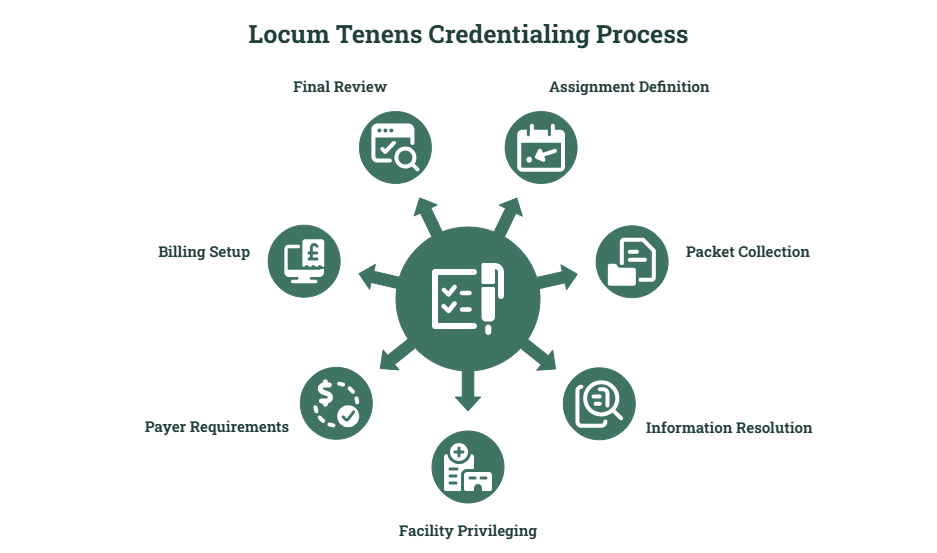
How Does the Locum Tenens Credentialing Process Work?
A clear process helps practices move a temporary physician from application to clinical and billing readiness without repeating the same work.
Each stage serves a different purpose, and missing one can lead to delays, compliance challenges, or claim issues later.
Step 1: Define the Assignment and Start Date
Confirm the specialty, practice location, services, expected procedures, facility, assignment dates, and start date. These details determine which credentials, privileges, and payer checks may apply.
Step 2: Collect the Provider Credentialing Packet
Gather the application, NPI details, licenses, education, board status, DEA information when applicable, malpractice records, work history, references, and other required documents.
Step 3: Verify Credentials With Primary Sources
Credentialing teams verify qualifying information with the original issuing sources. NCQA standards include primary-source verification for areas such as licensure, education, board certification, work history, malpractice history, and sanctions.
Step 4: Resolve Missing or Conflicting Information
Check for expired licenses, employment gaps, inconsistent names, missing references, or conflicting dates. Resolve deficiencies before final approval.
Step 5: Complete Facility Privileging
Submit the records required by the hospital or facility and confirm the specific clinical privileges granted to the locum provider.
Step 6: Review Payer and Enrollment Requirements
Separate credentialing from payer enrollment. For Medicare, CMS directs providers through NPI, PECOS enrollment, and their Medicare Administrative Contractor (MAC).
Step 7: Complete Billing and EHR Setup
Confirm provider data, payer instructions, claim configuration, EHR access, and internal billing workflows before patient services begin.
Step 8: Perform a Final Go-Live Review
Obtain final confirmation from credentialing, facility operations, payer/enrollment, billing, IT, and compliance teams. This creates a clear record that the locum is ready to start.
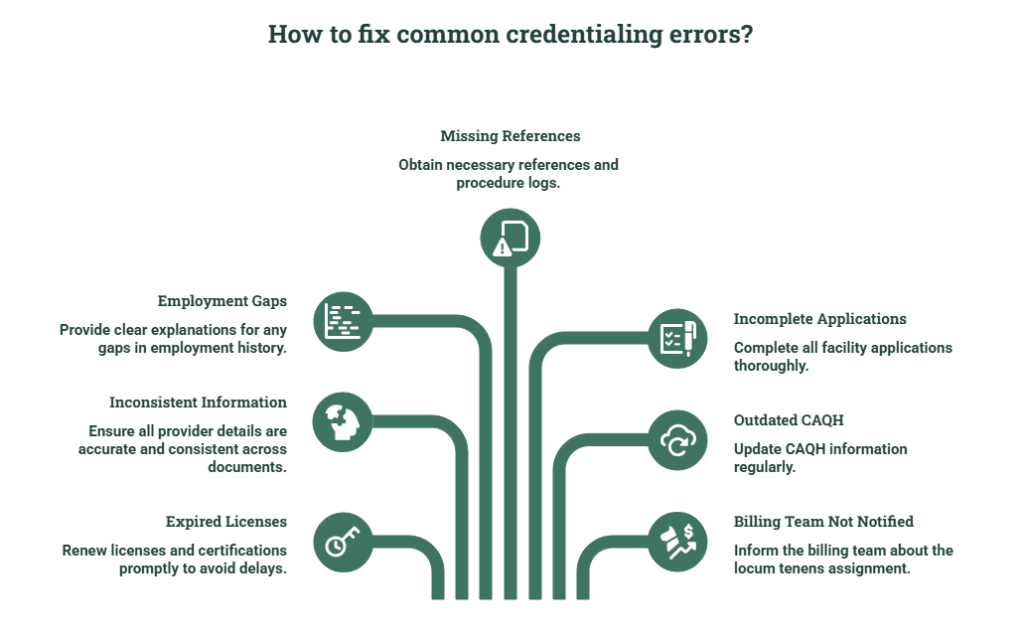
Common Locum Tenens Credentialing Errors and How to Fix Them
Credentialing delays often start with small documentation or communication problems that become larger operational issues.
Finding errors early helps practices avoid repeated requests, delayed privileges, payer issues, and billing rework.
Expired Licenses or Certifications
Fix: Check license, DEA registration, board certification, and other credential expiration dates before submission. Record renewal dates for ongoing monitoring.
Inconsistent Provider Information
Differences in the provider’s name, address, NPI, specialty, or dates across applications and records can trigger additional review.
Fix: Compare the application with the NPI record, CAQH profile, licenses, and supporting documents before submitting the file.
Gaps in Employment History
Unexplained gaps can delay credential verification and require additional documentation.
Fix: Review the required employment-history period and document every gap according to the facility’s credentialing policy.
Missing References or Procedure Logs
Some assignments require current references, procedure histories, or case logs to support clinical privileges.
Fix: Identify facility-specific requirements early and request missing records before the application reaches final review.
Incomplete Facility Applications
A provider can have valid credentials but still face delays because a hospital or facility application is incomplete.
Fix: Use a facility-specific checklist and verify that every required field, signature, attachment, and disclosure is complete.
Outdated CAQH Information
Old addresses, expired documents, or inconsistent practice information can affect payer-related processes.
Fix: Before submitting the payer information, review the CAQH profile and update any changes.
Credentialing Completed but Payer Requirements Missed
Clinical approval does not automatically confirm payer or billing readiness.
Fix: Create a separate payer review and document enrollment status, effective dates, and payer-specific instructions.
Billing Team Not Notified
A locum may be clinically approved, but claims could still face issues if billing staff fails to get appropriate provider and assignment information.
Fix: Make credentialing-to-billing handoff part of the final go-live review. Confirm provider identifiers, payer instructions, dates, and applicable claim requirements before services begin.
Conclusion
Locum tenens credentialing requires accurate documentation, timely verification, and clear coordination between credentialing, facility, payer, and billing teams.
Using assignment-specific checklists, resolving discrepancies early, and confirming privileges and payer requirements can reduce avoidable onboarding delays.
A final go-live review helps practices confirm that temporary physicians are properly cleared, billing-ready, and prepared to provide services without unnecessary payer or claim issues.
FAQs
What are the main locum tenens credentialing requirements?
Common requirements include a medical license, NPI, education and training records, board certification, DEA registration when applicable, malpractice coverage, work history, references, sanctions screening, and facility-specific documents.
How long does locum tenens credentialing take?
The timeline varies by facility, specialty, state, payer, and completeness of the application. Starting primary-source verification and resolving missing documents early can help reduce avoidable delays.
Is credentialing the same as payer enrollment for locum physicians?
No. Credentialing verifies a physician’s qualifications, while payer enrollment establishes the provider’s participation and billing status with a specific payer. Practices should track both separately.
Does a locum physician need facility privileges?
If the physician will provide services at a hospital or other facility that requires privileges, the appropriate facility privileging process must be completed. The scope of privileges depends on the facility and assignment.
How can practices avoid locum credentialing and billing problems?
Use an assignment-specific checklist, verify credentials through appropriate primary sources, reconcile provider information across records, track payer requirements, and complete a final credentialing-to-billing go-live review before services begin.