How long does provider credentialing take? A completed application may still be delayed if licenses, enrollment records, supporting documentation, or payer requirements do not match. Understanding the differences between Medicare, Medicaid, and commercial payer schedules in 2026 is crucial for planning provider onboarding and reducing billing gaps.
CMS states that Medicare Administrative Contractors normally review submitted enrollment applications within 45 days or less, while paper applications may take longer. Providers must also respond to requests for more information within 30 days; if not, the request will be rejected.
Medicaid does not have a single national timeline for provider credentialing. Based on CMS guidance, commercial payers set their own credentialing procedures and deadlines, but Medicaid state agencies are not subject to a federally mandated schedule for finishing the screening of a specific enrollment application.
In this blog, we will review the deadlines for commercial payer credentialing, Medicare, and Medicaid.
What Is a Provider Credentialing Timeline?
A provider credentialing timeline is the period required to verify a healthcare provider’s qualifications and complete the applicable payer credentialing or enrollment process.
It may include application preparation, document review, main source and payer verification, enrollment, contracting, and confirmation of the provider’s effective date.
The timeline varies by payer, provider type, state, specialty, and application accuracy. Medicare, Medicaid, and commercial insurers may follow different requirements and processing steps.
For practices, tracking each stage helps identify delays before they affect scheduling, payer participation, or claims submission. A physician may be clinically ready to begin work while waiting for payer approval or an active billing status.
Practices can also use professional provider credentialing services to help organize documentation, verification, and payer requirements throughout the process.
Credentialing, Enrollment, Contracting, and Billing Are Different
Credentialing verifies a provider’s qualifications, while enrollment registers the provider with a payer and contracting establishes network participation and payment terms.
Billing readiness comes later and depends on the payer’s approval, effective date, provider-group association, and required billing setup.
| Stage | What It Means |
| Credentialing | Verification of provider qualifications |
| Enrollment | Registration with a government payer or health plan |
| Contracting | Agreement establishing network participation and terms |
| Effective date | Date payer participation becomes active |
| Billing readiness | Point at which claims can be submitted under the applicable payer arrangement |
How Long Does Provider Credentialing Take?
A provider credentialing timeline can range from several weeks to several months, depending on the payer, provider type, and application completeness. Medicare, Medicaid, and commercial payers follow different review and enrollment processes, so no single timeframe applies to every provider.
Common Credentialing Timeline by Payer
This should be the article’s primary comparison table.
| Payer | Common Planning Range | Main Timeline Factors |
| Medicare | 60–90+ days | PECOS, application accuracy, verification, MAC processing |
| Medicaid | 60–120+ days | State agency, provider type, screening, state requirements |
| Commercial payers | 60–120+ days | Payer, network, contracting, CAQH, provider volume |
| Regional/smaller plans | Varies | Plan-specific requirements and network review |
Why Some Applications Take Longer
A credentialing application can take longer when the payer cannot verify information promptly, or additional documentation is required. Common causes include:
1. Missing or incomplete application documents
2. Expired licenses or certifications
3. Differences between CAQH and payer records
4. Delays in primary-source verification
5. Additional payer or state requirements
6. Incomplete work-history information
7. Malpractice coverage verification issues
8. Requests for clarification or supporting documents
9. Credentialing committee review schedules
10. Delays in contracting after credentialing approval
Primary-source verification is particularly important because payers and credentialing organizations may need to independently verify licenses, certifications, education, training, and other professional information. CVO credentialing services can support organizations that need structured verification processes.
Medicare Credentialing Timeline
For Medicare, provider credentialing is closely connected to enrollment and billing privileges. In 2026, the processing period depends on the application type, completeness, supporting records, and whether the MAC requests additional information.
Medicare Credentialing Timeline: What to Expect
CMS states that Medicare Administrative Contractors (MACs) take approximately 45 days to review submitted applications. Paper applications may take longer.
The clock can extend when a MAC requests missing documents or clarification. Providers should respond to requests within 30 days; failure to respond can lead to rejection of the application.
For planning purposes, monitor these milestones:
1. Application submitted and received by the MAC
2. Completeness and documentation review
3. Additional information requests, if applicable
4. Enrollment determination
5. Approval and billing activation
6. PECOS and Medicare Enrollment
PECOS is CMS’s online Medicare enrollment system. Physicians, NPPs, organizations, and other eligible providers can submit enrollment information and supporting documents electronically. CMS states that PECOS applications generally process faster than paper applications.
The 2026 CMS enrollment guidance also confirms that PECOS provides a tracking ID and allows providers to monitor application status.
Medicare Approval vs. Billing Readiness
Approval is an important milestone, but billing teams should verify the provider’s effective date and enrollment status before submitting claims.
CMS states that, when approved, the Medicare billing effective date is generally the later of the application receipt date or the date the provider began furnishing services. CMS also advises that providers can start billing after receiving the enrollment approval letter from their MAC.
This distinction helps prevent claims from being submitted before Medicare billing privileges are active.
Medicaid Credentialing Timeline
A Medicaid provider credentialing timeline depends heavily on the state Medicaid agency and the provider’s enrollment category. Managed care participation can add another review or contracting step after state enrollment.
Medicaid Credentialing Timeline by State
Unlike Medicare, Medicaid does not have one federal processing period for every provider application. CMS states that it does not require a specific timeframe for screening an individual Medicaid enrollment, re-enrollment, reactivation, or revalidation application.
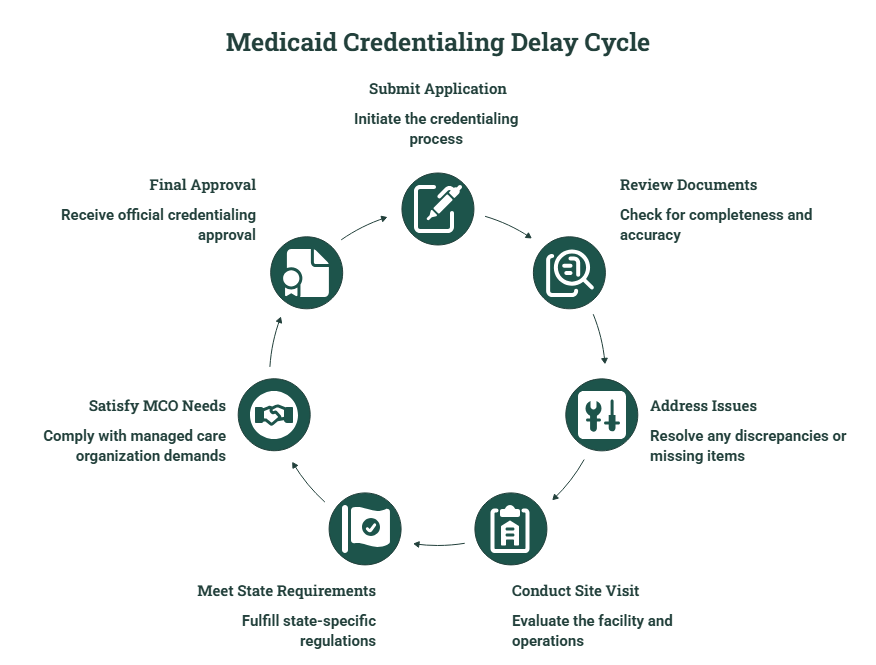
Each state may set its own procedures, systems, documentation requirements, and review practices. Required screening can include:
- Provider disclosures and ownership information
- License and credential checks
- Database screening
- Risk-based screening
- Site visits for applicable providers
- Verification of enrollment information
Medicaid Enrollment and Managed Care
State Medicaid enrollment and managed care participation are related but separate considerations. CMS requires states to screen and enroll network providers participating in Medicaid managed care programs under applicable federal requirements.
A provider may therefore need to complete state enrollment and then meet the requirements of a Medicaid managed care organization (MCO), depending on the state’s program structure.
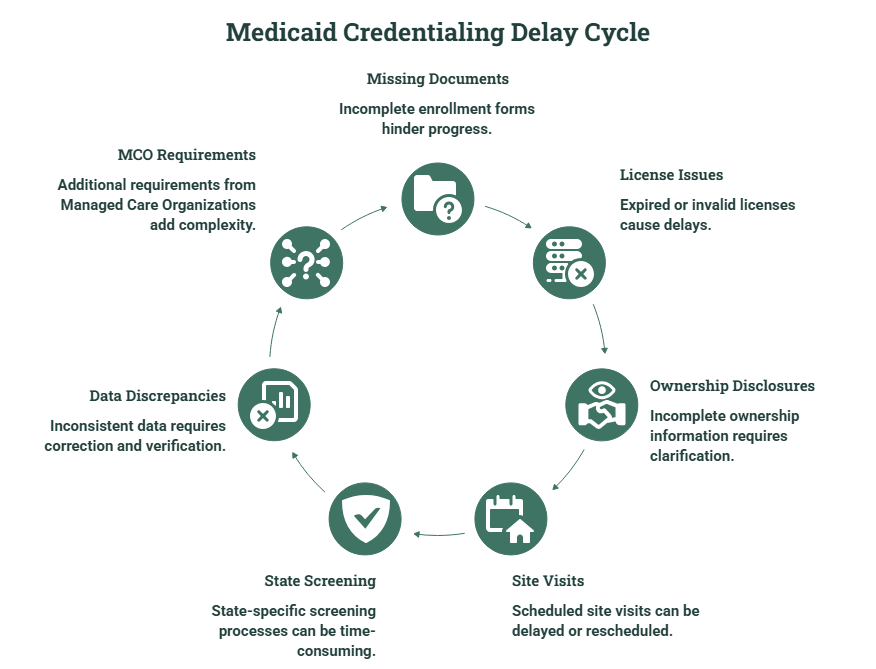
Common Medicaid Credentialing Delays
Common causes include:
- Missing enrollment documents
- License or certification issues
- Incomplete ownership disclosures
- Required site visits
- State screening requirements
- Data discrepancies
- Additional MCO credentialing requirements
Commercial Payer Credentialing Timeline
Commercial payer timelines vary because each health plan can set its own application, verification, committee review, and contracting procedures. A complete CAQH profile can reduce repeated data collection, but it does not create a single national processing period.
How Long Does Commercial Payer Credentialing Take?
There is no single commercial payer credentialing timeline in 2026. The difference between published payer samples is clear. According to Anthem, the credentialing process generally takes 45 days after receiving a completed CAQH application, but Medical Mutual says it can take up to 90 days after collecting the required documents. HealthLink claims that full certification takes 90-120 days for certain applicants.
Industry sources commonly describe commercial credentialing as taking roughly 60–120 days, but this should be treated as a planning range rather than a universal payer requirement.
Why Commercial Payers May Have Different Timelines
Several factors can change the processing period:
- Completeness of the credentialing application
- CAQH profile status and authorization
- Primary-source verification
- State licensing requirements
- Specialty-specific documentation
- Malpractice or work-history verification
- Payer credentialing committee schedules
- Contracting and network participation requirements
Conclusion
Provider credentialing timelines vary by payer, state, provider type, and application completeness, so Medicare, Medicaid, and commercial plans should not be assigned one universal timeframe. Tracking credentialing, enrollment, contracting, and effective dates separately helps prevent avoidable billing delays.
For 2026, accurate payer requirements and complete provider records remain essential for timely approval. Credentialing teams and practice administrators should monitor each application from submission through billing readiness to identify delays early.
FAQs
How long does provider credentialing take?
Provider credentialing can take several weeks to several months. The timeframe depends on the payer, provider type, state requirements, application completeness, verification, and contracting steps.
How long does Medicare credentialing take?
As reported by CMS, Medicare Administrative Contractors usually helpssubmitted enrollment applications within 45 days. Paper applications may take longer, and additional information requests can extend processing.
How long does Medicaid credentialing take?
There is no single federal Medicaid credentialing timeline. Each state Medicaid agency establishes its enrollment and screening procedures, so processing times can vary by state, provider type, and enrollment category.
How long does commercial payer credentialing take?
Commercial payer timelines vary by health plan. Some plans publish periods of around 45–90 days, while certain applications may take 90–120 days or longer depending on verification, network review, and contracting.
What causes provider credentialing delays?
Common causes include incomplete applications, expired credentials, inconsistent CAQH information, primary-source verification delays, additional documentation requests, state screening requirements, and delays in payer contracting.