

Medicare revalidation remains a critical compliance requirement in 2026. All enrolled providers and suppliers must periodically renew their enrollment information to keep Medicare billing privileges active. Most providers revalidate every five years, while DMEPOS suppliers revalidate every three years. Notices are sent about three to four months before the due date, and failure to revalidate can lead to a hold on reimbursement or deactivation of billing privileges. Providers can verify status using a provider revalidation lookup tool to track deadlines and avoid deactivation for non-response.
CMS posts revalidation due dates seven months in advance on the Medicare Revalidation List, and providers are responsible for tracking their deadlines even if they don’t receive a notice. Some off-cycle revalidation deadlines, such as for skilled nursing facilities, were extended to January 1, 2026, giving additional time for submission.
This guide focuses on Medicare Revalidation 2026 deadlines, the process for submitting on time, and the consequences of missing notices. Many providers use provider enrollment and credentialing services to manage deadlines and maintain compliance. It explains how to use the provider revalidation lookup tool, what to expect from your Medicare Administrative Contractors, and steps to avoid deactivation for non-response.
What Is Medicare Revalidation 2026?
This section explains how Medicare revalidation works and why it is required for providers and suppliers. It also outlines who must comply and how revalidation cycles are structured for 2026.
Definition and Purpose
Medicare revalidation is a process required by the Centers for Medicare & Medicaid Services to confirm provider enrollment data.
- Ensures billing records remain accurate
- Confirms ownership, practice location, and licensure
- Required to maintain active Medicare billing privileges
Providers must respond within the 90-day notice window. Failure to respond can lead to billing interruption and compliance issues. Revalidation is tied directly to claim processing and reimbursement. It is a compliance control, not a formality.
Who Must Revalidate
All enrolled Medicare providers and suppliers must complete revalidation. This includes:
- Physical Therapists and clinic owners
- Medical coders and billing teams
- Credentialing and enrollment specialists
- Hospital and practice administrators
- Pharmacists and retail clinic providers
- Healthcare compliance and IT teams
Revalidation Cycles (Cycle 3 Revalidation)
Revalidation follows a structured schedule known as Cycle 3 revalidation. Providers are assigned a cycle based on enrollment type and risk category.
- Most providers: every 5 years
- Certain suppliers: every 3 years
- Cycle 3 reflects the latest CMS revalidation grouping system
Providers receive a 90-day notice window before their due date. The MAC sends the notice and expects a complete response within that timeframe. Many practices rely on Physician Enrollment Services for accurate and timely submissions.
If no response is submitted:
- Enrollment may be deactivated
- Claims may be denied
- Re-enrollment may be required to restore billing
The 2026 Payer Revalidation Calendar
This section explains how to structure revalidation tracking for 2026. It connects deadlines, MAC timelines, and internal processes into a clear schedule.
Providers must align internal tracking with notices from the Centers for Medicare & Medicaid Services and follow all submission timelines. Missed deadlines can result in billing disruption or deactivation for non-response.
90-Day Notice Window
The 90-day notice window is the required period before a revalidation deadline. During this time, providers receive official communication from their assigned Medicare Administrative Contractors.
- Notices are sent via mail or electronic systems
- Providers must respond within 90 days
- Delays beyond this period increase the risk of deactivation
Key 2026 Deadlines
Medicare revalidation deadlines in 2026 follow a structured cycle system.
- Deadlines are assigned by provider type and enrollment status
- CMS publishes deadlines in advance on official lists
- Most providers follow a Cycle 3 revalidation timeline
Key actions:
1. Check the provider revalidation lookup tool
2. Confirm the assigned due date
3. Submit a complete application before the deadline
Monthly Tracking Framework
A structured tracking system helps prevent missed deadlines.
- Assign responsibility to a credentialing or billing team
- Track notices from MACs each month
- Use a centralized tracking system or spreadsheet
Recommended structure:
- Month
- Provider name
- Revalidation status
- Due date
- Submission status
Include both Medicare and commercial payer re-credentialing timelines in the same system. This reduces duplication and improves visibility across teams.
Role of Medicare Administrative Contractors in Revalidation
This section explains how MACs manage revalidation operations. It focuses on notice delivery, processing timelines, and provider responsibilities.
Medicare Administrative Contractors (MACs) act on behalf of the Centers for Medicare & Medicaid Services to process revalidation for enrolled providers. They control communication, review submissions, and enforce deadlines. Understanding their role is necessary to avoid delays, claim holds, or deactivation for non-response.
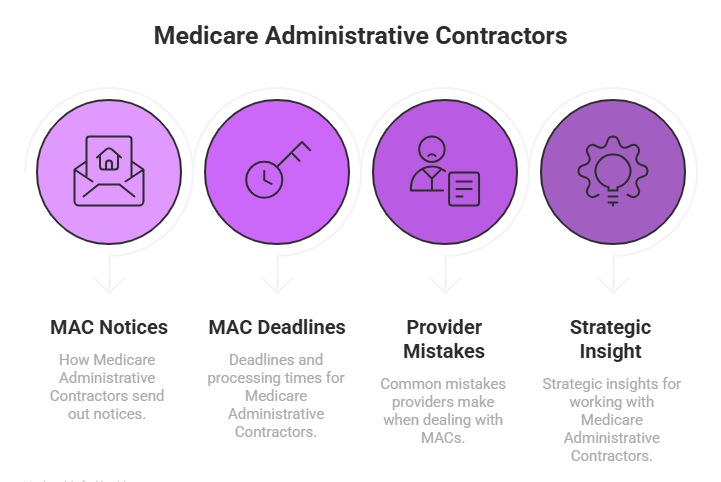
How MACs Send Notices
MACs send revalidation notices through structured communication channels. These notices trigger provider action within the required timeline.
- Notices are sent by mail and electronic systems
- Sent during the 90-day notice window
- Include instructions and submission requirements
Providers must keep contact details current. Outdated information leads to missed notices and delayed responses. Each notice is time-sensitive and linked to enrollment status.
MAC Deadlines and Processing
MACs follow strict processing timelines for all submissions. Deadlines must be met to maintain an active billing status.
- Deadlines align with Cycle 3 revalidation schedules
- Submissions must be complete and accurate
- MACs may request additional documentation
Processing delays occur when applications are incomplete. Providers should respond quickly to MAC requests to avoid interruptions. All timelines directly affect reimbursement and enrollment status.
Common Provider Mistakes with MACs
Providers often face issues due to missed communication or incomplete submissions.
Common errors:
1. Ignoring MAC notices
2. Missing the 90-day response window
3. Using outdated enrollment data
4. Not using the provider revalidation lookup tool
Strategic Insight
Most competitors explain MACs at a surface level. They do not explain how MAC actions directly impact revenue and compliance.
Your article must clearly connect MAC activity to:
- Billing continuity
- Compliance enforcement
- Financial risk
Step-by-Step Medicare Revalidation Process
This section explains the full revalidation workflow. It outlines each step providers must follow to stay compliant and avoid billing interruption.
The process begins with identifying your due date and ends with responding to MAC requests. Each step must be completed correctly to prevent deactivation for non-response. Providers should align actions with timelines set by the Centers for Medicare & Medicaid Services and their assigned Medicare Administrative Contractors.
Step 1: Identify Revalidation Requirement
Providers must first confirm if they are due for revalidation.
1. Use the provider revalidation lookup tool
2. Check enrollment status and assigned cycle
3. Confirm Cycle 3 revalidation assignment if applicable
Step 2: Prepare Required Information
Preparation reduces errors during submission. Incomplete data causes delays and MAC rejections.
Required information includes:
1. Provider and group details
2. Ownership and managing control data
3. Practice location and contact updates
4. Licensure and certification records
Step 3: Submit Application
Submit the revalidation application through the Medicare enrollment system.
1. Use appropriate CMS forms (e.g., CMS-855 series)
2. Submit before the MAC deadline
3. Include all required documents
Step 4: Respond to MAC Requests
After submission, MACs may request additional information.
1. Respond within the requested timeframe
2. Provide accurate and complete documents
3. Monitor communication from your assigned MAC
Deactivation for Non-Response: Risks and Impact
This section explains what happens when providers fail to respond to Medicare revalidation requests. Missing deadlines leads to suspension of billing privileges and cash flow disruption. Understanding this risk is critical for all providers and billing teams in 2026.
What Is Deactivation for Non-Response
Deactivation for non-response means Medicare has suspended a provider’s billing privileges due to a lack of response to revalidation or enrollment requests.
- Triggered by missed deadlines within the 90-day notice window
- Occurs after failure to submit required documents
- Applies across Cycle 3 revalidation and ongoing enrollment updates
Once deactivated, the provider cannot submit claims until the issue is resolved. The status remains inactive until CMS verifies and reactivates the record.
Financial and Operational Impact
Deactivation affects both revenue and operations immediately.
Financial impact:
- No claim submissions during deactivation
- Delayed reimbursements after reinstatement
- Possible loss of prior claims if the timely filing limits expire
Operational impact:
- Staff workload increases due to the backlog.
- Disruption in billing cycles and cash flow
- Increased administrative effort for corrections
Reinstatement Process
Reinstatement requires formal action and time.
Steps include:
1. Submit a complete revalidation or enrollment application
2. Provide all requested supporting documents
3. Pay applicable reapplication fees, if required
4. Wait for MAC review and approval
The assigned MAC reviews the submission and verifies all details. Processing time depends on the completeness and accuracy of the application.
Common Revalidation Errors and How to Avoid Them
This section highlights frequent errors that lead to revalidation delays and claim disruptions. Many providers lose billing privileges due to avoidable mistakes. In 2026, stricter oversight from the Centers for Medicare & Medicaid Services and MACs increases the need for accuracy.
Incomplete Applications
Incomplete submissions are one of the most common causes of rejection.
- Missing signatures or required forms
- Incomplete ownership or practice details
- Omitted supporting documents
Each application must match the current Medicare record. Any missing or inconsistent data leads to delays or MAC requests for correction. Use internal checklists before submission to ensure completeness.
Missed Deadlines
Missing deadlines leads to immediate compliance issues.
- Failure to act within the 90-day notice window
- Ignoring notices from Medicare or MACs
- Delayed response to revalidation requests
Missed deadlines can trigger deactivation for non-response, stopping all billing activity. To avoid this, monitor timelines closely and assign responsibility for tracking revalidation due dates.
Incorrect Documentation
Submitting incorrect documents delays approval and may trigger rejections.
- Expired licenses or certifications
- Mismatched provider information
- Incorrect tax or ownership details
All documentation must align with Medicare records. Before submission, verify every document for accuracy. Even small discrepancies can result in additional MAC review and delayed reactivation.
Conclusion
Medicare Revalidation 2026 requires strict attention to deadlines, accurate documentation, and a timely response within the 90-day notice window. Providers who follow structured tracking and use the provider revalidation lookup tool can avoid deactivation for non-response and protect billing continuity.
A clear process, aligned with MAC deadlines and Cycle 3 revalidation requirements, reduces compliance risk and operational delays. Consistent monitoring and internal accountability ensure uninterrupted revenue flow and long-term enrollment stability.
FAQs
What is Medicare Revalidation 2026?
Medicare Revalidation 2026 is the process of updating provider enrollment data to maintain billing privileges. It ensures accurate records with CMS and prevents claim disruptions.
How can I check my revalidation due date?
You can use the provider revalidation lookup tool to confirm your status and deadline. Providers must monitor this regularly, even if no notice is received.
What happens if I miss the 90-day notice window?
Missing the deadline can lead to deactivation for non-response. This stops claim submissions and delays reimbursement until reinstatement.
How often do providers need to revalidate?
Most providers revalidate every five years under Cycle 3 revalidation. Certain suppliers, such as DMEPOS, must revalidate every three years.