
Credentialing delays cost healthcare companies significant revenue. Have you ever thought why a fully qualified provider cannot see patients immediately after joining a practice? In 2026, more than half of hospitals and provider groups report considerable revenue losses directly related to credentialing delays, with many institutions losing more than $1 million per year owing to bottlenecks in verification and certification.
In practice, the credentialing time currently spans from 90 to 120 days on average, with some cases going above 180 days due to payer constraints and documentation challenges. This timeline directly impacts a provider’s ability to see patients, submit claims, and generate reimbursement, especially when new hires must wait months before they become billable.
These delays cost more than the revenue. Healthcare teams estimate that approximately one-third of practices have claim denial rates of 25% to 50% due to enrollment issues and incomplete paperwork. This results in lost time, administrative rework, and increased stress for medical coders, billers, physicians, and revenue cycle personnel responsible for clean claims and payer involvement.
Provider Credentialing Process
Provider credentialing process confirms that a healthcare provider’s qualifications, licenses, certificates, and work history meet payer, state, and federal requirements. Efficient credentialing ensures that providers can bill, serve patients, and remain compliant without delay. In 2026, monthly monitoring and shorter approval deadlines could render understanding this procedure critical for revenue cycle efficiency.
What Credentialing Means in Operational Terms
Credentialing is more than paperwork. It confirms the provider:
- Holds valid state licenses and DEA registration
- Maintains board certifications and current malpractice coverage
- Meets payer and network participation requirements
- Passes background checks and federal exclusion screenings
Why Credentialing Impacts Billing, Compliance, and Access to Care
Credentialing delays have a direct impact on both revenue and patient access. Hospitals and provider groups estimate that delayed validation processes will cost them $1 million per year by 2026. Incomplete documentation or delayed PSV can also increase claim denials by 25-50%, resulting in more administrative work for coders, billers, and revenue cycle teams.
Shorter NCQA timelines (90-120 days for most payers) and ongoing monthly monitoring require practices to maintain accurate data properly. Delays in committee review or payer enrollment keep clinicians from seeing patients, submitting claims, and receiving compensation. Understanding the workflow and implementing automation promotes compliance, quicker approvals, and consistent income flow.
Medical Credentialing Process: End-to-End Workflow
The medical credentialing process ensures every healthcare provider meets state, federal, and payer requirements before delivering patient care or billing. Delays in this process affect practices’ significant revenue, with some losing over $1 million annually. Understanding the end-to-end workflow is critical for coders, billers, and revenue cycle teams. To maintain this compliance without increasing administrative overhead, many practices utilize professional Physician Credentialing Services to manage documentation and verification steps.
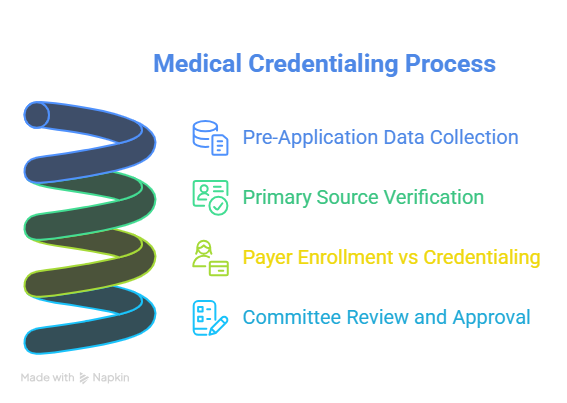
Pre-Application Data Collection
Successful credentialing begins with gathering complete provider documentation. Essential items include:
- State medical licenses and DEA certificates
- Board certifications and education transcripts
- Malpractice insurance verification
- Work history and references
Primary Source Verification
Primary source verification (PSV) confirms every credential directly with the issuing organization. Modern automated PSV systems complete verifications in 2–5 days with 95–98% accuracy, compared to 15–30 days manually. This step is crucial for compliance, minimizing rework, and ensuring providers meet payer and regulatory standards.
Payer Enrollment vs Credentialing
Credentialing verifies qualifications; enrollment establishes network participation and billing capability. Delays in payer enrollment prevent providers from seeing patients or submitting claims even after credentialing approval. Medicare and Medicaid require separate PECOS and state-specific enrollment processes, while commercial payers maintain individual systems.
Committee Review and Approval
After verification, credentialing committees evaluate provider credentials and background checks. Possible outcomes:
- Approved: Provider can see patients and bill.
- Conditional: Additional documents or monitoring required.
- Denied: Provider does not meet criteria.
Steps in Provider Credentialing Explained
The provider credentialing process involves precise steps to ensure compliance, billing readiness, and patient safety. Each step impacts revenue cycle efficiency, claim approvals, and payer participation. Understanding the sequence helps medical billers, coders, and administrators reduce delays and avoid errors.
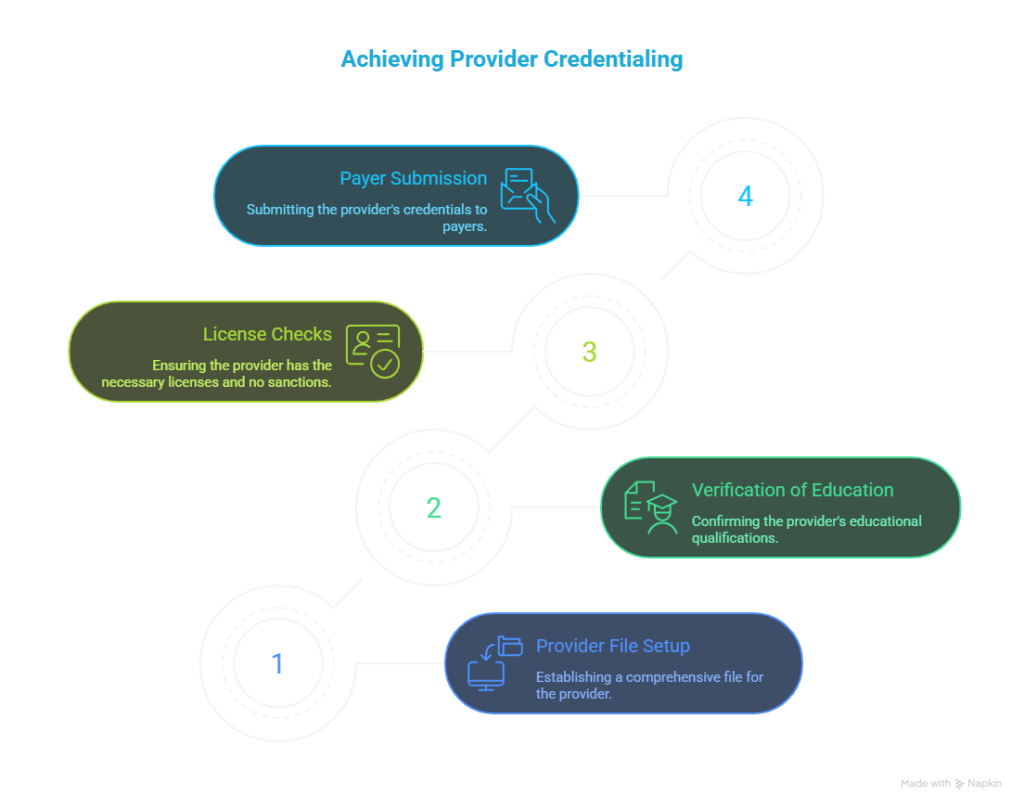
Step 1: Provider File Setup
The first step is creating a comprehensive provider file. This includes:
- Personal and professional information
- Education and training documents
- Licenses, certifications, and malpractice coverage
- Employment history and professional references
Step 2: Verification of Education and Training
Education, board certifications, and specialty training must be verified with issuing institutions. Primary source verification confirms authenticity and prevents credentialing denials. Automated verification systems now complete checks in 2–5 days with up to 98% accuracy, reducing manual workload by over 60%.
Step 3: License, DEA, and Sanctions Checks
State medical licenses, DEA registration, and sanction screening (OIG, SAM.gov, state exclusions) are verified during this step. Monthly monitoring is now required in 2026 to comply with NCQA and CMS regulations. Failing to flag an expired license or exclusion can halt revenue flow and violate federal guidelines.
Step 4: Payer Submission
Once verification is complete, applications are submitted to payers for enrollment. Commercial, Medicaid, and Medicare programs have unique submission requirements. Timely submission, tracking, and follow-up are essential to avoid delays that can extend the credentialing timeline from 90 to 120 days to 180 days. Automated tools and reminders help maintain accuracy and speed approval.
Credentialing Workflow: Systems and Documentation
A structured workflow and accurate documentation are critical to a smooth provider credentialing process. Efficient management reduces delays, ensures compliance, and supports timely billing. Modern systems help healthcare teams monitor credentials, track renewals, and submit accurate applications.
CAQH Profile Management
CAQH ProView is the industry standard for managing provider credentials. Maintaining an up-to-date profile allows automatic sharing with multiple payers, reducing repetitive document submission. Regular updates prevent enrollment delays and streamline multi-payer applications, improving approval timelines and accuracy.
NPI Enumeration
The National Provider Identifier (NPI) is required for all healthcare billing and payer interactions. Correct NPI enumeration ensures providers can submit claims immediately after credentialing. Errors in NPI data can cause claim denials, delayed reimbursements, and administrative rework for billing teams.
State License Tracking
State license verification and tracking are essential for multi-state practice compliance. Monthly monitoring of license status, expiration dates, and sanctions is now required under the 2026 NCQA and CMS standards. Digital systems can automatically flag upcoming expirations or new disciplinary actions, preventing interruptions in patient care and reimbursement.
Credentialing Timeline Overview
Understanding the timeline for provider credentialing helps practices plan staffing, billing, and patient access. Delays directly affect revenue and compliance, so knowing expected timeframes and bottlenecks is critical for healthcare teams.
Average Timelines by Payer Type
Credentialing with commercial insurers typically takes 90–120 days, while Medicare and Medicaid can extend up to 180 days, depending on documentation completeness and internal payer processes. Faster timelines are possible for providers with existing CAQH profiles and accurate supporting documents. Delays often occur when payer-specific requirements are unclear or when primary source verification responses are slow.
Hospital vs Group Practice Timelines
Hospital credentialing includes additional steps such as clinical privileging and committee reviews. Because these requirements are more rigorous, many providers choose to outsource these filings to dedicated Hospital Privileging Services to prevent start-date delays, which often add 30–45 days beyond standard payer timelines. Group practices generally see faster approvals but may experience delays if multiple providers are submitted simultaneously. Understanding these differences helps administrators allocate resources efficiently and plan for patient care coverage.
Where Delays Actually Occur
Most credentialing delays happen at three points:
- Primary Source Verification: Waiting on verification from schools, licensing boards, and previous employers.
- Committee Review: Credentialing committees may meet monthly or bi-monthly, creating scheduling bottlenecks.
- Incomplete Applications: Missing or inaccurate documentation forces resubmissions and extends the cycle.
Common Credentialing Delays and How to Prevent Them
Credentialing delays directly impact revenue, patient access, and claims processing. Knowing the main causes and applying preventive strategies helps healthcare teams complete credentialing faster and avoid costly errors.
Incomplete Provider Data
Missing or inaccurate documents are the leading cause of delays. Over 30% of applications are held up because providers fail to submit complete education, licensure, or work history information. Prevent this by:
Using checklists to ensure all documents are collected before submission.
Leveraging CAQH ProView to centralize provider data and reduce redundant paperwork.
Conducting pre-submission audits to catch omissions early.
Expired Licenses
Expired or soon-to-expire licenses, DEA registrations, or board certifications can stall the process. Practices risk delayed approvals and claim denials if providers begin seeing patients with outdated credentials. Prevention strategies include:
- Implementing automated license tracking systems to flag upcoming expirations.
- Requesting providers submit renewals well in advance of expiration.
- Scheduling monthly checks against state boards and OIG/SAM.gov databases.
Missed Committee Cycles
Credentialing committees review provider applications at scheduled meetings, often monthly or bi-monthly. Missing a cycle can add 2–4 weeks to the timeline. Mitigation strategies include:
- Submit applications ahead of deadlines for upcoming committee meetings.
- Tracking committee schedules and aligning application preparation accordingly.
- Maintaining clear communication with committee staff to ensure no application is overlooked.
Conclusion
Provider credentialing process directly affects billing accuracy, payer participation, and patient access. Delays at any stage reduce revenue, increase denials, and place avoidable pressure on coding, billing, and compliance teams.
Practices that keep verified data, review credentials on a regular schedule, and track committee and payer timeframes help to eliminate approval gaps. Consistent oversight promotes compliance, faster enrollment, and consistent reimbursement.
FAQs
What is the provider credentialing process in healthcare?
The provider credentialing process verifies a clinician’s licenses, education, work history, and sanctions status. It ensures eligibility to bill payers and meets regulatory requirements.
How long does the provider credentialing process take in 2026?
Most commercial payers complete credentialing in 90–120 days. Medicare and Medicaid may extend up to 180 days based on verification and enrollment reviews.
What is primary source verification in credentialing?
Primary source verification confirms credentials directly with issuing authorities. It validates licenses, education, and certifications to meet payer and compliance standards.
What is the difference between credentialing and payer enrollment?
Credentialing validates provider qualifications, while enrollment enables network participation and billing. A provider cannot submit claims until both steps are completed.
What causes delays in the provider credentialing process?
Common causes include incomplete applications, expired licenses, and missed committee review cycles. Poor data tracking also increases denial and resubmission risk.