A payer approval can arrive after services have already been provided, leaving providers and billing teams unsure which dates they can bill. “Can you bill after a backdated approval?” In 2026, CMS reported a 6.55% Medicare Fee-for-Service improper payment rate, representing $28.83 billion, with insufficient documentation among the leading causes.
Handling Retroactive Billing Dates requires more than changing a claim date. Teams must verify the payer’s effective date, credentialing or enrollment status, affected dates of service, and filing requirements. CMS also recognizes specific exceptions for certain retroactive Medicare entitlement situations, showing why the reason for a retroactive date matters.
This guide explains what providers, billers, CPCs, credentialing specialists, and RCM teams should check after receiving a backdated approval. Proper documentation can support accurate claim processing, while assuming approval automatically guarantees payment can create additional denials, rework, or payment issues.
What Is a Retroactive Billing Date?
A retroactive billing date enables an enrolled provider to file claims for services provided before the payer formally accepted enrollment, even if the payer has assigned an earlier effective date. CMS Medicaid guidance clearly specifies “backdating” enrollment in this way, while also stating that states must handle related payment and program-integrity issues.
For providers who need help establishing or maintaining payer enrollment, physician enrollment services can help address enrollment requirements and payer participation processes.
Approval Date vs. Effective Date
Explain with a simple example:
- Application submitted: March 1
- Payer approval issued: May 15
- Retroactive effective date: March 1
- Potential affected DOS: March 1–May 14
What Does “Backdated Credentialing” Mean?
Backdated credentialing occurs when a payer assigns a credentialing or participation effective date that is before when approval was provided. For example, a provider could receive approval on June 15 with an effective date of April 1.
The distinction matters because the approval date is not necessarily the effective date. Billing teams should review the payer’s written determination before submitting or correcting claims. They should also confirm whether the retroactive period applies to the provider, group, location, contract, or specific services.
A backdated credentialing effective date also does not automatically guarantee reimbursement. Other requirements may still affect payment, including enrollment status, authorization, covered services, coding, timely filing, and payer-specific claim rules. CMS’s 2026 provider-enrollment guidance continues to define Medicare billing privileges through specific effective-date rules, reinforcing the need to verify the applicable enrollment record.
Why Do Payers Grant Retroactive Effective Dates?
A retroactive effective date can allow eligible services from an earlier period to be considered under the provider’s approved enrollment or credentialing status. The reason for the backdated date matters because billing rules differ by payer and program.
For billing teams, the key question is simple: What caused the retroactive date, and exactly which dates of service does it cover?
Payer Processing Delays
Payer processing can take longer than the provider expected, even when an application is complete. Medicare Administrative Contractors (MACs), for example, review Medicare enrollment applications and may request additional information before issuing a decision.
For providers dealing specifically with Medicare enrollment, see the Medicare provider enrollment resource for additional information about Medicare enrollment requirements.
If the payer later assigns a backdated credentialing effective date, the billing team should:
- Obtain the written approval or determination.
- Confirm the exact effective date.
- Match the date against affected claims and dates of service.
- Follow the payer’s instructions for resubmission or reprocessing.
Delayed Enrollment or Credentialing Decisions
A delayed decision can create a gap between the date services began and the date approval was issued. Retroactive provider enrollment may address that gap when the applicable payer rules permit it.
CMS distinguishes the enrollment approval date from the effective date of Medicare billing privileges and, in certain circumstances, from a separate retrospective billing period.
When a provider is completing the credentialing and enrollment process, keeping the provider’s CAQH profile and supporting information accurate can also help reduce administrative issues. Practices can review CAQH credentialing services for assistance with CAQH-related credentialing workflows.
Administrative or Data-Processing Issues
Incorrect provider data, missing information, or delayed updates can affect payer records. Once corrected, the payer may issue an effective date that differs from the approval date.
Billing teams should verify the provider NPI, group, practice location, specialty, and participation status before submitting retroactive billing after credentialing.
State Medicaid Retroactive Enrollment Rules
Medicaid rules can permit retroactive credentialing or enrollment under specific circumstances. CMS’s Medicaid Provider Enrollment Compendium describes “backdating” enrollment as approving enrollment with a retroactive billing date, but states must address program-integrity risks.
Because state rules vary, never assume that a payer’s backdated approval makes every earlier claim payable.
What Providers Should Do After Receiving a Backdated Approval
A backdated approval can affect claims that were submitted before credentialing or enrollment was finalized. Before taking billing action, confirm exactly what the payer approved and which dates of service it covers.
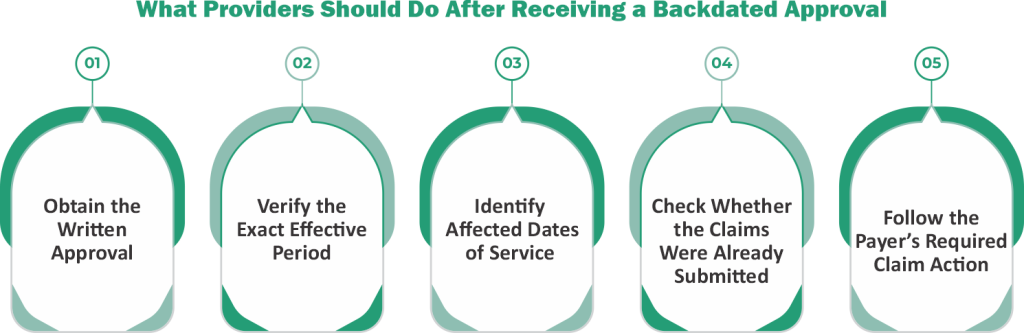
For Handling Retroactive Billing Dates, use this five-step review to connect the approval with the correct provider record, claims, and payer requirements.
1. Obtain the Written Approval
Keep the payer’s approval letter, portal notice, or other official determination in the credentialing file. Check the provider name, NPI, group, location, participation status, and effective date.
Do not rely on a verbal confirmation alone.
2. Verify the Exact Effective Period
Identify the start date and, if stated, the end date of the approval. A backdated credentialing effective date may cover a specific period rather than every service billed before approval.
Compare the payer’s determination with enrollment and contracting records.
3. Identify Affected Dates of Service
Create a list of claims with dates of service falling within the approved retroactive period. Record:
- Patient account or claim number
- Date of service
- Rendering provider
- Payer
- Original claim status
- Denial or adjustment reason
- Timely-filing deadline
4. Check Whether the Claims Were Already Submitted
Review claims that were denied, rejected, paid, or remain pending. A claim denied before retroactive provider enrollment may require a specific payer action rather than a new claim.
5. Follow the Payer’s Required Claim Action
The payer may instruct the provider to correct and resubmit, request reprocessing, submit a reconsideration, or file an appeal. Follow the payer’s stated procedure and retain supporting documentation.
A retroactive approval supports the provider’s status for the specified period, but it does not automatically resolve other claim requirements such as authorization, coding, medical necessity, or timely filing.
Can You Bill for Services Before the Credentialing Approval Date?
Yes, billing for earlier dates of service may be permitted when the payer expressly assigns a retroactive effective date that covers those services. The approval date alone does not establish billing eligibility.
For Handling Retroactive Billing Dates, teams should verify the payer, provider type, effective period, enrollment status, and claim requirements before submitting or correcting affected claims.
When Retroactive Billing May Be Permitted
A payer may allow retroactive billing after credentialing when its rules establish an effective date before the approval date. Medicaid guidance, for example, recognizes “backdating” enrollment as approval with a retroactive billing date, subject to state policy and program requirements.
Medicare has its own rules. CMS states that the effective date of billing privileges for many practitioners is generally based on the later of the application filing date or the date services began at a new practice location.
When Retroactive Billing May Still Be Denied
A backdated credentialing effective date does not remove every claim requirement. A claim may still be denied because of:
1. Timely-filing limits
2. Missing or invalid authorization
3. Coding or documentation errors
4. Incorrect NPI, TIN, or location
5. Services outside the approved effective period
6. Other payer-specific requirements
Medicaid guidance also states that states must have a documented basis for permitting retroactive billing and address program-integrity risks.
Why the Approval Letter Matters
The written determination establishes what the payer actually approved. Review the effective date, provider identity, group or entity, location, participation status, and covered period.
Keep the approval with the affected claims. If a claim is denied, the document can help support a reprocessing request, reconsideration, or appeal when permitted by the payer.
How Retroactive Billing Dates Affect Previously Denied Claims
A claim denied before credentialing approval does not automatically become payable after a backdated effective date is issued. The billing team must connect the denial, date of service, provider status, and payer’s retroactive determination.
For Handling Retroactive Billing Dates, review each affected claim separately rather than resubmitting every claim in the same way.
Denied Because the Provider Was Not Enrolled
If the original denial states that the provider was not enrolled, check whether the new retroactive provider enrollment period covers the claim’s date of service.
If it does, follow the payer’s process for reprocessing, corrected claims, reconsideration, or appeal.
Denied as Out of Network
A backdated credentialing effective date may affect network status, but this depends on the payer’s contract and participation terms. Confirm that the provider, group, tax ID, and service location were included in the approved period.
Denied for Missing Authorization
Retroactive credentialing does not automatically replace prior authorization. If the denial concerns authorization, follow the payer’s separate rules for retrospective authorization or appeal.
Denied for Timely Filing
A retroactive approval does not automatically extend the payer’s filing deadline. Review the original submission date, rejection or denial history, and any payer exceptions that apply.
Paid Then Recouped
If the payer previously paid a claim and later recouped it because the provider was considered ineligible, retain the retroactive approval and request a claim review if the payer’s rules allow it.
Common Mistakes When Handling Retroactive Billing Dates
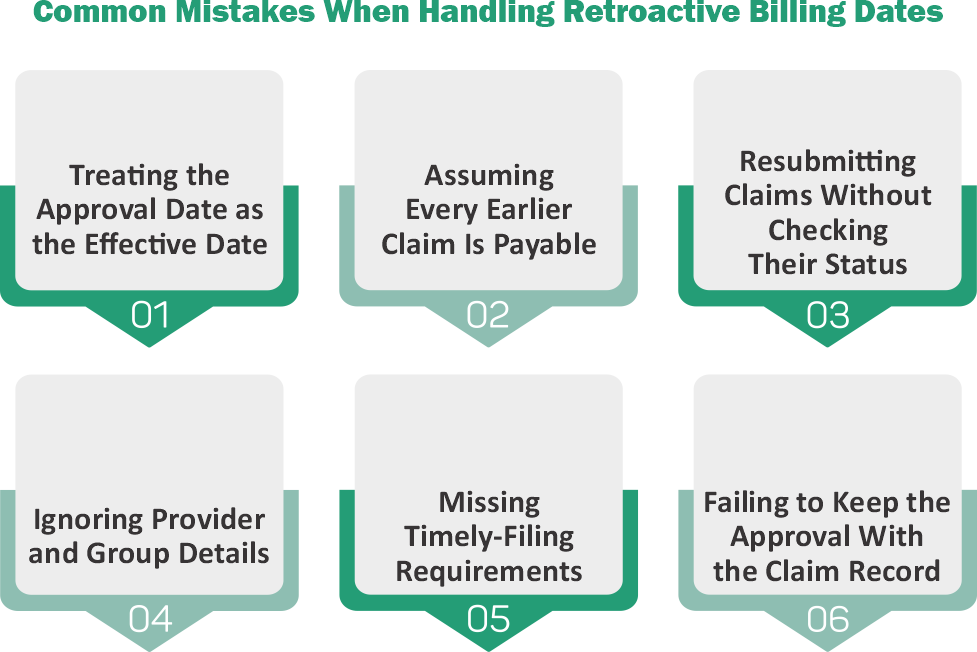
A retroactive approval can correct a provider-status issue, but it does not correct every claim issue. Small date or enrollment errors can still result in denials, duplicate submissions, or payment delays.
For Handling Retroactive Billing Dates, billing and credentialing teams should avoid these common errors.
1. Treating the Approval Date as the Effective Date
The date printed on the approval notice may differ from the date that determines billing eligibility. Always identify the payer-assigned effective date and covered period.
2. Assuming Every Earlier Claim Is Payable
Retroactive credentialing does not guarantee payment for every previous service. Claims must still meet requirements for coding, documentation, authorization, medical necessity, timely filing, and other payer rules.
3. Resubmitting Claims Without Checking Their Status
Do not send a second claim simply because the first one was denied before approval. First determine whether the payer requires a corrected claim, reprocessing request, reconsideration, or appeal.
4. Ignoring Provider and Group Details
Check the provider NPI, group NPI, TIN, practice location, specialty, and participation status. A backdated credentialing effective date may apply to one entity or location but not another.
5. Missing Timely-Filing Requirements
A retroactive effective date does not automatically remove filing deadlines. Review the payer’s current rules and document any applicable exception before taking claim action.
6. Failing to Keep the Approval With the Claim Record
Store the payer determination with the credentialing and billing records. Include the effective date, affected period, payer instructions, claim numbers, submission dates, and outcomes.
A clear claim-by-claim record helps billing, credentialing, compliance, and RCM teams show why every action was taken.
Conclusion
Handling Retroactive Billing Dates requires more than a backdated payer approval. Providers and billing teams must verify the effective period, enrollment status, affected dates of service, claim history, and payer-specific requirements.
A written approval, accurate claim review, and proper follow-up can help prevent avoidable denials and payment delays. Always confirm the payer’s rules before billing or resubmitting services from a retroactive period.
FAQs
What is a retroactive billing date in medical billing?
A retroactive billing date is an earlier effective date assigned by a payer for provider enrollment, credentialing, or billing eligibility. It may allow eligible services from that period to be submitted, subject to payer rules.
Can providers bill for services before credentialing approval?
Yes, in some cases. If the payer grants a retroactive effective date covering those dates of service, the provider may be able to submit or correct claims. Other requirements, such as authorization, coding, documentation, and timely filing, still apply.
Does retroactive credentialing guarantee claim payment?
No. Retroactive credentialing establishes eligibility for the approved period but does not guarantee reimbursement. Claims can still be denied for timely filing, authorization, coding errors, incorrect provider information, or other payer requirements.
What should providers do with claims denied before retroactive approval?
First, identify the original denial reason and confirm that the claim’s date of service falls within the approved retroactive period. Then follow the payer’s instructions for corrected claims, reprocessing, reconsideration, or appeal.
What documentation should billing teams keep for retroactive billing?
Keep the payer’s written approval, effective date, enrollment or credentialing records, affected dates of service, claim numbers, denial notices, submission records, payer correspondence, and final claim outcomes. This creates a clear record for billing and compliance review.