

Can a medical group credential physicians itself instead of waiting for each commercial health plan to complete the process? Under an approved delegation arrangement, it may be able to perform specific credentialing functions on a payer’s behalf. However, delegated credentialing does not automatically establish a physician’s network participation or billing eligibility.
Understanding delegated credentialing vs. direct payer enrollment helps medical groups choose an appropriate onboarding process, meet applicable oversight requirements, and distinguish a delegation agreement’s effective date from a physician’s confirmed payer status.
Delegated Credentialing vs. Direct Payer Enrollment: What Is the Difference?
The main difference is who performs the credentialing work and under what arrangement. With delegated credentialing, a health plan authorizes an organization to perform specified functions under a formal agreement. With direct payer enrollment, the physician or practice follows the payer’s own credentialing and enrollment process.
Delegated credentialing
A health plan may delegate defined credentialing responsibilities to an eligible medical group, hospital system, IPA, or other organization. Depending on the agreement, these responsibilities may include verifying professional credentials, reviewing files, making credentialing decisions, and managing recredentialing.
The delegate must follow the applicable agreement, documented procedures, and oversight requirements. Delegation does not remove the health plan’s responsibility to oversee the functions it has delegated.
Direct payer enrollment
Under direct enrollment, the physician or practice submits the information required by the health plan. The payer reviews the application, verifies credentials as required, completes its internal processes, and communicates the provider’s status.
This route is common when a payer does not offer delegation to the group, the organization has not been approved for delegation, or a particular provider or function falls outside the agreement.
Practices that need help managing payer applications, documentation, and follow-ups can explore physician enrollment services for support with payer enrollment.
Key differences at a glance
| Factor | Delegated credentialing | Direct payer enrollment |
|---|---|---|
| Credentialing workflow | Approved functions are handled by the delegate | The payer manages its credentialing process |
| Agreement | Formal delegation agreement defines responsibilities | Provider follows payer application and participation requirements |
| Oversight | Delegate must meet applicable monitoring and audit requirements | Payer manages its internal controls |
| Administrative workload | May reduce duplicated work for delegated functions | May require separate payer-specific applications and follow-up |
| Provider activation | Still requires confirmation of applicable payer and provider-level requirements | Depends on the payer’s review and activation process |
Note: Neither approach guarantees faster approval. The practical result depends on payer requirements, application completeness, provider circumstances, and how well the process is managed.
How Delegated Credentialing Works for Physicians: A Step-by-Step Workflow
Delegated credentialing gives a medical group more control over specified credentialing activities, but the group must establish a compliant process before performing those functions.
Step 1. Establish the delegation agreement
The payer and organization define the delegated functions, responsibilities, reporting requirements, and oversight arrangements in writing. The group should confirm that it has the resources and procedures to meet those obligations.
Step 2. Collect and verify credentials
The credentialing team obtains the required information and completes verification using the sources and methods required by the applicable standards and payer agreement. Depending on the physician and payer, the file may include licensure, education and training, board certification, work history, malpractice information, and sanctions or disciplinary checks.
Step 3. Complete the required review and decision
The organization follows its approved policies and committee procedures, where applicable. It retains evidence of verifications, review dates, decisions, and any follow-up needed to resolve deficiencies.
Step 4. Maintain provider records and report changes
The group submits required provider information and updates according to the payer’s process. New physicians, terminations, practice locations, specialties, and other changes should be tracked to prevent discrepancies between internal records and payer systems.
Step 5. Confirm provider status
Before treating a physician as active for a specific commercial plan, confirm the applicable credentialing decision, network participation, effective date, contract requirements, and billing setup. The delegation agreement alone does not establish that every physician is ready to bill.

NCQA Delegated Credentialing Audit Standards: What to Prepare
NCQA provides credentialing standards and frameworks relevant to credentialing programs and delegation oversight. The precise requirements depend on the applicable program, standards year, and payer agreement. Medical groups should consult the current NCQA Credentialing program and its credentialing standards information rather than relying on an old checklist.
For practical audit preparation, organize the evidence into four areas.
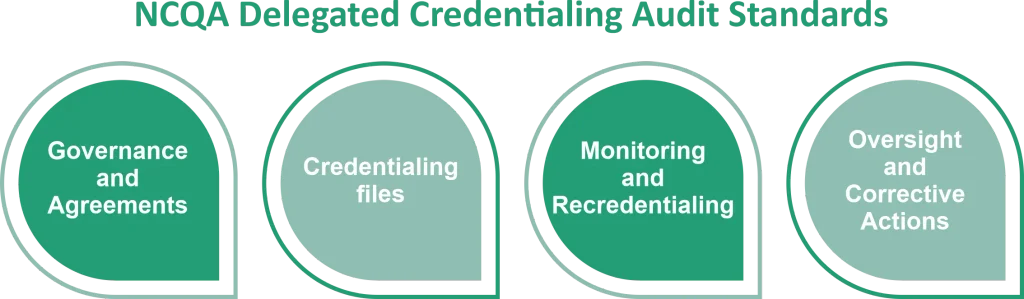
A complete file is not enough if the underlying process does not meet the applicable requirements. The group should be able to demonstrate how it performs credentialing, how it documents decisions, and how it corrects deficiencies.
Organized records make it easier to locate verification evidence, review decisions, and corrective actions during an audit. See this guide to credentialing documentation management for additional workflow practices.
Is an annual delegation audit always required? Do not assume a single audit schedule applies to every arrangement. Check the current NCQA standards and the specific payer agreement for the required review frequency, scope, and reporting obligations.
Delegation Agreement Effective Date vs. Payer Roster
A delegation agreement’s effective date and a physician’s payer participation date serve different purposes.
The delegation agreement effective date establishes when the contractual delegation arrangement takes effect. It does not automatically mean that every physician in the group has been credentialed, added to the payer’s systems, or approved to bill.
A provider roster communicates information about physicians and their affiliations to the payer. Submitting a roster does not, by itself, prove that the payer has processed the change or confirmed the physician’s individual participation status.
Example
To prevent errors, track each of these dates separately:
- 1Delegation agreement date
- 2Credentialing decision
- 3Roster submission and acknowledgment
- 4Payer-confirmed effective date
- 5Billing-system activation
Tip: If dates conflict, contact the payer and obtain confirmation instead of assuming that the physician is active or that coverage applies retroactively.
Advantages of Delegated Credentialing for Medical Groups
Delegated credentialing can be useful for organizations that regularly onboard physicians and have the infrastructure to manage credentialing responsibilities. Its main advantages include:
- More consistent onboarding: A centralized team can apply standardized procedures and track missing information across providers.
- Less duplicated work: The arrangement may reduce repetitive credentialing tasks for functions covered by the delegation agreement.
- Better operational visibility: Shared tracking makes it easier to identify incomplete files, expiring credentials, pending decisions, and unresolved roster discrepancies.
- Scalable processes: Established workflows can support medical groups as they add physicians, locations, and participating plans.
Keep in mind: These benefits are not automatic. Delegated credentialing requires trained staff, reliable records, quality controls, and ongoing oversight. Smaller practices or groups with limited credentialing resources may find direct payer enrollment more practical.
How to Choose the Right Approach
Before pursuing delegation, assess your group’s provider volume, staffing, compliance processes, and relationships with commercial payers.
Some groups use both approaches because delegation may apply only to specific payers, provider types, or credentialing functions.
Also remember that commercial payer delegation does not replace separate government program enrollment obligations. Physicians should follow the relevant program’s requirements, including CMS Medicare enrollment guidance where applicable.
How CVO Credentialing Services Can Help
A credentials verification organization (CVO) or credentialing services partner can support document collection, credential verification, file maintenance, application tracking, and follow-up. This support can help medical groups organize their processes and identify missing information before it creates delays.
However, outsourcing credential verification does not automatically make a group an approved delegate. The payer’s authorization and the applicable agreement determine which functions may be delegated and who remains responsible for oversight.
Dr. Credentialing’s CVO credentialing services can be considered as part of a broader provider onboarding workflow. Confirm the actual scope of services and ensure it aligns with your payer agreements and compliance responsibilities.
Final Takeaway
Delegated credentialing can help medical groups standardize physician onboarding and reduce duplicated work, but it requires a formal payer agreement, documented procedures, and appropriate oversight. Direct payer enrollment remains necessary when delegation is unavailable, or a particular function falls outside the agreement.
Key point: The key to avoiding onboarding and billing errors is to track credentialing decisions, roster processing, and provider-level effective dates separately. Confirming the physician’s status with the payer helps ensure that administrative progress is not mistaken for approval to participate or bill.