
Bringing a new provider into your group practice should increase patient access, strengthen revenue, and support long-term growth. However, adding a provider involves much more than completing a hire. From credentialing and payer enrollment to EHR configuration and billing readiness, every step must be completed accurately to avoid claim denials, reimbursement delays, and compliance risks.
Many practices lose valuable revenue because enrollment applications are submitted late, provider information is inconsistent, or payer approvals are not secured before patient visits begin. A structured onboarding process helps ensure your new provider can start seeing patients, billing insurance companies, and contributing to practice growth as quickly as possible.
What Does It Mean to Add a New Provider to an Existing Group Practice?
Adding a new provider to an existing group practice involves much more than hiring a physician, nurse practitioner, physician assistant, or specialist. To successfully integrate a provider into the practice, you must complete credentialing, payer enrollment, billing setup, and operational onboarding processes that allow them to legally practice and bill insurance companies under the group’s structure.
Whether you’re adding a primary care physician, behavioral health provider, therapist, or specialist, the provider must be properly linked to the practice before claims can be submitted and reimbursements can be received.
In most cases, providers join the group’s existing contracts, Tax ID, and billing framework rather than creating entirely new payer agreements. However, each payer has its own requirements, timelines, and approval processes that must be carefully managed to prevent revenue disruptions.
Prerequisites Before Adding a New Provider
Before beginning the credentialing and enrollment process, practices should ensure all required provider and organizational information is available and up to date. Missing documents or outdated records are among the most common causes of enrollment delays.
Verify Provider Credentials
Start by confirming the provider’s qualifications and professional standing. Most payers and credentialing organizations will verify:
- Active state license
- Board certifications
- DEA registration (if applicable)
- Professional liability insurance
- Educational background
- Training history
- Employment history
Addressing discrepancies early can prevent delays later in the enrollment process.
Ensure the Provider Has an Individual NPI
Every healthcare provider must have an individual National Provider Identifier (Type 1 NPI). This unique identifier is used by insurance companies and government payers to identify the provider on claims and enrollment applications.
Many practices mistakenly assume providers can bill solely under the group’s NPI. In reality, claims generally require both the provider’s individual NPI and the organization’s Type 2 NPI.
Confirm Group Practice Information Is Current
Before submitting applications, verify that all group information is accurate across payer records and internal systems, including:
- Group NPI
- Tax Identification Number (EIN)
- Practice locations
- Ownership information
- Taxonomy codes
- Contact information
Even minor inconsistencies between records can trigger application rejections or requests for additional documentation.
Documents Required to Add a New Provider
Having all required documentation prepared before starting enrollment can significantly reduce processing times and administrative burden.
| Provider Documents | Group Practice Documents |
| Individual NPI | Group NPI |
| State License | EIN Verification Letter |
| DEA Certificate | W-9 Form |
| Curriculum Vitae (CV) | Existing Payer Contracts |
| Malpractice Insurance Certificate | Practice Location Information |
| Board Certifications | Taxonomy Codes |
| CAQH Profile | EFT and Banking Information |
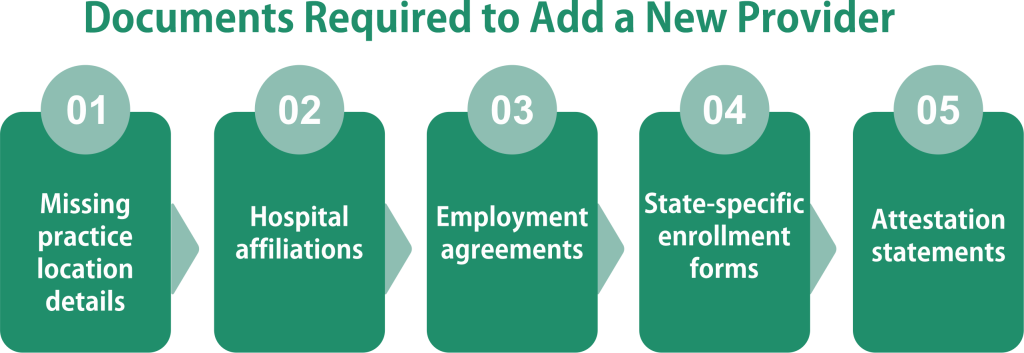
Some payers may also request:
- Provider photographs
- Hospital affiliations
- Employment agreements
- State-specific enrollment forms
- Attestation statements
Creating a centralized provider credentialing file helps ensure documents are easily accessible throughout the enrollment process.
Step-by-Step Process to Add a New Provider to an Existing Group Practice
Step 1: Complete Internal Provider Onboarding
The provider onboarding process should begin immediately after the hiring decision is finalized. Waiting until the provider’s first day often creates enrollment bottlenecks that delay billing and reimbursement.
A comprehensive onboarding process should include:
- Executing employment agreements
- Confirming the provider’s start date
- Collecting demographic information
- Assigning office locations
- Establishing billing responsibilities
- Gathering credentialing documentation
- Creating internal system accounts
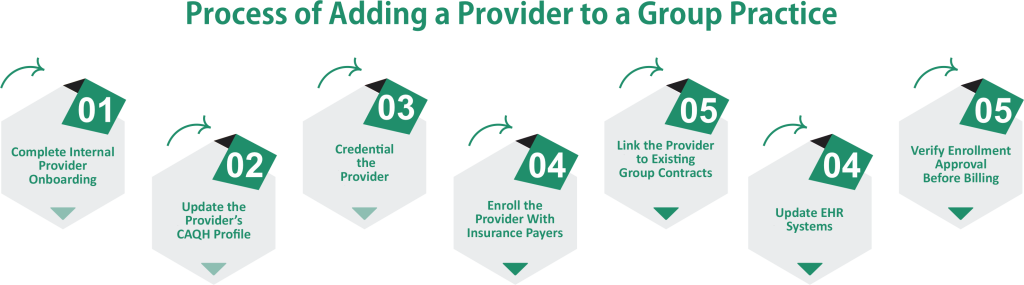
Step 2: Update the Provider’s CAQH Profile
The CAQH ProView database is one of the most important components of the provider enrollment process. Most commercial insurance companies use CAQH to collect and verify provider information during credentialing reviews.
Before submitting enrollment applications, ensure the provider’s CAQH profile is:
- Fully completed
- Accurate and up to date
- Supported by current documentation
- Properly attested
- Shared with participating insurance payers
Common documents uploaded to CAQH include:
- Medical licenses
- DEA certificates
- Malpractice insurance certificates
- Board certifications
- Curriculum vitae
- Professional references
Step 3: Credential the Provider
Once onboarding and CAQH updates are complete, the next step is provider credentialing. This process verifies the provider’s qualifications, professional history, and eligibility to participate in insurance networks.
Credentialing is one of the most critical stages of adding a provider to an existing group practice because most payers will not approve enrollment until credentialing requirements have been satisfied.
During credentialing, insurance companies and credentialing organizations typically verify:
- Medical education and training
- State licensure
- Board certifications
- DEA registration
- Work history
- Malpractice insurance coverage
- Malpractice claims history
- Sanctions and exclusions
- National Practitioner Data Bank (NPDB) records
Step 4: Enroll the Provider With Insurance Payers
Credentialing verifies the provider’s qualifications, but enrollment is what allows the provider to bill insurance companies and receive reimbursement.
After credentialing begins or is completed, practices must submit enrollment applications to each payer with whom the provider will participate.
Most practices prioritize enrollment with:
- Medicare
- Medicaid
- Blue Cross Blue Shield
- UnitedHealthcare
- Aetna
- Cigna
- Humana
- Regional and local insurance carriers
Each payer maintains its own enrollment requirements, documentation standards, and processing timelines.
Step 5: Link the Provider to Existing Group Contracts
After enrollment applications have been submitted, the provider must be connected to the group’s existing payer contracts.
This step is often overlooked, yet it directly impacts whether claims are processed correctly.
In most cases, the new provider is added as a rendering provider under the group’s established contracts rather than negotiating entirely new agreements.
The process may involve:
- Adding the provider to payer rosters
- Updating network participation records
- Establishing billing relationships
- Completing reassignment of benefits forms
- Linking provider and group NPIs
Proper contract linkage ensures the provider can bill under the group’s reimbursement arrangements while maintaining individual identification for claims processing.
Step 6: Update Practice Management and EHR Systems
Adding a provider to payer networks is only part of the process. The provider must also be configured within the practice’s operational systems before patient appointments can be scheduled and claims can be submitted.
System setup should include:
- Electronic Health Record (EHR) configuration
- Practice management software updates
- Scheduling system access
- Billing software setup
- Electronic claims enrollment
- Provider directory updates
- Telehealth platform configuration
Many practices focus exclusively on credentialing and enrollment while overlooking operational readiness. This can create workflow disruptions even after payer approvals are received.
Step 7: Verify Enrollment Approval Before Billing
Before submitting claims under a new provider, it’s essential to confirm that all payer enrollments have been approved and that effective dates are active. Many practices assume enrollment is complete once an application is submitted, only to discover later that claims are being denied because the provider was not officially active with the payer.
Submitting claims before approval can result in:
- Claim denials
- Delayed reimbursements
- Costly claim resubmissions
- Revenue loss
- Increased administrative workload
To avoid these issues, conduct a final verification review before the provider begins seeing insured patients.
Credentialing vs Enrollment vs Privileging: What’s the Difference?
These three terms are often used interchangeably, but they serve very different purposes. Understanding the distinction can help practice owners and administrators avoid confusion during provider onboarding.
| Process | Purpose | Conducted By |
| Credentialing | Verifies qualifications and professional history | Insurance Payers and Credentialing Organizations |
| Enrollment | Authorizes participation and billing with payers | Insurance Companies and Government Programs |
| Privileging | Grants permission to perform services at a facility | Hospitals and Healthcare Facilities |
How Long Does It Take to Add a New Provider to a Group Practice?
The timeline for adding a provider depends on several factors, including payer requirements, specialty type, state regulations, and document readiness.
While some enrollments move quickly, others can take several months to complete.
| Task | Estimated Time |
| Document Collection | 1–2 Weeks |
| CAQH Setup and Review | 1–2 Weeks |
| Credentialing | 30–90 Days |
| Medicare Enrollment | 30–60 Days |
| Commercial Payer Enrollment | 60–120 Days |
| EHR and Billing Setup | 1–2 Weeks |
In many cases, the entire process can take between 90 and 180 days from hire date to full billing readiness.
This is why leading practices begin credentialing and enrollment activities at least three to four months before the provider’s anticipated start date.
Factors That Can Delay Approval
Several issues commonly extend enrollment timelines:
Incomplete Applications: Missing signatures, outdated forms, or incomplete sections often trigger requests for additional information.
Expired Documents: Licenses, DEA certificates, malpractice insurance policies, and board certifications must remain current throughout the review process.
Inaccurate CAQH Information: Payers frequently compare enrollment applications against CAQH records. Any discrepancies can create delays.
Taxonomy Errors: Incorrect provider taxonomy codes can affect enrollment approvals and claim processing.
Payer Backlogs: Even perfectly completed applications may experience delays during periods of high enrollment volume.
Practices that proactively monitor application status and follow up regularly often achieve faster approvals.
Common Mistakes That Delay Provider Enrollment
Provider enrollment delays are often preventable. Understanding the most common mistakes can help practices reduce approval timelines and avoid revenue interruptions.
1. Waiting Until the Provider Starts
One of the biggest mistakes practices make is delaying enrollment activities until after the provider begins employment.
Since payer approvals can take several months, this approach often leads to significant reimbursement delays.
The best practice is to begin enrollment activities 90 to 120 days before the provider’s first day.
2. Incomplete CAQH Profiles
Many enrollment applications are delayed because CAQH records contain:
- Missing documents
- Outdated information
- Expired attestations
- Incorrect practice affiliations
Maintaining an accurate CAQH profile is one of the simplest ways to accelerate approvals.
3. Inconsistent Provider Information
Even small discrepancies can trigger enrollment issues.
Examples include:
- Different practice addresses
- Mismatched provider names
- Incorrect NPI numbers
- Inconsistent licensing information
Every application should be reviewed carefully before submission.
4. Missing Reassignment Documentation
For Medicare and many commercial payers, reassignment forms establish the relationship between the provider and the group practice.
Missing forms can delay claim payments even after enrollment approvals have been issued.
5. Incorrect Taxonomy Codes
Taxonomy codes identify a provider’s specialty and are used by payers to determine participation and reimbursement eligibility.
Incorrect codes may result in:
- Enrollment denials
- Claims processing errors
- Payment delays
6. Failure to Track Effective Dates
Approval notices often contain effective dates that determine when services become billable.
Practices that fail to track these dates may:
- Submit claims too early
- Miss retroactive billing opportunities
- Experience unnecessary denials
7. Ignoring Location-Specific Requirements
Many payers require providers to be enrolled separately for each practice location.
This issue is especially common in multi-location organizations and can lead to unexpected billing problems if overlooked.
Medicare and Medicaid Considerations When Adding a Provider
Government payer enrollment often requires additional attention because Medicare and Medicaid have unique requirements that differ from commercial insurance plans.
Failing to complete these requirements correctly can delay participation, create billing issues, and increase compliance risks.
Medicare Enrollment Requirements
If the provider will treat Medicare beneficiaries, enrollment must be completed through Medicare’s enrollment system before claims can be submitted.
Key Medicare considerations include:
- Individual provider enrollment requirements
- Group practice enrollment verification
- Reassignment of benefits
- Practice location reporting
- Ownership disclosure requirements
- Ongoing revalidation obligations
Medicare enrollment is particularly important because many commercial payers use Medicare records as part of their credentialing review process.
Medicaid Enrollment Requirements
Unlike Medicare, Medicaid enrollment requirements vary significantly by state.
Some states maintain relatively simple enrollment processes, while others require:
- Additional provider screenings
- Site visits
- Fingerprinting
- Ownership disclosures
- Separate managed care enrollment applications
Because requirements differ across states, practices should verify enrollment rules for every location where the provider will practice.
How to Track Provider Enrollment Status?
One of the most effective ways to accelerate provider enrollment is by maintaining a centralized tracking system. Without a structured process, applications can easily become lost in payer backlogs, follow-up deadlines may be missed, and approval notices can go unnoticed.
Why Enrollment Tracking Matters?
A provider may be enrolled with multiple payers simultaneously.
Each payer has:
- Different application requirements
- Different timelines
- Different approval processes
- Different effective dates
Tracking progress in one centralized location helps practices maintain visibility throughout the enrollment cycle.
Information Every Tracking System Should Include
Your enrollment tracker should monitor:
| Field | Purpose |
| Payer Name | Identifies the insurance company |
| Application Submission Date | Tracks when enrollment began |
| Credentialing Status | Monitors review progress |
| Enrollment Status | Tracks approval stage |
| Assigned Team Member | Establishes accountability |
| Follow-Up Date | Prevents missed communications |
| Effective Date | Confirms billing eligibility |
| Approval Date | Records final approval |
| Notes | Documents payer communications |
Whether maintained in a spreadsheet, credentialing software platform, or revenue cycle management system, a structured tracker significantly improves efficiency.
Recommended Follow-Up Schedule
Many applications stall simply because practices fail to follow up consistently.
A proactive follow-up schedule may include:
- Initial confirmation after submission
- Follow-up every 2–3 weeks
- Immediate response to payer requests
- Final verification before billing begins
Regular communication often helps uncover missing information before it causes significant delays.
Cost of Adding a New Provider to a Group Practice
Many practices underestimate the true cost of adding a provider.
While salary and benefits receive the most attention, credentialing, enrollment, and operational setup expenses can also be significant.
Credentialing Costs
Credentialing expenses may include:
- Staff labor
- Verification services
- Credentialing software
- Third-party credentialing organizations
- Background screening fees
Organizations handling credentialing internally typically invest substantial administrative time throughout the process.
Provider Enrollment Costs
Enrollment-related expenses can include:
- Application preparation
- Payer follow-up activities
- Data management
- Compliance reviews
- Outsourced enrollment services
Although some payer enrollments do not charge direct application fees, the administrative workload can be substantial.
Technology and System Setup Costs
Adding a provider often requires updates to:
- EHR systems
- Practice management software
- Scheduling platforms
- Billing systems
- Telehealth solutions
Additional licensing fees may apply depending on the technology vendor.
Best Practices for Faster Provider Enrollment
Provider enrollment delays can directly impact patient access, cash flow, and overall practice growth. While some factors are outside your control, implementing proven best practices can significantly reduce approval timelines and improve operational efficiency.
Start the Process 90–120 Days Before the Provider’s Start Date
One of the biggest mistakes healthcare organizations make is waiting until a provider is hired to begin credentialing and enrollment activities.
Most payer approvals take several weeks or even months. Starting the process at least 90 to 120 days before the anticipated start date gives practices enough time to:
- Collect required documentation
- Complete credentialing reviews
- Submit enrollment applications
- Address payer requests
- Secure effective dates
Early preparation minimizes the risk of delayed reimbursements after the provider begins seeing patients.
Create a Standardized Enrollment Checklist
A documented enrollment workflow helps ensure critical tasks are not overlooked.
Your checklist should include:
- Document collection
- CAQH updates
- Credentialing submissions
- Medicare enrollment
- Medicaid enrollment
- Commercial payer enrollment
- Reassignment forms
- EHR setup
- Billing system configuration
- Enrollment verification
Standardization improves consistency and reduces administrative errors.
Maintain a Centralized Provider File
Keeping all provider information in one location can dramatically improve efficiency.
A centralized file should contain:
- Licenses
- Certifications
- NPI documentation
- Malpractice insurance
- Curriculum vitae
- Enrollment approvals
- CAQH information
This allows staff to quickly respond to payer requests and simplifies future enrollments.
Monitor Applications Proactively
Submitting an application is only the beginning.
Practices should actively monitor:
- Credentialing status
- Enrollment progress
- Missing documentation requests
- Effective date notifications
Regular follow-up often prevents applications from becoming stalled in payer review queues.
Keep CAQH Information Current
Many payer delays originate from outdated CAQH profiles.
Implement a process for reviewing:
- Practice affiliations
- Licenses
- Contact information
- Insurance coverage
- Certifications
Maintaining accurate records helps avoid unnecessary enrollment interruptions.
Verify Approval Before Scheduling High-Volume Patient Panels
Many organizations begin aggressively scheduling patients before enrollment approvals are confirmed.
Instead, verify:
- Effective dates
- Participating payer status
- Billing eligibility
- Provider roster updates
This precaution helps prevent claim denials and reimbursement issues.
Final Thoughts
Adding a new provider to an existing group practice is a critical growth initiative, but success depends on far more than completing a hire. Credentialing, payer enrollment, contract linkage, system configuration, and billing readiness all play a vital role in ensuring a smooth transition.
By following a structured process, healthcare organizations can accelerate provider onboarding, reduce claim denials, improve cash flow, and position new providers for long-term success from day one.
Need help adding a provider to your group practice? Partnering with experienced credentialing and enrollment specialists can streamline approvals, minimize administrative burdens, and help your providers start generating revenue faster.