Why are insurance enrollment delays crucial in 2026? Insurance enrollment delays remain one of the most common operational issues in healthcare administration in 2026. Most provider organizations currently face delays varying from 60 to 180 days per payer, depending on specialty, documentation accuracy, and payer flow. Even minor errors in CAQH profiles, NPI data, or credentialing documents can lead to delays of several weeks.
What is the actual financial impact of enrollment delays? Based on recent industry data for 2026, about 40% of providers experience delayed reimbursement due to credentialing or enrollment challenges, with practices losing approximately $7,000-$12,000 per physician per month as a result of enrollment delays. These delays have a direct impact on cash flow, personnel plans, and patient scheduling, especially in firms with many providers or states.
This blog explains practical methods to address these issues. It covers the main causes of delays, the provider insurance enrollment process, and actionable steps to reduce payer enrollment time. Each section is structured to help healthcare professionals identify gaps in their current workflow and improve accuracy, follow-up, and documentation control.
Why Insurance Enrollment Delays Matter
Insurance enrollment delays affect provider readiness, billing activation, and reimbursement timelines in healthcare systems. These delays are common in payer onboarding and often start from small data errors or missing documentation. Understanding this section helps explain how to Reduce Insurance Enrollment Delays in real practice.
For healthcare providers, billing teams, and credentialing staff, delays create workflow gaps and slow down revenue cycles. Each day of delay can affect claim submission timelines and patient scheduling. This section breaks down the operational and financial effects in a structured way.
Financial Impact of Enrollment Delays
Insurance enrollment delays directly affect revenue flow for healthcare organizations. Providers cannot submit claims until enrollment is active with the payer. This creates a billing gap from the provider start date to payer activation.
Key financial effects include:
- Delayed claim submission
- Temporary loss of reimbursable services
- Increased administrative rework
- Revenue cycle interruptions per provider onboarding cycle
Effect on Patient Access and Provider Scheduling
Enrollment delays also affect patient care. Providers may be fully credentialed but still unable to bill insurers. This leads to scheduling limitations and reduced patient intake.
Common operational effects include:
- Postponed provider start dates in clinics
- Limited insurance acceptance during onboarding
- Increased out-of-pocket burden for patients
- Reduced appointment availability in the early months
Compliance and Operational Risks
Enrollment delays also introduce compliance and administrative risks. Incorrect or incomplete enrollment data can lead to payer rejection or audit flags. These issues often come from inconsistent provider records or missing documentation.
Key risks include:
- Incorrect NPI or taxonomy submissions
- CAQH profile mismatches
- Delayed payer approval due to incomplete files
- Risk of claim denial after activation
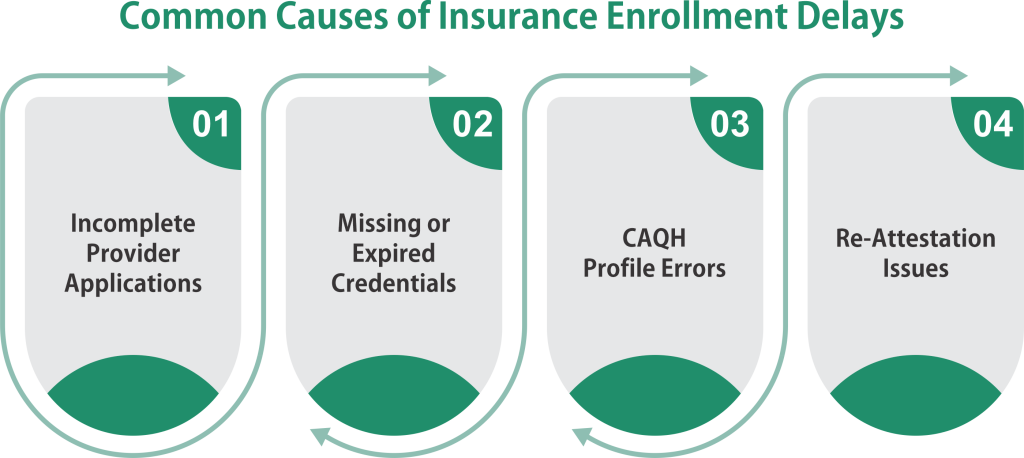
Common Causes of Insurance Enrollment Delays
Preventable errors in provider data, documentation, and payer submission processes frequently cause insurance enrollment delays. These issues affect credentialing teams, billing staff, and healthcare providers during onboarding. Understanding these causes is a key step in reducing insurance enrollment delays and improving enrollment outcomes.
Incomplete Provider Applications
Incomplete applications are one of the most common reasons for enrollment delays. Payers reject or return applications when required fields or documents are missing.
Common issues include:
- Missing demographic details
- Incomplete employment history
- Unverified practice locations
- Missing W-9 forms or tax documents
- Incorrect contact information
Missing or Expired Credentials
Expired or missing credentials create immediate barriers in the enrollment process. Payers require valid, up-to-date documentation before approving provider participation.
Common credential issues include:
- Expired medical licenses
- Lapsed DEA registration (where applicable)
- Missing board certification proof
- Outdated malpractice insurance certificates
- Incomplete continuing education records
CAQH Profile Errors and Re-Attestation Issues
CAQH profile accuracy plays a major role in enrollment speed. Many payer systems rely on CAQH data for verification, making errors a frequent cause of delay.
Common CAQH-related problems include:
- Outdated provider information
- Missing work history updates
- Inconsistent practice addresses
- Failure to complete re-attestation on time
- Incorrect specialty or taxonomy data
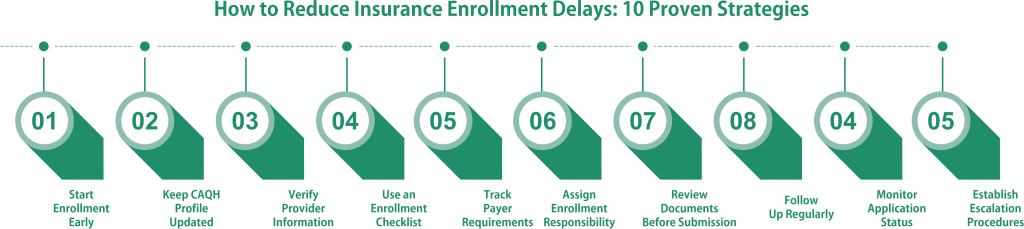
How to Reduce Insurance Enrollment Delays: 10 Proven Strategies
Insurance enrollment delays can be reduced with structured workflows, accurate documentation, and consistent follow-up with payers. Healthcare providers, credentialing teams, and billing departments often face delays due to avoidable process gaps.
These strategies focus on early preparation, data accuracy, and clear ownership of each enrollment task. Applying them helps reduce payer enrollment time and supports faster provider activation for billing and reimbursement.
Start Enrollment Before Provider Start Date
Begin the enrollment process 60–120 days before the provider’s first working day. Early submission reduces pressure during payer review cycles. It also helps identify missing documents before they cause rejection.
- Submit payer applications before onboarding completion.
- Align start dates with payer processing timelines
- Identify missing documents early to avoid resubmission delays
Maintain an Accurate CAQH Profile
Keep CAQH information updated at all times. Ensure work history, practice locations, and certifications match submitted applications. Re-attestation should be completed on schedule to avoid processing delays.
- Update CAQH profile after any provider change
- Match CAQH data with payer enrollment forms
- Complete re-attestation before expiration dates
Verify NPI, Taxonomy, and Demographic Information
Check that NPI records match enrollment applications. Confirm taxonomy codes align with specialty and payer requirements. Ensure address, contact details, and practice affiliations are consistent across all systems.
- Cross-check NPI registry data with enrollment forms
- Confirm taxonomy codes match payer specifications
- Standardize provider demographic details across systems
Use a Standard Enrollment Checklist
Create a checklist for every provider enrollment file. Include all payer-required documents, forms, and verification items. This reduces missing submissions and avoids repeated payer requests.
- Include all payer-specific document requirements
- Verify each item before submission
- Maintain a checklist template for repeated use
Track Payer-Specific Requirements
Each payer follows different enrollment rules. Maintain updated requirement lists for Medicare, Medicaid, and commercial insurers. This reduces rejection due to incomplete or incorrect submissions.
- Maintain separate payer requirement folders
- Update guidelines when payer rules change
- Review requirements before each submission
Assign Clear Enrollment Ownership
Assign one responsible person or team for each enrollment case. This improves accountability and reduces missed follow-ups. Shared responsibility without ownership often leads to delays.
- Assign a dedicated enrollment coordinator
- Define clear task responsibilities per case
- Monitor accountability through status tracking
Audit Documentation Before Submission
Review all documents before sending to payers. Check for expired licenses, missing signatures, and mismatched details. Pre-submission audits reduce return cycles.
- Verify all documents are current and valid
- Check for signature and form completeness
- Match documents with payer requirements
Follow Up With Payers on a Fixed Schedule
Set a structured follow-up cycle with payers, such as weekly or biweekly. Regular contact helps identify stalled applications earlier and reduces inactive waiting periods.
- Set weekly or biweekly follow-up reminders
- Document every payer communication
- Escalate stalled cases after defined timelines
Monitor Enrollment Status Using Tracking Tools
Use tracking sheets or systems to monitor each application process. Record submission dates, payer responses, and pending actions. Visibility improves control over timelines.
- Track submission and approval dates
- Monitor pending payer responses
- Maintain a centralized enrollment dashboard
Create Escalation Procedures for Delayed Applications
Define clear escalation steps for applications that exceed normal processing times. Contact payer representatives or supervisors when delays extend beyond expected timelines. This prevents long-term inactivity.
- Define escalation timelines for each payer
- Contact payer support or supervisors when delayed
- Document escalation actions for follow-up reference
How to Speed Up Insurance Credentialing
Insurance credentialing impacts how quickly a provider can enroll with payers. Slow credentialing processes often lead to delayed billing activation and longer revenue gaps. Improving this step is essential for How to Reduce Insurance Enrollment Delays and ensuring faster payer readiness.
Credentialing delays usually occur due to missing documents, outdated records, or slow verification processes. A structured approach reduces errors and improves turnaround time for providers and billing teams.
Collect Documents Early
Start collecting provider documents before the application process begins. Early preparation reduces last-minute gaps and avoids repeated payer requests.
Keep all core documents ready, including licenses, certifications, and malpractice coverage. This ensures faster submission and fewer rejections.
Early collection also helps identify missing or inconsistent information before submission. This reduces back-and-forth communication with payers and shortens review cycles.
Maintain Credential Files
Maintain a complete and updated credential file for each provider. This file should include all professional and compliance documents in one place.
Regular updates reduce the risk of expired or missing records. It also improves response time during payer verification.
Centralized files also help billing and credentialing teams work with consistent data. This reduces duplication and avoids conflicting information during enrollment.
Perform Primary Source Verification Promptly
Primary source verification confirms provider qualifications directly with issuing authorities. Delays in this step often slow the entire credentialing process.
Complete verification as soon as documents are received. Faster validation supports quicker payer review and approval.
Timely verification also reduces the risk of payer rejection due to outdated or unconfirmed data. It ensures the provider file is accurate before submission.
Track Recredentialing Deadlines
Recredentialing ensures providers remain active within payer networks. Missing deadlines can restart the entire credentialing cycle.
Set reminders for expiration dates of licenses and certifications. Early action prevents unnecessary delays in enrollment updates.
Tracking systems also help avoid last-minute compliance issues. This keeps providers active in payer systems without interruption.
Monitor Expiring Licenses and Certifications
Expired credentials are one of the most common reasons for credentialing delays. Regular monitoring prevents interruptions in the approval process.
Track all renewal dates in a centralized system. Timely renewals support continuous enrollment readiness and reduce processing gaps.
Consistent monitoring also improves compliance with payer requirements. It ensures providers remain eligible for uninterrupted billing and participation.
Conclusion
Insurance enrollment delays continue to affect provider onboarding, reimbursement timelines, and overall practice efficiency. Most delays come from preventable issues such as incomplete documentation, CAQH errors, and inconsistent payer follow-up. Addressing these gaps is essential for improving financial flow and operational stability.
A structured enrollment process supported by accurate data, early preparation, and clear accountability can significantly reduce processing time. Healthcare providers, credentialing teams, and billing staff must follow consistent workflows to maintain payer readiness and reduce interruptions in claim submission.
FAQs
What are the main causes of insurance enrollment delays?
Insurance enrollment delays are usually caused by incomplete applications, missing credentials, CAQH errors, and payer backlogs. Data mismatches in NPI or taxonomy also slow down approval.
How long does provider enrollment usually take in 2026?
In 2026, provider enrollment typically takes 60 to 180 days, depending on payer type and documentation accuracy. Medicare, Medicaid, and commercial payers all have different processing timelines.
How can CAQH errors delay enrollment?
Incorrect or outdated CAQH profiles can stop payer verification and pause the enrollment process. Missing re-attestation or mismatched provider details often trigger additional review requests.
What is the fastest way to reduce enrollment delays?
The fastest way is to submit accurate applications early, maintain updated credentials, and follow payer-specific requirements. Regular follow-ups and structured tracking also reduce delays significantly.
Who is responsible for reducing insurance enrollment delays?
Credentialing specialists, practice managers, and medical billing teams share responsibility for reducing delays. Clear ownership and coordinated workflows help prevent missing data and slow submissions.